
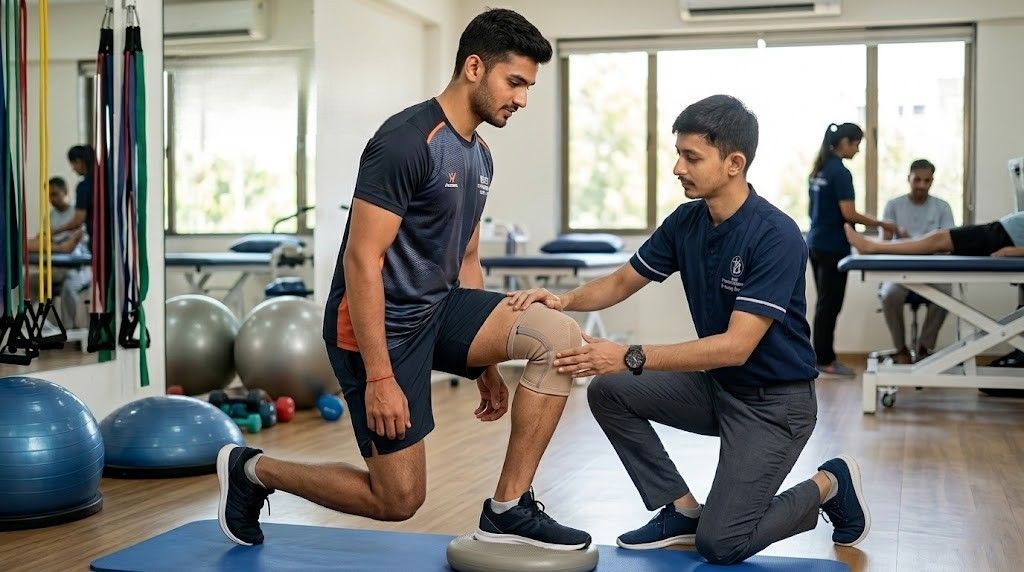
You are 25 years old. You are playing a high‑intensity cricket match on the turf at South Bopal Sports Ground, or pushing through a heavy squat set at your local gym in Bopal, Ahmedabad. You plant your foot, pivot to change direction — and in that split second, you feel a sharp, sickening pop from deep inside your knee. The joint collapses beneath you.
A few hours later, a doctor confirms it: ACL tear.
Your first thought is surgery. Your second is the cost. Your third is the thought of months away from work, driving, and everything you love.
But here’s what most Bopal patients are never told: an ACL tear does not always end on a surgeon’s table. For many active adults, ACL tear recovery physiotherapy Bopal Ahmedabad is the complete, non‑surgical answer — and it starts by understanding exactly what has happened inside your knee.
What Actually Happens When You Tear Your ACL
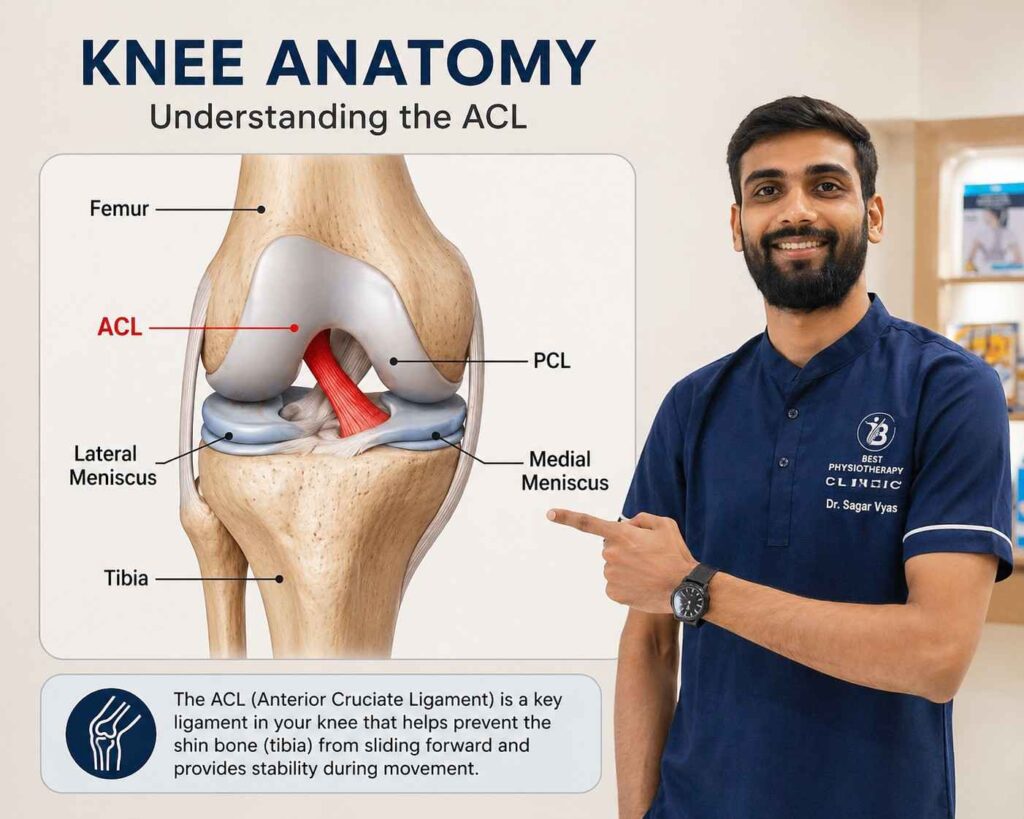
The Anterior Cruciate Ligament (ACL) is a thick, diagonal band of fibrous tissue running through the centre of your knee joint. It connects your femur (thigh bone) to your tibia (shin bone) and acts like an emergency brake, preventing the tibia from sliding too far forward and keeping the joint stable during pivoting, jumping, and sudden changes in direction.
When you play sports that demand explosive pivoting, rapid deceleration, or awkward landings — cricket, football, badminton, or heavy gym squatting — your knee absorbs enormous rotational force. If that force exceeds the ACL’s strength, the ligament tears.
At Best Physiotherapy Clinic Bopal, our dedicated Sports Injury Rehabilitation explains how ligament injuries are assessed and treated. ACL injuries are classified into three grades:
- Grade 1 — Sprain: Overstretched but not fully broken; minimal pain and swelling. Conservative physiotherapy is standard.
- Grade 2 — Partial Tear: The ligament is damaged and loose, causing intermittent instability and a “giving way” feeling. Highly responsive to structured rehab.
- Grade 3 — Complete Rupture: The ACL is fully torn, leaving the knee significantly unstable. Even here, surgery is not automatically required.
For more detail on how knee ligament injuries are classified and treated, our conditions covers every grade and injury pattern.
Surgery vs. Physiotherapy — When Do You Actually Need the Knife?
Hearing “torn ligament” often makes patients assume surgery is the only way to restore function. But current evidence shows that non‑surgical rehabilitation can be just as effective for many active adults in Bopal.
The KANON randomised controlled trial followed young, active patients with complete Grade 3 ACL tears for two years. Half had early surgery; half had structured physiotherapy, with the option to cross over to surgery later. Full study on PubMed. The result: both groups achieved similar functional outcomes, and almost half of the physiotherapy group never needed surgery.
These patients are called “copers” — their quadriceps, hamstrings, and glutes are trained to act as dynamic stabilisers, effectively compensating for ACL laxity.
Our evidence‑based approach to ACL recovery is built on this exact clinical evidence. We recommend surgery only when it is truly necessary, not by default.
When Surgery IS the Right Decision
Surgical ACL reconstruction is genuinely indicated when:
- You are an elite or professional athlete whose career depends on high‑speed pivoting sports.
- Your ACL tear is combined with complex meniscus damage or multiple ligament tears.
- You complete a full supervised physiotherapy programme and still experience daily knee buckling during basic activities like walking downstairs.
For most recreational athletes, gym‑goers, and weekend sportspeople in Bopal, surgery introduces extra risks — infection, clotting, donor‑site pain, and 9–12 months of recovery — without proven long‑term advantage over expert conservative rehab.
The 4 Stages of ACL Tear Recovery Physiotherapy in Bopal Ahmedabad
At Best Physiotherapy Clinic Bopal, we design a personalised ACL recovery plan for every patient, based on injury grade, baseline strength, and sport goals. Our four‑phase framework is the backbone of every rehab we run.
Stage 1 — Acute Management (Weeks 1–3)
Goal: Control swelling, restore range of motion, begin walking normally
In the first days after an ACL injury, the knee is swollen, painful, and stiff. We focus on controlling inflammation before loading.
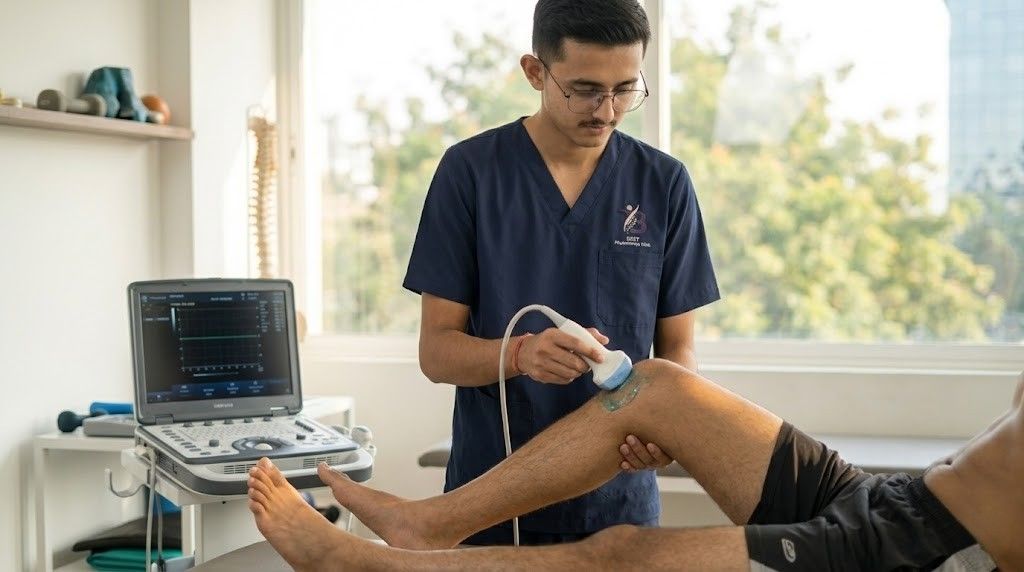
- Use electrotherapy, cryotherapy, and therapeutic ultrasound to reduce swelling and pain.
- Apply hands‑on manual therapy to mobilise the kneecap and joint, restoring full bending and straightening.
- Begin gait retraining to correct limp patterns and protect hips, lower back, and the opposite leg.
Milestone: Full weight‑bearing with a normal walking pattern and complete passive extension.
Stage 2 — Strength Foundation (Weeks 4–6)
Goal: Rebuild the muscles that protect and stabilise the knee
Pain inhibits the nervous system, causing arthrogenic muscle inhibition — the brain deliberately “turns down” the quadriceps, hamstrings, and glutes around the injured knee.
We target the root cause with:
- Quadriceps activation using neuromuscular electrical stimulation (NMES) when needed.
- Hamstring loading to physically limit forward tibial slide and replace ACL‑like control.
- Glute‑dominant exercises to reduce knee compression and fix the faulty movement patterns that caused the injury.
Milestone: At least 70% limb symmetry index on single‑leg strength testing.
Stage 3 — Neuromuscular Reprogramming (Weeks 7–10)
Goal: Train the nervous system to protect the knee automatically
This is the most overlooked yet critical stage. A torn ACL destroys the mechanoreceptors inside the ligament that constantly tell your brain where your knee is in space.
We rebuild the neuromuscular feedback loop through our specialised balance and coordination training programme:
- Progressive single‑leg balance on wobble boards and unstable surfaces.
- Reactive perturbation training — sudden, unexpected forces that sharpen reflex stabilisation.
- Controlled, slow‑speed sport‑specific movements (e.g., cricket batting pivot, cricket‑style cut) before ramping up intensity.
Milestone: Equal bilateral balance scores and zero episodes of giving way in daily life.
Stage 4 — Return‑to‑Sport Preparation (Weeks 11–16)
Goal: Prepare the knee for the full demands of your sport
Patients often want to rush this stage — but it cannot be rushed. We follow an objective, evidence‑backed approach.
- Plyometric training — jumping, hopping, and controlled landings under close biomechanical supervision.
- Agility drills — cone circuits, lateral shuffles, and directional changes at increasing speed.
- Sport‑specific simulation — bowling run‑ups, cutting drills, barbell squats, or cricket‑specific turns — all in the clinic before you return to the field.
We clear you using internationally validated return‑to‑sport criteria:
| Test | Passing Score |
|---|---|
| Single‑leg hop test (limb symmetry) | ≥ 90% |
| Quadriceps strength symmetry | ≥ 90% |
| Y‑Balance Test | Within norms |
| Psychological readiness (ACL‑RSI) | ≥ 65 |
You pass when your body passes the tests, not just because the calendar says “16 weeks”.
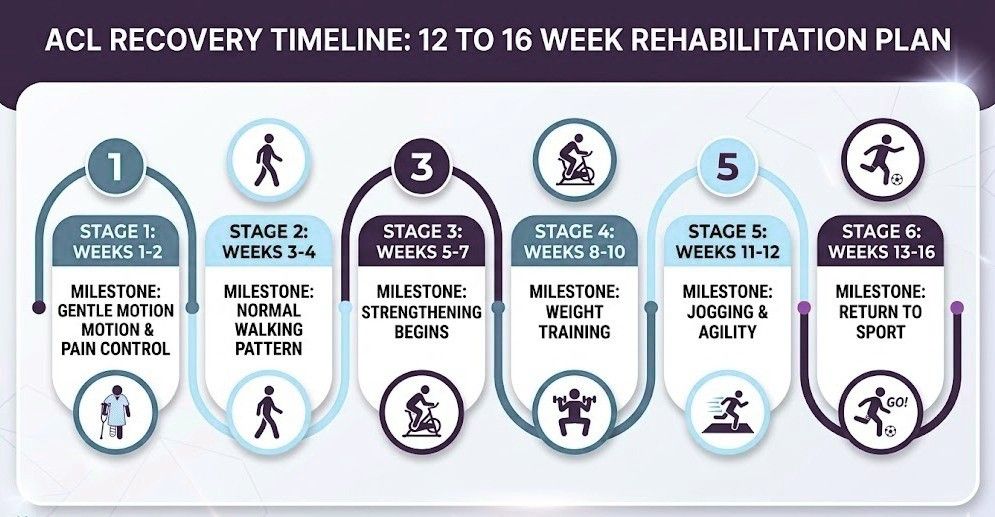
ACL Tear Recovery Physiotherapy Bopal Ahmedabad — A Complete 12–16 Week Rehabilitation Roadmap
One of the biggest worries after an ACL diagnosis is “how long will this take?” We give every patient a clear, week‑by‑week plan.
Weekly Milestones (Non‑Surgical Pathway)
| Week | Milestone |
|---|---|
| 1–2 | Full weight‑bearing without crutches; swelling controlled; gait normalised |
| 3–4 | Pain‑free full range of motion; stationary cycling begins |
| 5–7 | Supervised squats, leg presses, and deadlifts under controlled load |
| 8–10 | Straight‑line jogging; structured landing mechanics training |
| 11–12 | Dynamic direction changes; bilateral single‑leg hop testing |
| 13–16 | Full return‑to‑sport testing; sport‑specific simulation; clearance when criteria are met |
Why Bopal Athletes Who Skip Physiotherapy Re‑Tear Their ACL Within 2 Years
A common pattern we see: a patient rests for 3–4 weeks, pain fades, and they jump back into cricket or the gym. Months later, they return — often with a second, more severe ACL injury.
Evidence shows that athletes who return to sport without structured rehab have up to 70% re‑injury risk within two years. A second ACL tear on the same knee — or the opposite side — dramatically increases the risk of early‑onset arthritis and meniscus damage.
The problem is not just weakness — it is neuromuscular neglect. When the ACL tears, the mechanoreceptors that send joint‑position data to the brain are destroyed. Rest rebuilds some muscle bulk, but it does nothing to restore that reflex‑based control.
Research from the British Journal of Sports Medicine confirms that psychological readiness and neuromuscular function — not just pain reduction — are the true gatekeepers of safe return‑to‑sport after ACL injury.
Skipping proper ACL tear recovery physiotherapy Bopal Ahmedabad does not save time. It borrows time from a future, more serious injury.
Book Your ACL Tear Recovery Physiotherapy Assessment in Bopal Ahmedabad
At Best Physiotherapy Clinic Bopal, our team has over 11 years of experience helping active people across Bopal, South Bopal, Ghuma, Ambli, and West Ahmedabad return to sport and daily life — without unnecessary surgery.
What makes our ACL tear recovery physiotherapy Bopal Ahmedabad different:
- We treat the root cause — movement patterns, muscular imbalances, and biomechanical faults — not just symptoms.
- Every session is one‑on‑one with your physiotherapist, using advanced modalities like ultrasound, NMES, dry needling, and manual joint mobilisation only when clinically needed.
- You are discharged when your body objectively passes return‑to‑sport tests, not when your package runs out.
Frequently asked question
Yes, for many non‑professional athletes. The KANON trial showed nearly 50% of Grade 3 patients returned to sport with physiotherapy alone. Your suitability depends on injury pattern, activity level, and goals — we assess this in your first appointment.
With a structured rehab programme, most recreational athletes return between Week 13 and 16, after passing objective strength, balance, and hop‑test criteria. Returning early increases re‑injury risk.
Yes. Delayed rehab is still effective. Chronic ACL laxity responds well to our neuromuscular strengthening protocol. We’ll evaluate your current strength, stability, and goals.
Yes. We treat patients from across West Ahmedabad and surrounding areas. Our clinic is located at TRP Mall Central, Bopal, with easy access from South Bopal, Ghuma, and Ambli.
No. Many ACL tears — including some complete ruptures — can be managed with structured physiotherapy. Surgery is usually reserved for high‑level athletes or when instability persists after rehab.
Most patients recover in 12–16 weeks with a planned rehab programme. Full return to sport depends on reaching strength, balance, and functional benchmarks.
Skipping rehab raises the risk of re‑tear, knee instability, secondary meniscus damage, and early arthritis. Physiotherapy is essential for safe, lasting recovery.
Most patients follow a 12–16‑week plan, attending 2–3 sessions per week early on and gradually reducing as the knee stabilises. Exact frequency depends on your grade, progress, and how consistently you do home exercises. We tailor your schedule at your first assessment.
Yes, in most cases. We adapt your rehab to your lifestyle — whether you’re a student, office worker, or on your feet all day — and teach you safe ways to move, sit, and climb stairs so you can recover without major life disruption.
No, it should not be painful. We work within your comfort zone, using gentle techniques, guided exercises, and modern modalities to reduce pain while gradually rebuilding strength and confidence in your knee.