
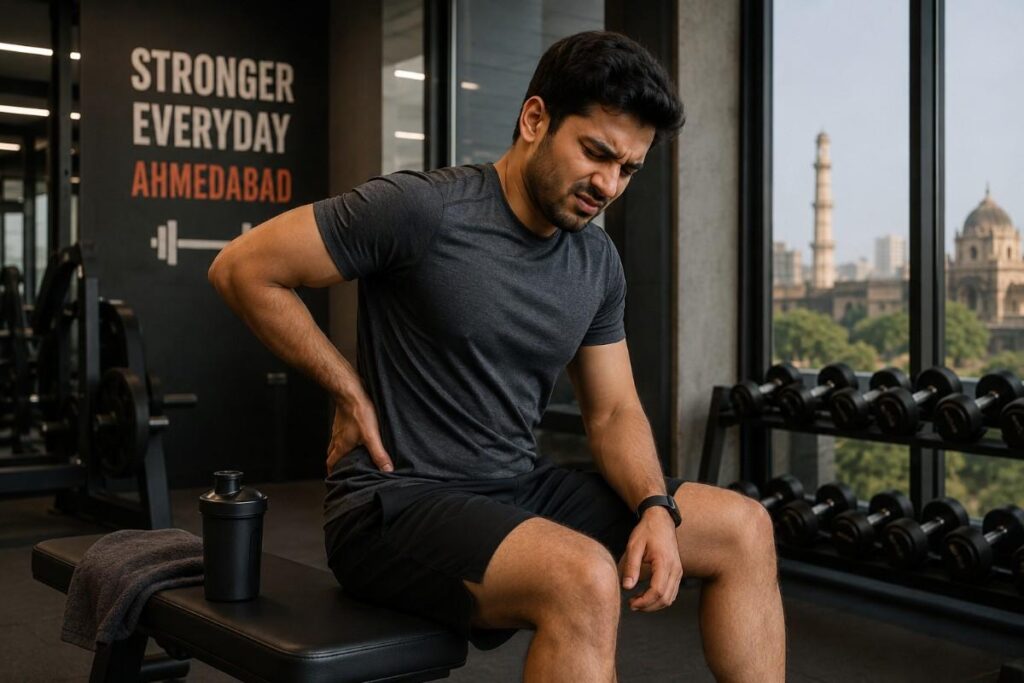
According to the WHO, low back pain is the single leading cause of disability worldwide — and gym-going populations are among the fastest-growing segments affected. Do you keep getting lower back pain after gym workout sessions — even when you take a full week off? You rest. The pain fades. You head back to the gym. And within days, the exact same spot flares up again.
This cycle is one of the most common patterns we see at our clinic in Bopal, Ahmedabad. Gym-goers across SG Highway, South Bopal, Shela, and GIFT City train hard every single week — and most of them manage the pain with rest, hot packs, or painkillers. Very few ever find out why it keeps coming back.
The answer is not complicated, but it is almost always missed. The biomechanical root cause — the faulty movement pattern quietly overloading your lumbar spine — is never identified and never corrected. Lower back pain physiotherapy Ahmedabad specialists understand this distinction well. This guide explains exactly what is happening inside your lower back every time you lift, why resting alone can never fix a movement problem, and what a structured physiotherapy assessment actually does differently.
If you are experiencing back pain after every gym session — or dealing with low back pain that keeps returning no matter how long you rest — this is the clearest, most clinically accurate answer you will find. We treat all back pain conditions at our Bopal clinic.
Why Lower Back Pain Is Becoming Common Among Young Gym-Goers in Ahmedabad
Ahmedabad is one of India’s fastest-growing cities. Gym culture has exploded — especially around SG Highway, South Bopal, Shela, and GIFT City. Hundreds of young professionals and college students now train daily. Fitness is no longer optional. It has become a lifestyle.
But this growth has also brought a sharp rise in gym-related musculoskeletal injuries. Back pain is now among the top reasons people search for gym injury physiotherapy Ahmedabad — and for good reason.
Here is the reality most gym-goers never stop to consider. A person in Bopal typically spends 8 to 10 hours sitting at a desk. During those hours, the hip flexors tighten progressively. The glutes slowly switch off. The deep stabilizing muscles of the lumbar spine lose activation. The entire posterior chain — the muscle group designed to protect the back — becomes functionally weak without the person realizing it.
Then, at 7 PM, that same person walks into the gym and loads a barbell for deadlifts.
The hip flexors are already shortened and pulling the pelvis forward. The glutes are not firing. The deep core is not braced. The lumbar spine is now completely unprotected — and it absorbs every kilogram of that barbell. Over weeks and months of training in this compromised state, the lower back accumulates stress until it finally gives out.
This pattern is not rare. Clinically, it is the single most common story we hear from patients across Bopal and Ahmedabad who arrive with gym-related musculoskeletal back injuries.
Seeking lower back pain physiotherapy Ahmedabad early — before the pattern becomes chronic — is the single most important step a gym-goer can take to break this cycle for good.
The 4 Gym Mistakes That Quietly Overload Your Lower Back
Most gym back injuries do not happen in one dramatic moment. They build slowly — one rep at a time. Studies on gym-related back injuries consistently show that poor lifting mechanics, inadequate warm-up, and muscle imbalance are the primary contributors to lower back strain during exercise.
The Most Common Cause of Back Pain in the Gym
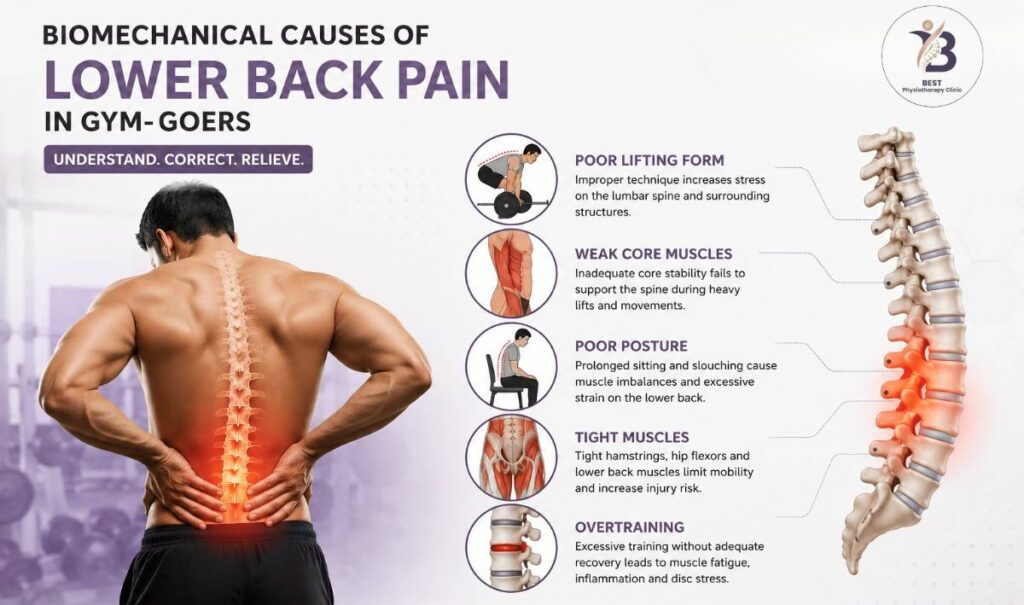
The single most common cause of back pain among gym-goers is not a dramatic accident — it is poor movement mechanics repeated silently across hundreds of sessions. Here are the four mistakes that drive it:
1. Rounding the Lumbar Spine During Deadlifts and Squats
This is the most destructive pattern we see. During a proper deadlift, the hips should absorb most of the load. The spine should remain long and neutral throughout the movement. But when the hip flexors are tight and the glutes are not firing, something very different happens. The pelvis tilts forward. The lower back rounds and compensates. Instead of the hips driving the lift, the lumbar vertebrae bend under load. Over hundreds of repetitions, this creates microscopic damage to the spinal discs and erector spinae muscles that slowly hardens into chronic lower back pain.
2. Loading Too Heavy Too Soon
Increasing weight without first building foundational stability overloads the passive structures of the spine — the discs, facet joints, and ligaments. When the active muscles cannot control the load, the spine absorbs the impact instead. This is one of the most avoidable causes of recurrent lower back pain in gym training.
3. Skipping the Warm-Up
A cold hip flexor is a tight hip flexor. When you skip mobility work before lifting, the pelvis is already in anterior pelvic tilt before the first rep. Every squat and deadlift from that point reinforces the dysfunctional pattern and adds cumulative stress to the lumbar region.
4. Ignoring Early Warning Pain
Pain is your spine’s communication system. When you train through early warning signs, you teach your nervous system to compensate around the dysfunction. Movement patterns worsen. The injury deepens. What could have been resolved in two weeks becomes a three-month problem.
If any of these habits sound familiar, explore sports injury rehabilitation before the damage compounds further.

Why Rest and Painkillers Never Fix the Real Problem
The recurrent lower back pain gym cycle looks like this:
Injury → Rest → Feel Better → Return to Gym → Same Injury
How Chronic Back Pain Develops Due to Untreated Gym Injuries
Most people repeat this loop three to five times before they seek proper help. This is precisely how a simple gym strain becomes chronic back pain — not due to one catastrophic event, but due to the same faulty mechanics repeating unchecked over months. Rest removes pain. It does not remove the cause.
Think of it this way. Imagine a car with a wheel alignment problem. Every few months, the tyres wear out on one side. You replace the tyres. The car drives fine for a while — then the same thing happens again. The problem was never the tyre. It was the alignment. Replacing the tyre did not fix the alignment.
Your lower back works exactly the same way. The pain is the worn tyre. The underlying movement dysfunction — the weak glute that forces the lumbar spine to compensate, the tight hip flexor that tilts the pelvis forward — is the alignment problem. Rest lets the tyre heal. It does absolutely nothing about the alignment.
Painkillers work by the same flawed logic. They suppress the brain’s pain signal. But the moment you return to the gym and perform the same movement pattern, the same tissue takes the same load. The pain returns because the mechanics never changed.
This is why lower back pain physiotherapy Ahmedabad is fundamentally different from rest. Physiotherapy does not simply wait for pain to settle. It investigates the movement pattern that caused the pain in the first place — and systematically corrects it so the injury has no structural reason to return.
Our manual therapy for back pain and exercise therapy programs are both designed around this principle: treat the cause, not the symptom.
Root Causes of Back Pain and Spine Stress in Gym-Goers
Most gym-goers assume back pain is a back problem. In clinical reality, it is almost always a whole-body movement problem that the back ends up paying the price for.
Research in musculoskeletal physiotherapy consistently confirms that the lower back rarely hurts because of the lower back alone. It hurts because another region is not doing its job — and the lumbar spine is forced to compensate for the failure.
Here are the most common hidden contributors:
Anterior Pelvic Tilt from Tight Hip Flexors
When the hip flexors are chronically shortened from hours of sitting, they pull the front of the pelvis downward. This pushes the lumbar spine beyond its neutral curve. Every loaded squat or hip hinge in this position jams the posterior facet joints and compresses the lumbar discs unevenly across thousands of reps.
Glute Inhibition
The gluteus maximus is the primary hip extensor and the most powerful protector of the lower back. When it stops activating — which happens quickly with a desk-heavy lifestyle — the lumbar erectors take over hip extension entirely. A muscle group built for fine postural control is now performing the job of the body’s most powerful muscle. It cannot sustain that demand under load.
Thoracic Immobility
When the upper back is stiff, the body borrows rotation and extension from the lumbar spine instead. The lower back then performs movements it was never designed to sustain under heavy load. Over time, this accelerates disc wear and facet joint irritation significantly. Correcting this is part of our posture correction approach.
Sacroiliac Joint Dysfunction
Poor load transfer through the pelvis creates asymmetry in how force travels up the spine. One side absorbs more stress than the other. This produces recurring one-sided lower back pain that keeps returning to exactly the same spot — and puzzles every person who experiences it.
Understanding these patterns is precisely what separates a trained physiotherapist from a generic exercise list.
How Lower Back Pain Physiotherapy in Ahmedabad Identifies the Real Problem
If you are dealing with recurring back pain in Bopal or Ahmedabad, a proper movement assessment is what separates real recovery from temporary pain relief. This is the core of lower back pain physiotherapy Ahmedabad — and it looks entirely different from simply booking an MRI.
An MRI shows the structure of your spine. It cannot show how your hips move, whether your glutes are activating, or whether your deep core muscles are bracing correctly during a squat. Movement cannot be diagnosed on a scan.
At our Best Physiotherapy clinic in Bopal, a comprehensive biomechanical movement screening evaluates all of this:
- Hip mobility test — Are tight hip flexors limiting your pelvic position under load?
- Glute activation check — Do the glutes fire before or after the lower back activates?
- Loaded movement analysis — What happens to your lumbar spine when you hinge, squat, or carry load?
- Core bracing assessment — Are the deep spinal stabilizers engaging to protect the lumbar vertebrae?
This assessment identifies the exact dysfunctional pattern causing your pain. It is precise, clinical, and evidence-based — not a guess.
Our manual therapy then addresses the physical restrictions identified in the assessment — stiff facet joints, overactive muscle groups, and restricted thoracic segments — using hands-on techniques to restore normal movement before any loading resumes. Joint mobilization is a key part of this process, directly improving spinal segment mobility and reducing the compensatory patterns driving your injury.
We also integrate dry needling therapy where clinically indicated, targeting overactive trigger points in the lumbar erectors and hip flexors that manual therapy alone may not fully release.
For gym athletes and active individuals seeking sports physiotherapy Bopal locals consistently trust, real recovery starts here — not with a generic list of stretches, but with a precise clinical diagnosis of how your body actually moves under load.
Core Stability vs. Core Strength: What Most People Get Wrong
Here is something that surprises almost every gym-goer we see. You can have a strong core and still have a completely unstable spine. These are two entirely different things — and confusing them is one of the most common reasons lower back pain keeps returning.
Core strength is the ability to produce force. Crunches, sit-ups, and leg raises build surface core strength. They develop the rectus abdominis and obliques — the muscles visible in a mirror.
Core stability is the ability to protect the spine under load by controlling movement. It is driven by deep, largely invisible muscles — the transverse abdominis (your body’s natural weight belt), the multifidus (segmental stabilizers of each lumbar vertebra), and the pelvic floor. These muscles do not create large movements. They prevent unwanted movement. That is their entire job.
Core instability physiotherapy specifically targets this deeper system. Imagine a high-rise building. The visible steel frame represents surface strength. The internal cross-beams hidden inside the walls represent stability. Without those internal supports, the entire structure becomes vulnerable under dynamic load.
Now picture a heavy deadlift performed without deep core activation. The transverse abdominis does not brace. The lumbar spine loses its neutral position under the bar. The discs absorb shear force instead of pure compression. The multifidus cannot protect the individual spinal segments. This is how a single gym session creates weeks of pain — not because the weight was too heavy, but because the internal stabilizing system was simply never switched on.
Training this system is the foundation of every recovery plan at our Bopal clinic. We use a targeted stretching and strengthening program combined with functional training to rebuild deep stability before any return to loaded gym training.
Our 6-Week Recovery and Movement Correction Approach
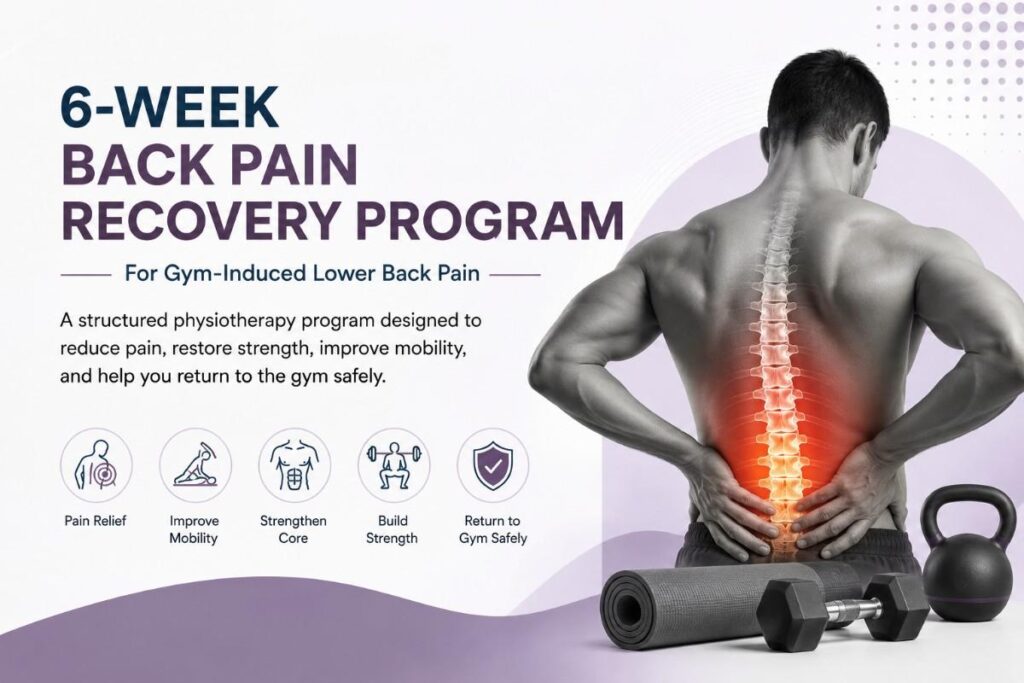
This is not a generic plan you can find on the internet. Every program we build at our Bopal clinic is designed around exactly what we found during your individual movement screening. Here is what a clinically structured recovery for gym-related lower back pain looks like:
Weeks 1–2: Pain Reduction, Deloading, and Full Assessment
In this phase, we use hands-on manual therapy and gentle neural mobilization to reduce acute pain and tissue reactivity. We identify every movement restriction — hip flexibility, glute activation, thoracic mobility, and deep core function. We also begin basic breathing mechanics training. Diaphragmatic breathing is the overlooked foundation of deep core activation. Most gym-goers have never been taught to brace correctly before they started loading the bar.
Weeks 3–4: Movement Re-Education and Stability Rebuilding
This is where the real work happens. We correct the specific faulty movement patterns identified in your assessment. If your glutes are not activating, we retrain glute-fire sequencing before any hip hinge movement is performed. If tight hip flexors are driving anterior pelvic tilt, we systematically lengthen them and teach neutral pelvic positioning. Deep core activation — not surface crunches — is trained every single session.
Weeks 5–6: Load Tolerance Rebuilding and Return-to-Gym Progression
Once movement quality is restored, we progressively reload the spine under controlled conditions. We retrain the deadlift hinge, the squat pattern, and pressing mechanics — with correct bracing and glute engagement from the first rep. Load is built gradually, testing the spine’s ability to absorb force safely before returning you to independent training. A final movement screen confirms readiness to go back to the gym.
This approach mirrors the return-to-sport protocols used in elite athletic rehabilitation. It is the difference between a full recovery and a half-recovery that breaks down again in three months.
This is exactly why lower back pain physiotherapy Ahmedabad patients who follow a structured 6-week plan return to gym training with confidence — not with fear of the same injury repeating.
When You Should Stop Ignoring Persistent Lower Back Pain
Most people in Bopal and across Ahmedabad wait too long before seeking lower back pain treatment from Ahmedabad specialists. By the time they finally come in, what started as a manageable gym injury has developed into a chronic pain pattern that takes significantly longer and more effort to resolve.
When to See a Spine Specialist in Ahmedabad
If your gym back pain keeps returning, you do not just need rest — you need a spine specialist or physiotherapist who can assess your movement, identify the root cause, and correct it clinically. Here are the signs that mean you should stop waiting and book an assessment right now:
- Pain that persists beyond 2 weeks without meaningful improvement
- Pain radiating into the buttock or leg — this may indicate nerve involvement or sciatica
- Numbness, tingling, or weakness in the legs or feet — neurological warning signs that require prompt assessment
- Morning stiffness lasting longer than 30 minutes that eases gradually with movement
- Pain that wakes you at night — a red flag for inflammatory or structural causes
- Back pain that increases with coughing, sneezing, or prolonged sitting — a sign of disc pressure on neural tissue, potentially linked to a herniated disc or slipped disc
- Repeated episodes of the same injury despite rest periods between them
The last point is the most important for gym-goers. If you have had the same back injury more than twice, your body is telling you clearly and repeatedly that the movement problem was never fixed.
Treatment Options Available for Spine Care in Bopal
Treatment options available at our Best Physiotherapy Clinic in Bopal spine care include movement correction physiotherapy, deep core stability training, joint mobilization, ultrasound therapy, and structured exercise rehabilitation — all tailored to your specific injury profile, not a one-size-fits-all protocol.
The earlier you reach out for lower back pain physiotherapy Ahmedabad, the shorter and more complete your recovery will be. Do not allow a fixable movement problem to become a permanent spinal condition.
Book a Free Physiotherapy Assessment in Bopal
Stop the cycle of rest and reinjury. Come in for a free physiotherapy assessment at Best Physiotherapy Clinic Bopal. Our evidence-based clinical team will screen your movement, identify exactly what is causing your back pain, and build a structured recovery plan designed specifically around you.
Frequently asked question
You keep reinjuring your back because the movement dysfunction that caused the first injury was never corrected. Rest stops the pain signal, but it does not fix weak glutes, tight hip flexors, or poor lifting mechanics. The moment you return to the same exercise with the same faulty pattern, the same injury occurs. A biomechanical movement assessment identifies and corrects the exact pattern causing your reinjury cycle.
The most effective approach is a proper physiotherapy movement screening followed by targeted movement correction. This identifies the specific muscle imbalance or faulty mechanics behind your pain. Hands-on therapy, deep core retraining, and a structured return-to-gym progression are the three key steps. Rest and random exercises alone are not a sufficient solution.
The most common culprits are weak or inhibited glutes, underactive deep core muscles — specifically the transverse abdominis and multifidus — and tight, overactive hip flexors. When the glutes stop working, the lower back takes over hip extension under every loaded movement. Rebuilding stability in these specific muscles is central to any effective lower back recovery program.
Yes. Research in musculoskeletal physiotherapy confirms that repetitive movements performed with poor mechanics — such as deadlifts with a rounded lower back or squats in anterior pelvic tilt — gradually damage spinal discs, facet joints, and surrounding soft tissue. The injury rarely arrives suddenly. It accumulates silently over weeks until the back finally gives way.
Lower back pain physiotherapy Ahmedabad is one of the most effective approaches for gym-related back injuries because it treats the cause rather than the symptom. A trained physiotherapist identifies the exact movement dysfunction, applies hands-on treatment to restore mobility, and rebuilds the functional stability needed to return to training safely and confidently.
Most gym-related lower back injuries respond well within 4 to 6 weeks of structured physiotherapy. Recovery time depends on how long the problem has been present, the severity of tissue involvement, and how consistently the patient follows the movement correction program. Early assessment always leads to a faster and more complete recovery.
Core strength is the ability to produce force — sit-ups and crunches build this. Core stability is the ability to protect the spine under load using deep, largely involuntary muscles like the transverse abdominis and multifidus. Most gym-goers have strong surface core muscles but poor spinal stability. Building deep stability first is essential before returning to heavy training safely.
You do not always need to stop training completely. However, you should modify your training to avoid spinal loading until you have been properly assessed. A physiotherapist can identify which exercises are currently safe, which need to be modified, and build a plan that keeps you active during recovery without worsening the injury.
Yes — significantly. Prolonged sitting creates tight hip flexors, inhibited glutes, and poor deep core activation. When a person carrying these deficits then performs heavy gym training without correcting them first, the lumbar spine compensates for every weak link in the chain. The combination of a desk job posture plus gym loading without proper movement preparation is one of the most common patterns behind lower back injuries in Ahmedabad's young professional population.
Best Physiotherapy Clinic Bopal is the leading evidence-based physiotherapy clinic in Bopal, Ahmedabad. We specialize in hands-on assessment and treatment for gym-related back injuries, sports rehabilitation, and chronic lower back pain. Book a free movement assessment and get a clear, structured plan for your recovery.