
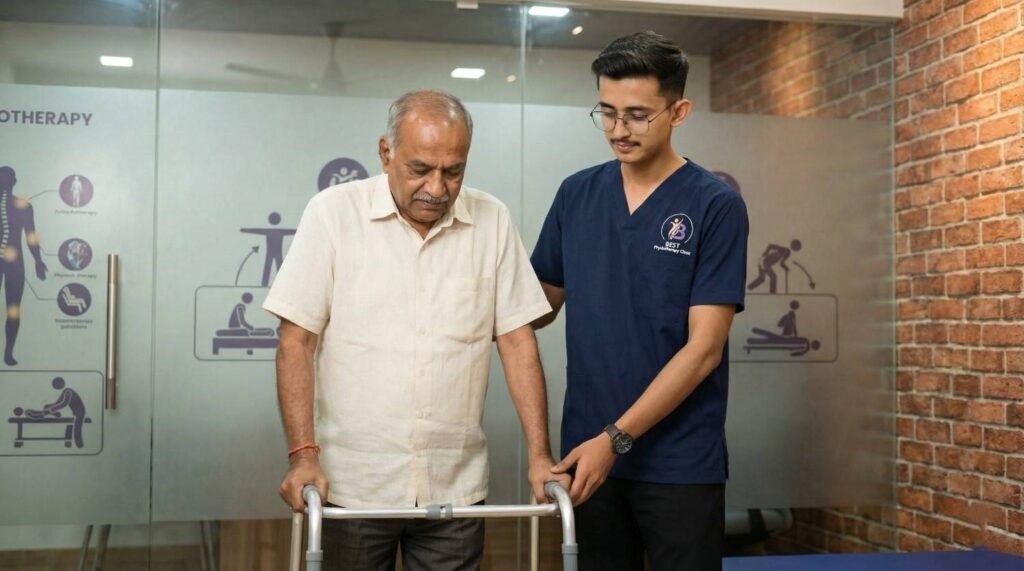
You’ve been discharged from the hospital in Ahmedabad. The surgeon is happy, the stitches are in, and you’re back home in Bopal. Many patients assume the hard part is over. However, clinically speaking, the surgery is only half the battle. Whether it was a Total Knee Replacement, an ACL Reconstruction, or a Spine Surgery, the procedure merely corrected the structural defect.
The second half—the half that determines whether you walk with a limp or return to the cricket field—is Post-Surgical Rehabilitation. At Best Physiotherapy Clinic Bopal, we specialize in bridging the gap between “hospital discharge” and “full functional recovery.”
“A perfect surgery can be ruined by poor rehabilitation. We don’t just help you heal; we ensure the time and money you invested in your surgery actually yield the life-changing results you were promised.”
— Dr. Kanaiya Gadhavi, Sports Physiotherapist
The body does not heal all at once. It heals in specific biological phases. If you skip a phase or push too hard too early, you risk graft failure or permanent stiffness.
Stage 1: The Protection Phase (0-2 Weeks)
Immediately after surgery, the goal is Inflammation Management. We focus on reducing swelling and protecting the surgical site. Using advanced modalities like Cryotherapy and gentle Range of Motion (ROM) exercises, we prevent the “freezing” of joints without stressing the stitches.
Stage 2: The Mobility Phase (2-6 Weeks)
Once the initial inflammation subsides, we fight scar tissue. If you don’t move now, your body will lay down thick, inelastic fibers that lead to permanent stiffness. Our therapists use Manual Therapy and Joint Mobilization to ensure your joint regains its natural glide.
Returning to Power: The Road to Functional Independence
The final stages of rehab are where most patients quit too early—and that is a mistake.
Stage 3: The Strengthening Phase (6-12 Weeks)
Your muscles atrophy (shrink) incredibly fast after surgery. In this stage, we transition to Functional Training. We rebuild the muscle groups that support your new joint, using targeted resistance to ensure you can climb stairs and walk long distances without fatigue.
Stage 4: The Return-to-Life Phase (12+ Weeks)
This is the final polish. Whether you want to return to driving in Ahmedabad traffic or playing sports, we use Proprioceptive Training (balance re-training) to ensure your brain and body are perfectly synced.
- Customized Timelines: We adjust these stages based on your surgeon’s specific protocols.
- Complication Prevention: We monitor for signs of DVT (blood clots) or infection that you might miss at home.
- Gait Training: We ensure you don’t develop a “compensatory limp” that causes back pain later.
- Neuromuscular Re-education: Training your nerves to fire the muscles correctly around the surgical site.
Conclusion
Your surgery was an investment in your future. Don’t let it go to waste by settling for a “wait and see” approach to recovery.
Take the final step toward recovery.
Schedule your post-surgical assessment at Best Physiotherapy Clinic Bopal today. Let’s make sure your surgery is a 100% success.
Frequently asked question
In most cases, physiotherapy should begin within 24 to 48 hours after surgery. Even while you are still in the hospital, simple movements are initiated to prevent blood clots and lung complications. Once you are home in Bopal, formal outpatient rehab typically starts as soon as your surgeon clears you, usually within the first week. Early intervention is the best predictor of a full recovery.
While home exercises are a part of the process, they cannot replace professional supervision. A physiotherapist provides Manual Therapy to break down scar tissue and ensures your form is perfect. Doing exercises incorrectly can put undue stress on a new graft or implant, potentially causing failure. Professional guidance ensures you are progressing at the right biological pace.
The duration varies by procedure. A minor arthroscopy might require 4 to 6 weeks, while a Total Knee Replacement or ACL Reconstruction usually requires 3 to 6 months of consistent work. The "rehab" isn't finished when the pain stops; it’s finished when your strength and balance have returned to 100% of their pre-injury levels.
Stiffness is a result of internal swelling and the body’s natural healing response (scar tissue). Think of scar tissue as "biological solder." If you don't move the joint through its full range, that solder hardens in a shortened position. Physiotherapy uses specific techniques to keep these tissues pliable while they heal.
Skipping rehab often leads to Permanent Range of Motion Loss and muscle atrophy. You may find that your "successful" surgery still leaves you with a limp, chronic stiffness, or pain in other joints (like your back) because your body is compensating for a weak, stiff limb.