
A stroke changes everything — in just a few minutes. One moment your loved one is fine. The next, they cannot move their arm. They cannot speak clearly. They cannot stand up alone. It is one of the most frightening things a family can face. But here is what every family in Bopal and Ahmedabad needs to know: stroke recovery is possible. The brain can heal. It can rewire itself. With the right hands-on care and an evidence-based plan, many patients do get back their movement, speech, and independence. This blog will walk you through exactly how stroke rehabilitation physiotherapy Bopal Ahmedabad works — and what you can do right now to help your loved one recover.
What Happens to the Brain and Body After a Stroke — Explained for Families
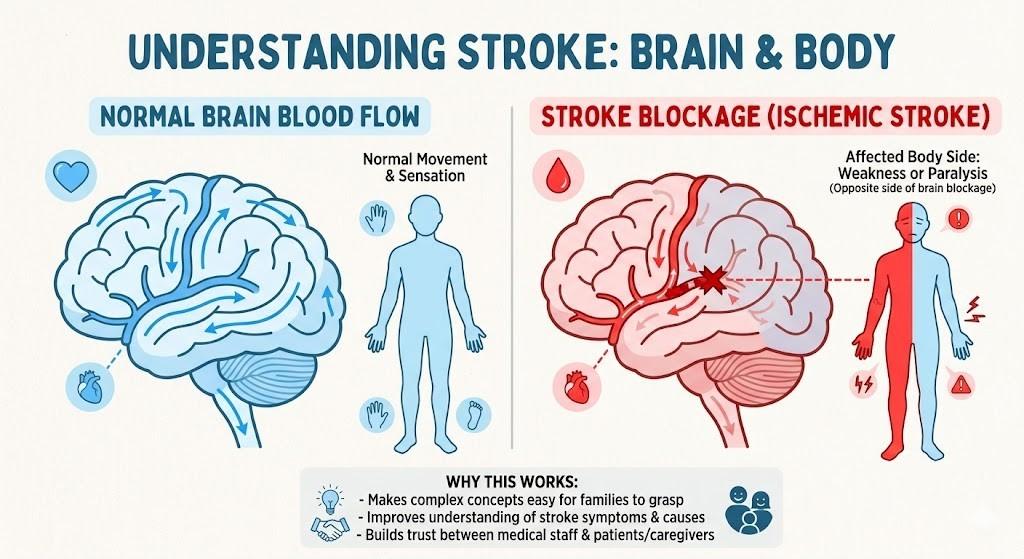
When a stroke happens, the brain loses blood flow very fast. Brain cells begin to die within minutes. This is not like a broken bone that heals on its own. The brain needs active help to recover. For families in Bopal watching a loved one go through this, it can feel overwhelming. But knowing what is happening inside the body helps you understand why physiotherapy matters so much. The brain controls every movement we make — lifting an arm, saying a word, taking a step. When part of the brain is damaged, those functions stop working. The good news is that the brain has an amazing ability to find new ways to do the same job — but only if it is given the right treatment and exercises. Our neurological rehabilitation at our Bopal clinic is designed to target exactly these damaged areas and help the brain find new paths forward.
What a Stroke Does to Brain Cells and Blood Flow
The brain needs blood to survive. Blood carries oxygen to brain cells. During a stroke, a blood vessel either gets blocked or bursts. Oxygen stops reaching part of the brain. Brain cells in that area begin to die very quickly. The more brain cells that die, the more functions are affected. Fast medical care and early physiotherapy help limit this damage.
Why Movement, Speech, and Balance Are Suddenly Affected
Every area of the brain controls a different part of the body. One area moves your right arm. Another area makes speech happen. Another keeps you balanced. When stroke damages one of these areas, that function is lost or weakened. That is why stroke symptoms vary so much — it depends on which part of the brain was hit.
Understanding Paralysis (Hemiplegia) After Stroke
Hemiplegia means one full side of the body is paralysed. It is very common after stroke. If the left side of the brain is damaged, the right side of the body is affected — and the other way around. Our neurological rehabilitation at our Bopal clinic is built to treat hemiplegia and paralysis with proven, hands-on methods that get results.
How Stroke Impacts Memory, Thinking, and Coordination
A stroke does not only hurt movement. It can also affect memory, focus, and coordination. A patient may forget simple words. They may struggle to button a shirt or pick up a cup. These are brain-related challenges — not a sign of weakness. With time and the right care, they improve.
Why Every Stroke Patient Shows Different Symptoms
No two strokes are alike. The damage depends on where the stroke hit and how severe it was. Some patients lose speech. Others lose leg movement. Some lose both. That is exactly why our physiotherapists build a personalised recovery plan for each patient — not a one-size-fits-all approach.
Why Starting Physiotherapy Within 72 Hours of a Stroke Changes Long-Term Recovery
There is a common, well-intentioned mistake many families make after a loved one suffers a stroke: they believe the patient needs complete, undisturbed bed rest to recover from the trauma. While adequate rest is necessary, prolonged immobility is actually detrimental to stroke recovery.
Medical studies and global health guidelines consistently show that the most rapid period of neuroplasticity—the time when the brain is most receptive to rewiring—occurs in the immediate days and weeks following the stroke. The crucial 72-hour window is when early mobilization should begin. During the acute hospital phase, this might mean simple, passive movements where a therapist gently moves the patient’s limbs to maintain joint flexibility and send vital sensory signals back to the brain.
Once your loved one is medically stable and discharged from the hospital, continuing this momentum without a gap is paramount. Waiting weeks to start outpatient rehabilitation allows muscles to atrophy (shrink), joints to stiffen (contractures), and the brain’s window of peak adaptability to narrow.
Starting early intervention prevents secondary complications and capitalizes on the brain’s natural healing state. Whether your loved one is ready to visit our clinic or requires early-stage home visits because they are not yet fully mobile, initiating a continuous, guided movement plan immediately upon hospital discharge dramatically changes their long-term recovery trajectory.
The 4 Areas of Stroke Rehabilitation Physiotherapy Bopal Ahmedabad at Best Physiotherapy Clinic
Every stroke is unique, which means every patient requires a completely tailored approach. We do not use a generic, one-size-fits-all checklist. Instead, Dr. Sagar and Dr. Kanaiya develop a personalised recovery plan based on a comprehensive, hands-on assessment.
Our specialized neurological rehabilitation at our Bopal clinic focuses on four core pillars to rebuild the whole person:
Motor Rehabilitation: Retraining Arm and Leg Movement
Motor rehab helps the brain relearn how to move the body again. We use the Bobath approach and the PNF technique — both proven, evidence-based methods for stroke recovery. Our hands-on sessions guide the patient’s limbs through correct movement patterns. With repetition, the brain builds new neural pathways and the movements become easier.
Balance and Gait Training: Helping Patients Stand and Walk Safely
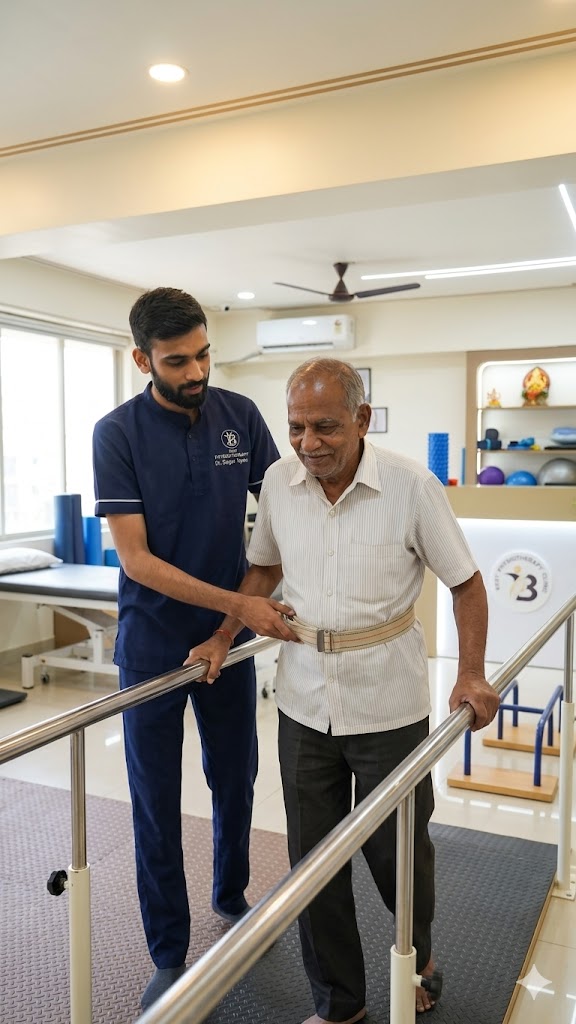
Many stroke patients cannot stand or walk safely at first. Our balance and coordination training helps patients regain their footing in a safe, step-by-step way. We use parallel bars, support tools, and guided walking exercises. The goal is steady, confident walking without fear of falling — a milestone that changes a patient’s entire outlook on recovery.
Spasticity Management: Reducing Stiffness and Muscle Tightness
Spasticity means muscles that are stiff, tight, and hard to control. It is one of the most common problems after a stroke. Our physios use hands-on stretching, manual therapy, and electrotherapy to relax these muscles. Reducing stiffness leads to more comfort, better movement, and faster overall progress.
Functional Independence Training: Daily Activities Made Possible Again
We also help patients do everyday tasks on their own — getting dressed, eating, cooking, writing, and walking to the bathroom. Our functional training sessions focus on real-life activities. The goal is always independence — and the joy that comes with doing things yourself again.
How a Personalised Recovery Plan Is Created for Each Patient
After a full hands-on assessment, Dr. Sagar and Dr. Kanaiya build a custom recovery plan for each patient. This plan looks at the type of stroke, the patient’s age, current abilities, and personal goals. The plan is reviewed and updated as the patient improves — because no two recovery journeys are the same.
What a Realistic Stroke Recovery Timeline Looks Like — Week by Week
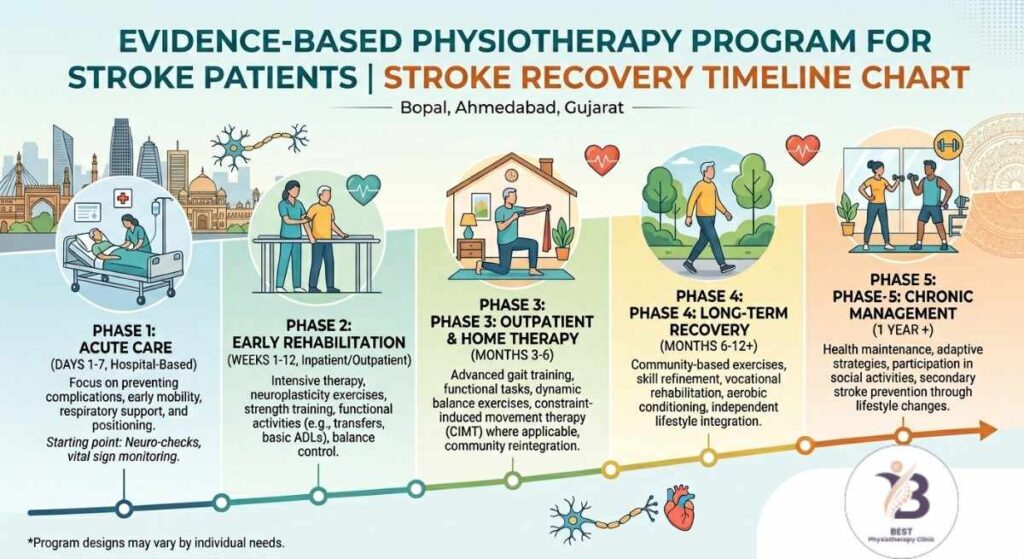
Recovery from stroke takes time. There are no shortcuts. But knowing what to expect at each stage helps families stay hopeful, patient, and focused on progress. Outcome-based stroke rehabilitation data shows that consistent physiotherapy — done at the right pace — leads to the best long-term results. Every patient at our Bopal clinic receives a clear timeline so the family understands the journey ahead. There will be hard days. There will also be breakthrough moments that make everything worthwhile. Here is what a typical stroke recovery journey looks like, week by week and month by month.
Week 1–2: Stabilisation and Passive Movement
In the first two weeks, the main goal is stability and gentle care. The physio performs passive movements — moving the patient’s arms and legs for them. This keeps blood flowing, prevents stiffness, and begins to send signals to the brain. Even these small movements matter.
Month 1: Sitting Balance and Early Active Movement
By month one, many patients can begin to sit upright with support. They start to move their limbs on their own — even just a little. Sitting balance exercises begin every day. Reaching this milestone is a huge boost for patient confidence and family morale.
Month 2–3: Standing, Assisted Walking, and Strength Building
By months two and three, many patients begin to stand and take their first steps with assistance. Strength exercises for the legs, core, and arms are added. Functional rehabilitation research shows this is often when the most visible progress happens — and families are amazed.
Month 4–6: Improving Independence and Coordination
By month six, many patients can do more on their own. They may walk short distances. They can do more daily tasks with less help. Fine motor skills — like picking up a spoon — improve with daily practice. This stage is also when confidence grows the most.
6–12 Months: Long-Term Recovery and Continued Progress
Stroke recovery does not stop at six months. The brain keeps building new paths for a year or longer. Patients who stay consistent with their physiotherapy sessions continue to improve. Neuroplasticity research confirms the brain can make meaningful progress well beyond the first six months — especially with a structured, evidence-based plan.
How Neuroplasticity Works — And Why It Makes Stroke Recovery Possible at Any Age
Neuroplasticity is the single most important reason why stroke recovery is possible. It is the brain’s built-in ability to change, adapt, and build new connections. You do not need to be young for this to work. You do not need to have had a mild stroke. Neuroplasticity works in patients of all ages and all levels of severity — as long as the right therapy is applied consistently. This is the foundation of our evidence-based stroke rehabilitation program in Bopal. Understanding how neuroplasticity works will help your family stay motivated through the harder days of recovery, because you will know that every session — every repeated movement — is literally rebuilding the brain. Research on neuroplasticity and stroke recovery confirms this is not a theory. It is a measurable, proven process.
What Is Neuroplasticity? (Simple Explanation for Families)
Think of the brain like a road map. A stroke blocks a main road. Neuroplasticity means the brain can build new smaller roads to reach the same place. These new roads are called neural pathways. Every time a patient practises a movement, one of these new roads gets a little stronger.
How the Brain "Rewires" Itself After a Stroke
Every time the patient tries to lift a cup or take a step, the brain looks for a new path to make it happen. With each attempt, that path gets clearer. Over time, with enough repetition, the movement becomes natural again. This rewiring is real and can be seen on brain scans. Hands-on physiotherapy speeds up this rewiring process significantly.
Why Repetition Is the Key to Recovery
The brain learns by repeating actions over and over. One try is not enough. Ten tries are better. A hundred tries build a strong new path. This is why our physios in Bopal give structured, repetition-based exercises. Every session builds on the last. Skipping sessions slows the process down. Staying consistent speeds it up.
How Evidence-Based Physiotherapy Strengthens New Brain Pathways
Our evidence-based approach to stroke recovery uses proven methods to stimulate neuroplasticity. As explained by neuroplasticity and brain recovery evidence from the National Institute of Neurological Disorders, the brain can form new connections at any age when given the right stimulation. Techniques like mirror therapy, the PNF technique, and the Bobath approach all activate these new brain circuits. Mirror therapy shows the patient a reflection of their healthy hand moving — tricking the brain into activating the weaker side. This speeds up neural rewiring and improves arm function faster than rest alone.
Book a Stroke Rehabilitation Assessment in Bopal — Same-Day Available
Navigating life after a stroke is overwhelming, but you do not have to do it alone. The most important thing you can do for your loved one is to ensure they are receiving targeted, consistent, and hands-on therapy as early as possible.
When it comes to expert stroke rehabilitation physiotherapy Bopal Ahmedabad families trust Dr. Sagar and Dr. Kanaiya at Best Physiotherapy Clinic Bopal to provide compassionate, high-level neuro-rehabilitation.
We know that waiting weeks for an appointment is not an option when dealing with stroke recovery. We reserve specific clinical time for neurological cases, ensuring same-day assessments are available so your loved one can begin their personalized recovery plan without delay.
If your loved one has recently been discharged and is currently bedridden or unable to safely travel, we also provide comprehensive Home Physiotherapy visits. We will bring our expertise directly to your living room to ensure they don’t miss the critical early window of recovery.
Take the next step toward reclaiming their independence.
Location: 3057–3058, TRP Mall, Central Bopal, Ahmedabad
Hours: Monday to Saturday, 8:00 AM to 8:00 PM
Frequently asked question
Physiotherapy helps the brain build new paths to control the body again. Hands-on exercises, movement training, and evidence-based techniques stimulate neuroplasticity — the brain's ability to rewire itself. Research shows that early and regular stroke rehabilitation physiotherapy Bopal Ahmedabad leads to the best outcomes for movement, speech, and independence.
Start physiotherapy as early as possible. Practice daily guided exercises at home and in clinic. Repetition is the key — the brain relearns movement through repeated practice. Our team at Best Physiotherapy Clinic Bopal creates a personalised, hands-on recovery plan to help every patient regain as much movement as possible.
A basal ganglia stroke affects movement, balance, and coordination. Recovery typically takes 3 to 6 months, depending on severity and when treatment started. With consistent, evidence-based physiotherapy and neuroplasticity-driven exercises, many patients see steady, meaningful improvement over this period.
Functional training is the key. This means practising daily tasks like dressing, eating, and walking under the guidance of a physiotherapist. Our team at Best Physiotherapy Clinic Bopal uses step-by-step functional training to help patients become as independent as possible — at the clinic or through home physiotherapy visits in Bopal and Ahmedabad.
Yes. We offer home physiotherapy for stroke patients across Bopal and Near by areas. Our physios visit your home and deliver the same hands-on, evidence-based care as at the clinic. This is ideal for patients who cannot travel in the early stages of recovery.
Absolutely. Neuroplasticity works at any age. Older patients across Ahmedabad have made remarkable progress with regular physiotherapy. The brain keeps rewiring itself as long as the patient keeps practising. Starting at 65 or 75 still leads to real, meaningful recovery. It is never too late.
Best Physiotherapy Clinic Bopal at TRP Mall, Central Bopal is one of the most trusted neuro rehabilitation clinics in the area. With specialist doctors, personalised evidence-based plans, same-Day appointments, and home visit options, we provide the most complete stroke rehabilitation physiotherapy Bopal Ahmedabad service closest to you.
Yes, many stroke patients can improve their speech with the right therapy. Speech therapy is the main treatment, but physiotherapy supports posture, breathing, and muscle control, which also help in speaking more clearly over time.
Stroke physiotherapy should ideally be done 5–6 days per week in the early stages. Regular and consistent sessions help activate neuroplasticity and speed up recovery. The frequency may change as the patient improves.
Early signs include slight movement in weak limbs, better sitting or standing balance, improved grip strength, and clearer speech. These small improvements show that the brain is starting to rewire and recover.