
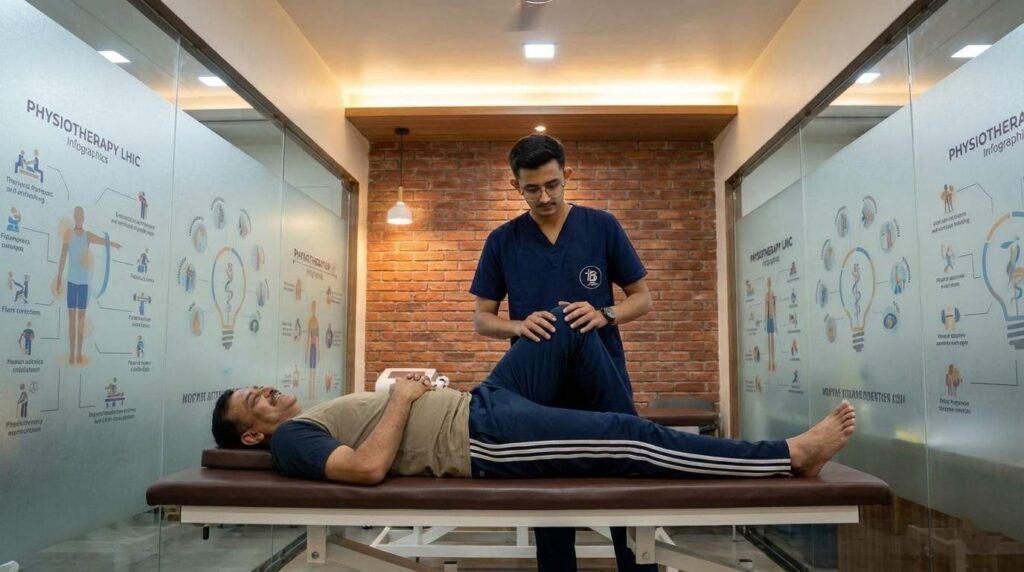
At Best Physiotherapy Clinic Bopal, we see the same story every day: a patient walks in with lower back pain or a stiff neck, convinced they have a serious injury. Often, the root cause isn’t trauma—it’s the cumulative effect of a sedentary lifestyle. Whether you are commuting daily to SG Highway or sitting for hours at a desk in South Bopal, your muscles are slowly shortening, limiting your Range of Motion (ROM) and setting the stage for injury.
True flexibility isn’t about doing the splits; it is about functional mobility. It’s the difference between picking up your child without a twinge of pain and throwing out your back. Effective stretching improves musculoskeletal health, enhances blood circulation to the joints, and is a critical component of our pain management protocols here in Ahmedabad.
“Flexibility is not a luxury; it is a clinical necessity. 80% of the chronic joint pain cases we treat in Bopal could have been mitigated with a consistent, scientifically-backed stretching routine. Do not wait for the injury to start moving.”
— Dr. Kanaiya Gadhavi, Sports Physiotherapist
Many patients mistakenly believe all stretching techniques is the same. However, using the wrong technique at the wrong time can actually decrease performance or cause muscle strain.
- Dynamic Stretching (Pre-Activity):
Before you go for a run at Bopal Park or start your gym session, your goal is to warm up the tissue. Dynamic stretching involves movement—think leg swings, arm circles, or torso twists. This primes your nervous system and prepares your connective tissues for load.
- Static Stretching (Post-Activity):
This is what most people are familiar with—holding a position for 30 seconds. This is best done after your workout or treatment session when the muscles are warm. Static stretching helps realign muscle fibers, reduce delayed onset muscle soreness (DOMS), and permanently increase flexibility over time.
Restoring Function: Why Flexibility Matters for Your Health
Our approach specifically targets the “tight zones” common to modern life. When you ignore flexibility, your body compensates. Tight hamstrings pull on your pelvis, which causes lower back pain. Tight chest muscles pull your shoulders forward, causing neck strain.
By integrating Proprioceptive Neuromuscular Facilitation (PNF) and targeted stretching into your routine, you unlock significant clinical benefits:
- Injury Prevention: Pliable muscles can absorb shock better than stiff ones, reducing the risk of ACL tears and ankle sprains.
- Postural Correction: Releasing tight chest and hip flexor muscles allows your spine to return to its neutral alignment, correcting the “slouch” common in office workers.
- Enhanced Circulation: Stretching increases blood supply to the muscles and joints, delivering nutrients and removing waste products like lactic acid.
- Stress Reduction: Tension headaches are often caused by tight upper trapezius muscles. Releasing this tension provides immediate relief.
- Joint Longevity: Full range of motion ensures that your joints wear evenly, delaying the onset of osteoarthritis.
Conclusion
Stretching is simple, but it must be precise. If you are struggling with stiffness that won’t go away, or if you are recovering from an injury, “guessing” your stretches can be dangerous.
Need a personalized flexibility plan?
Don’t let stiffness turn into chronic pain. Visit Best Physiotherapy Clinic Bopal for a comprehensive musculoskeletal assessment. We will design a recovery roadmap tailored to your body’s needs.
Frequently asked question
Yes, stretching every day is generally safe and highly beneficial, provided you are not forcing your body into painful positions. A daily routine helps counteract the cumulative effects of sedentary habits, such as sitting at a desk or driving for long periods. Consistent, gentle stretching maintains the natural resting length of your muscles and keeps joints lubricated. However, intensity matters. You should not perform aggressive deep stretching daily on the same muscle group without rest. Instead, focus on a "maintenance" routine of light mobility work daily, and save deeper, more intense flexibility sessions for 3-4 times a week to allow tissue recovery.
While often used interchangeably, they are clinically distinct. Flexibility is the passive ability of a muscle to lengthen (e.g., how far someone can push your leg up). Mobility is your ability to actively control a joint through that range of motion using your own strength. You can be flexible but have poor mobility, which increases injury risk because you lack stability at the end ranges of your movement. In physiotherapy, we prioritize mobility because it translates to functional strength. We want you to not just have the range, but to own the range during daily activities.
For static stretching (lengthening a muscle while staying still), current research suggests holding the position for 30 to 60 seconds is optimal for most adults. Holding for less than 20 seconds often isn't enough to trigger the "relaxation response" in the muscle spindle fibers, meaning the muscle resists the stretch. Conversely, holding for more than 60 seconds yields diminishing returns for the average person and creates unnecessary fatigue. The key is to relax and breathe deeply during this time; if you are holding your breath, your nervous system will tense up and fight the stretch.
Absolutely, because lower back pain is rarely just about the back—it is often a "referral" problem caused by tightness elsewhere. Specifically, tight hamstrings and hip flexors are the usual culprits. When hamstrings are tight, they pull down on the pelvis, flattening the natural curve of the lower spine. When hip flexors are tight (from sitting), they pull the pelvis forward. Both scenarios force the lumbar spine muscles to overwork. A targeted stretching routine that releases the hips and legs can significantly decompress the lower back, often providing more lasting relief than painkillers.
Shaking during a stretch is a warning signal from your nervous system. It usually means you have pushed past your muscle's current capacity, and your body is activating a protective reflex to prevent tearing. This is not a sign that the stretch is "working hard"; it is a sign that you are fighting your own physiology. If you experience shaking, you should immediately ease off the intensity until the shaking stops. Effective stretching requires a calm nervous system. If your body is in "fight or flight" mode (shaking), the muscle will actually tighten up to protect itself, defeating the purpose.