

You just had hip replacement surgery. Maybe at Shalby Hospitals, Zydus Hospital, or another orthopedic center in Ahmedabad. You are home now. You feel sore. You are wondering: “How long until I walk like myself again?”
This guide will answer that clearly. You will learn what happens each week during hip replacement recovery. You will learn which exercises are safe, which movements to avoid, and how to set up your home — including how to handle the very real challenge of low Indian toilets and floor-level seating. If you are recovering in Bopal or anywhere in Ahmedabad, this guide is written for you.
What Hip Replacement Surgery Actually Does
Before we talk about recovery, it helps to understand the surgery itself. Hip replacement — also called hip arthroplasty — means your surgeon removes the old, damaged hip joint and puts in a new one made of metal, ceramic, or hard plastic.
Your hip joint is like a ball sitting in a cup. Arthritis, injury, or age can wear this ball and cup down until every step hurts. The new joint does the same job — just without the pain.
Most patients in Ahmedabad have this surgery done as a total hip replacement, which replaces both the ball and the socket together. Some surgeons now use an anterior (front) approach, which is less invasive and can speed up the very early stages of recovery.
No matter which technique your surgeon used, what happens after surgery matters most. A good recovery plan — with the right exercises, safety rules, and physiotherapy — is the real key to walking normally again.

Your Hip Replacement Recovery Timeline at a Glance
Recovery from hip replacement does not happen overnight. But it follows a very predictable path. Here is the overall timeline most patients can expect:
| Stage | Timeline | Main Goal |
|---|---|---|
| 🏥 Hospital Stay | Days 1–3 | Stand up, take first steps |
| 🏠 Early Home Recovery | Weeks 1–3 | Rest, gentle exercise, reduce swelling |
| 💪 Building Strength | Weeks 4–6 | Walk farther, use less support |
| 🚶 Return to Normal Life | Weeks 7–12 | Walk without aid, climb stairs |
| 🎉 Full Recovery | 6–12 Months | Return to activities you love |
Full recovery may take up to a year. This does not mean you will feel unwell for a year. It means your muscles and tissues around your new hip joint keep rebuilding. Most people feel 80% better well before the 6-month mark.
Hip Replacement Recovery Week by Week: What to Expect After Surgery
Let us walk through hip replacement recovery week by week. This breakdown will help you know exactly what to expect and when.
Weeks 1–2: The First Steps After Surgery
Most patients start walking on the very day after surgery — or even the same day. This sounds surprising, but it is important. Early walking prevents dangerous blood clots. It also wakes up the muscles around your hip.
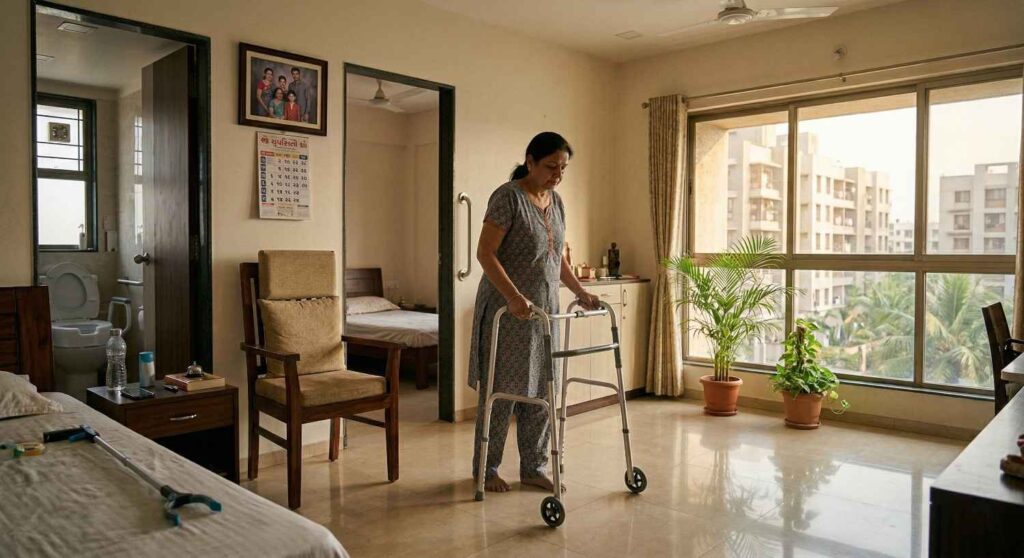
You will use a walker in the first 1 to 2 weeks. Your physiotherapist will guide your first few steps in the hospital. You will feel unsteady at first. That is completely normal.
At home, your exercises in weeks 1–2 will include:
- Ankle pumps — point your toes up and down while lying in bed. Do 20 reps every hour. This keeps blood moving and reduces swelling.
- Heel slides — slowly slide your heel toward you, then back. Do 10 to 15 reps.
- Quad sets — press the back of your knee gently into the bed. Hold 5 seconds. Repeat 10 times.
Walk indoors for 5 to 10 minutes, 3 to 4 times a day. Short and frequent is better than one long walk.
Pain after hip replacement is normal in weeks 1 and 2. Your doctor will prescribe medicine. Use an ice pack wrapped in a cloth for 15 minutes at a time to reduce swelling. Rest when your body asks you to.
Week 3: Gaining Confidence
By week 3, many patients feel a real shift. Pain starts to drop. Walking feels a little easier. You may be tempted to do more — be careful. Your hip is still healing inside even when it feels better on the outside.
How much should you walk 3 weeks after hip replacement? A good goal is 15 minutes of walking, 3 to 4 times a day. Increase the time slightly every few days, but never push through sharp pain.
Most people still use a walker or one crutch at week 3. Some patients who had anterior hip replacement may progress to a cane earlier. Follow your physiotherapist’s guidance, not your neighbour’s experience.
What to expect 3 weeks after hip replacement surgery: some swelling remains, especially in the evening. Your incision site may still be tender. Fatigue is common. Sleep and rest are still a major part of your recovery at this stage.
Weeks 4–6: Building Real Strength
This is when recovery really accelerates. Pain is much more manageable. Many patients switch from a walker to a single cane around week 4 or 5.
Exercises to add during weeks 4–6:
- Standing hip raises — hold a sturdy chair, slowly lift your knee up (do not go past 90 degrees), hold 3 seconds, lower slowly.
- Side leg lifts — stand, hold a chair, lift your leg out to the side slowly. This works the muscles around your hip that control balance.
- Mini squats — hold a chair, bend both knees slightly, hold 5 seconds, come back up. This rebuilds strength in your thighs.
According to the American Academy of Orthopaedic Surgeons (AAOS) recommends doing these exercises 2 to 3 times a day during the 4 to 6 week phase. Consistency matters far more than intensity at this stage.
At 6 weeks, your surgeon will likely call you back for an X-ray check-up. This is a big milestone. Most hip replacement patients get good news at this visit — the new hip joint is settling in well.
Can you walk without crutches 2 weeks after hip replacement? For most people, no — and that is okay. But by weeks 5 to 6, many patients take their first crutch-free steps. Your physiotherapist will tell you when you are truly ready.
Weeks 7–12: Returning to Normal Life
By weeks 7 to 12, hip replacement recovery reaches an exciting stage. Most patients walk without any aid. They climb stairs, ride in cars comfortably, and return to light daily activities.
Good exercises at this stage include:
- Stationary cycling — start with low resistance, 10 to 15 minutes
- Walking in a park (the Bopal Ecological Reserve trail is a gentle, flat option many local patients use)
- Water walking or swimming — very gentle on the new joint and excellent for rebuilding strength
As you get stronger, balance and coordination training becomes a key focus. This removes any remaining limp and helps you move confidently on uneven surfaces. Your physiotherapist will include single-leg standing drills and controlled weight shifts as part of this stage.
What should you be doing 12 weeks after hip replacement? Walk daily for 20 to 30 minutes. Keep up your strengthening exercises. Avoid running, jumping, and any activity with sudden twisting. These stay off-limits for at least 6 months.
Can you bend 12 weeks after hip replacement? Yes — but still carefully. The standard rule is no bending past 90 degrees at the hip. Most surgeons relax this restriction between 3 to 6 months after surgery. Ask your own surgeon before you change this.
The Right Exercises for Each Stage of Recovery
Exercise is the engine of your recovery. The NHS recommends starting gentle exercises within 24 hours of surgery and building up gradually over the following weeks. But knowing which exercises are appropriate — and which ones to avoid — makes a real difference in how smoothly you heal.
In the early weeks, the goal is to reduce swelling and prevent blood clots. Simple movements like ankle pumps and heel slides do this well. From weeks 4 onward, the goal shifts to rebuilding the strength you lost before and during surgery.
A structured stretching and strengthening programme tailored to hip replacement patients covers both flexibility and muscle strength in a safe sequence. Your physiotherapist will progress you through each level when your body is ready — not on a fixed calendar schedule.
Hip replacement exercises to avoid at any stage include:
- Deep squats or sitting cross-legged
- Bending forward past your knees while seated
- Twisting your body while your foot is planted
- Any high-impact activity — running, jumping, court sports — in the first 6 months
These movements put sudden stress on your new hip joint and increase the risk of dislocation. If you are unsure whether an activity is safe, always ask before you try it.
Safe Recovery After Hip Replacement Surgery: Home Setup Tips in Ahmedabad
This is one of the most overlooked parts of hip replacement recovery — especially in India. Many homes in Bopal and Ahmedabad have features that are challenging after hip surgery.
The Indian Toilet Problem
Indian-style squat toilets require deep bending at the hip — exactly what you must avoid after surgery. Before your surgery, install or borrow a raised Western-style commode seat, or use a commode chair. Your hip must never go below 90 degrees when sitting.
If your home only has an Indian toilet, discuss this with your surgeon or physiotherapist before discharge from hospital. In Bopal and across Ahmedabad, medical supply shops can rent or sell raised toilet seats and commode frames at a reasonable cost.
Low Furniture and Floor Seating
Traditional Indian homes often use low charpoys, floor mattresses, or low sofas. All of these are unsafe in the first 6 to 12 weeks after hip replacement. You need a firm, high chair or bed where your hips stay above your knees.
A simple fix: place firm foam blocks or wooden boards under the bed legs to raise the height. Your physiotherapist can advise on the right level.
Monsoon and Wet Floors
If your recovery falls in the monsoon months (June to September), wet floors are a serious fall risk in Ahmedabad. Place non-slip mats at every doorway, the bathroom, and the kitchen. Remove decorative rugs. Walk slowly on any tiled surface.
Falls in the first 3 months can dislocate your new hip joint. This is one of the most serious complications after surgery. Preventing falls is just as important as doing your exercises.
Important Don'ts After Hip Replacement
Knowing what not to do is just as important as your exercise plan. These rules protect your new hip joint from dislocation.
Do not:
- Cross your legs at the knee or ankle — even while sleeping
- Bend your hip past 90 degrees — no reaching your feet from a chair, no low seating
- Twist or pivot on your operated leg
- Sit for more than 45 to 60 minutes without getting up
- Return to heavy lifting, running, or impact sports before your surgeon clears you
Do:
- Sleep with a pillow between your knees for the first 6 weeks
- Use your walker or cane until your physiotherapist says otherwise
- Wear slip-on shoes or use a long-handled shoe horn
- Keep all your physiotherapy appointments — even when you feel good
Most hip replacement patients need to follow these precautions for 6 to 12 weeks following surgery. After that, your surgeon will tell you which rules you can relax based on your X-ray and progress.
Hip Replacement Recovery for Older Adults (Ages 65–80)
Many people who have hip replacement surgery in Ahmedabad are in their 60s and 70s. Age affects recovery — but perhaps less than people fear.
Hip replacement recovery time for a 70-year-old is typically 10 to 14 weeks to walk without any aid, and 6 to 12 months for full recovery. Research consistently shows that patients in their 70s achieve excellent outcomes — major pain relief and a real return to active daily life.
The biggest risks for older patients are falls and reduced motivation to exercise. Both are manageable. Understanding your personal fall risk factors early in recovery helps your physiotherapist build in the right precautions from the start — whether that means extra balance work, home safety checks, or supervised walking sessions. If you are an older adult recovering from hip replacement near Bopal, Ahmedabad, our post-surgical rehabilitation programme is designed with these specific needs in mind.
Many of our patients in their 70s walk better one year after surgery than they did in the two years before it.
Conclusion
Hip replacement recovery is very manageable when you know what to expect. The first few weeks are the hardest. After that, each week brings real, noticeable progress. Follow your exercises, protect your new hip joint, and set up your home safely — especially if you have Indian-style toilets or low furniture.
If you are recovering from hip surgery and need expert post-surgical rehab near you in Bopal, Ahmedabad, we are here. Our team creates a personal plan that fits your home, your age, and your goals. Take the first step toward walking normally again — book an appointment with us today.
Frequently asked question
Most patients walk without any support in 6 to 12 weeks. Walking without a limp — truly normally — takes 3 to 6 months for most people. Consistent physiotherapy is the single biggest factor in how quickly you reach that milestone.
For most patients, no — and trying too soon increases your fall risk. With an anterior hip replacement approach, some patients progress faster. Your physiotherapist will assess your strength and balance before clearing you to stop using aids.
Walking 20 to 30 minutes daily, doing strengthening exercises, and possibly cycling on a stationary bike. Avoid running, jumping, or twisting sports. Attend your final surgeon review and keep up with your physio sessions.
Yes, with care. The 90-degree hip bend restriction typically applies for the first 6 to 12 weeks. Ask your surgeon when your specific restriction ends — it depends on your implant and surgical approach.
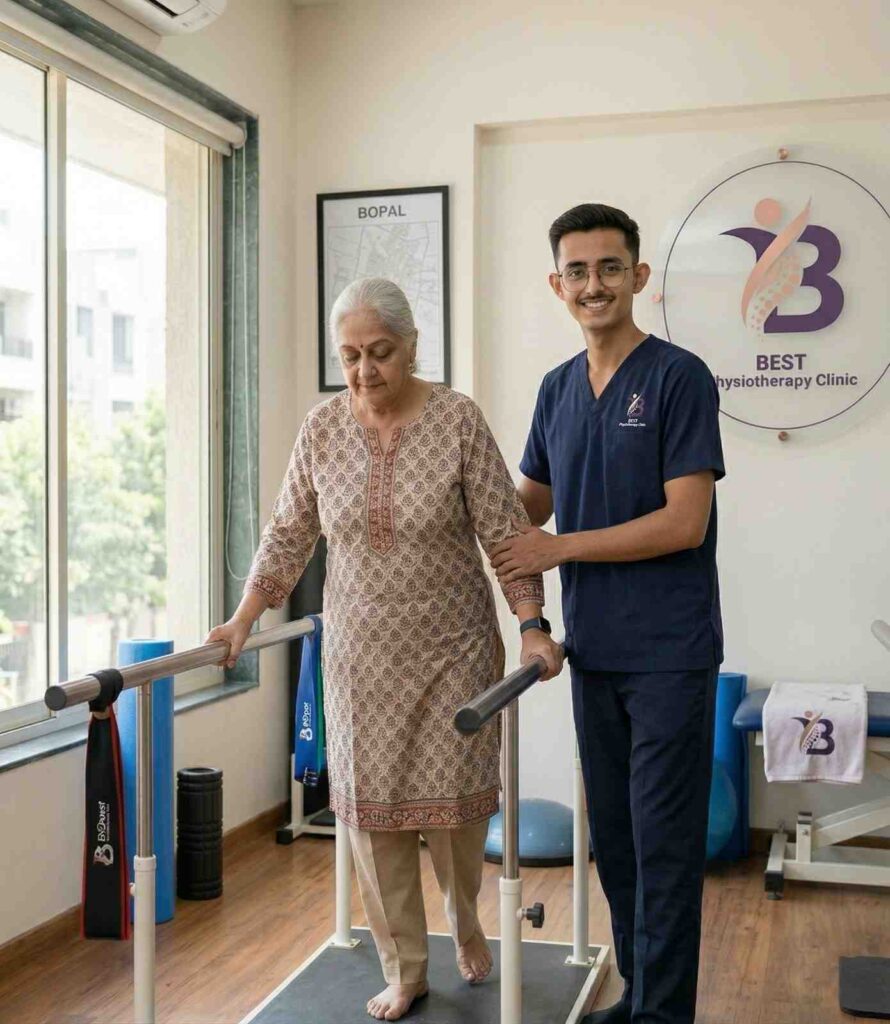
Best Physiotherapy Clinic in Bopal, Ahmedabad offers structured post-surgical rehabilitation for hip replacement patients. We coordinate with your orthopedic surgeon and create a recovery plan tailored to your home setup, age, and goals. Book online or call us — we are right here in your area.
Yes. Avoid deep squats, crossing your legs, bending past 90 degrees at the hip, and any high-impact activity (running, jumping) for at least 6 months. Your physiotherapist will give you a personalised list based on your surgery type.
Wet floors during monsoon season significantly increase your fall risk. Use non-slip mats, walk slowly on tiles, and keep a mobile phone nearby at all times. If you use a walker, rubber tips on the legs are essential in wet conditions
It depends on your job type. For desk or office work, most patients return within 4 to 6 weeks after surgery. For physically demanding jobs involving lifting, extensive walking, or standing for long hours, expect 8 to 12 weeks before your surgeon clears you. Always get written clearance from your doctor before resuming work — especially if your job involves driving.
Sleep on your back with a pillow placed between your knees for the first 6 weeks after surgery. This keeps your hip in a safe, neutral position and prevents you from accidentally crossing your legs during sleep — one of the top causes of dislocation in early recovery. Avoid sleeping on your operated side until your physiotherapist or surgeon specifically clears you.
Modern hip implants are highly durable. Research shows that more than 95% of hip replacements last 15 to 20 years, and many patients keep the same implant for the rest of their lives. Following your physiotherapy programme, maintaining a healthy weight, and avoiding high-impact activities are the three biggest factors that extend implant life.