

Do you wake up and feel your shoulder is stuck? Is the pain sharp when you try to lift your arm? You are not alone. Many people in Bopal, Ahmedabad deal with this kind of stiffness every day. It may be a condition called frozen shoulder. Most people try to wait it out. But waiting makes it much worse. This guide will help you understand frozen shoulder. It covers the causes, the stages, and how frozen shoulder physiotherapy can help you get better. If you live in Bopal, South Bopal, Ambli, or nearby — this is for you.
Frozen Shoulder Treatment Bopal Ahmedabad: Why Acting Early Is the Key
When it comes to frozen shoulder treatment in Bopal, Ahmedabad, time is everything. The earlier you start care, the faster you heal. The longer you wait, the more the shoulder joint tightens up.
Many people in Ahmedabad think shoulder pain will go away on its own. Sometimes it does — but not with frozen shoulder. Without care, the pain gets worse over months.
Fortis Healthcare confirms that delayed treatment turns a manageable condition into a long, painful recovery. Patients who wait can face 2 to 3 years of restricted movement. Those who act early often recover in 3 to 6 months.
Who is most at risk?
- Women between 40 and 60 years of age
- People with diabetes or thyroid disease
- Anyone who had a shoulder injury or surgery
- People who keep the arm still for a long time
If you fall into any of these groups and feel shoulder pain — do not ignore it.
What Exactly Is Frozen Shoulder — And Why Does It Happen?
Frozen shoulder is a painful condition that affects the shoulder joint. It is also called adhesive capsulitis. The word “adhesive” means sticky. The word “capsulitis” means swelling of the capsule.
The shoulder capsule is the tissue that wraps around your shoulder joint. When it gets inflamed, it starts to shrink and tighten. As it shrinks, the shoulder becomes very stiff. Moving the arm becomes painful and hard.
Think of it like a jacket that is two sizes too small. Your whole arm gets restricted. Even simple tasks — like reaching a shelf or putting on a shirt — cause pain.
UT Southwestern Medical Center reports that frozen shoulder affects 2–5% of all people. It is most common in women and in adults between ages 40 and 60. People with diabetes are up to 4 times more likely to develop frozen shoulder than others.
Common frozen shoulder causes:
- A past injury or fall on the shoulder
- Surgery that required the arm to rest for weeks
- Conditions like diabetes, hypothyroidism, or heart disease
- Poor posture from sitting at a desk for long hours
- Keeping the shoulder still for any reason
In many cases, there is no clear cause at all. The shoulder simply begins to stiffen on its own. But no matter the cause — early diagnosis and care always leads to better outcomes.
The 3 Stages of Frozen Shoulder (And Why Stage 1 Is Your Best Window)
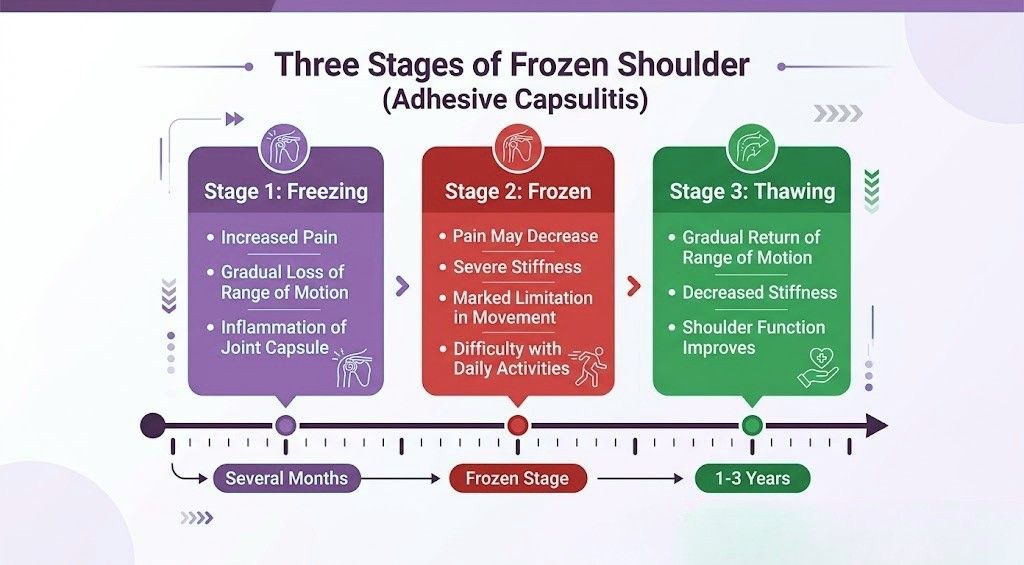
Frozen shoulder does not happen overnight. It moves through three clear stages. Understanding each stage helps you know what to expect — and when to get help.
Stage 1 — The Freezing Stage
This is when the shoulder begins to hurt. Pain comes on slowly at first. The range of motion gets smaller week by week. This stage lasts 2 to 9 months.
This is your best window for treatment. Frozen shoulder physiotherapy started now can make a big difference. Acting early can stop the condition from progressing to the harder stages.
Stage 2 — The Frozen Stage
The sharp pain may feel slightly less severe. But the stiffness is at its worst now. The shoulder becomes very hard to move. Even small actions — like combing hair or reaching behind your back — feel impossible. This stage lasts 4 to 12 months.
Stage 3 — The Thawing Stage
Movement slowly starts to return. The capsule begins to loosen. Recovery happens gradually. But without physical therapy, this can take 6 months to 2 full years.
Orlando Health confirms that most patients recover fully — but recovery is significantly faster with early care. Missing the Stage 1 window means a much longer journey.
If you live in Bopal or nearby areas like Ghuma or Ambli — see a physical therapist the moment you notice stiffness. It truly makes a big difference.
Frozen Shoulder Symptoms: What to Watch For
Frozen shoulder symptoms can be easy to miss at first. The pain is mild in the early days. But over weeks, it builds up.
Watch for these signs:
- Dull or aching pain deep in the shoulder joint
- Pain that gets worse at night and disturbs sleep
- Stiffness that makes it hard to raise your arm
- Difficulty reaching behind your back or across your body
- Trouble with tasks like dressing, driving, or lifting bags
- A feeling that the arm is “blocked” or won’t cooperate
These frozen shoulder symptoms get worse without treatment. The shoulder becomes more painful and more rigid over time.
If two or more of these signs have been present for more than 2 weeks — do not wait. Get a proper diagnosis as soon as possible.
Frozen Shoulder Causes and Risk Factors: What Puts You at Risk
Understanding frozen shoulder causes helps you take the right action early. There are two types of causes — known and unknown.
Known Causes (Secondary Frozen Shoulder)
This develops when there is a clear reason:
- Rotator cuff injury — damage to the tendons around the shoulder
- Shoulder surgery or fracture where the arm was kept still
- Stroke — where arm movement is limited for a long time
- Diabetes — this is the most common and well-proven risk factor
- Heart disease or thyroid conditions
Unknown Causes (Primary Frozen Shoulder)
In many cases, the shoulder simply starts to stiffen with no known reason. This is called primary adhesive capsulitis. It tends to affect women more than men and is more common after age 40.
Orlando Health notes that women are diagnosed with frozen shoulder much more often than men. Hormonal changes during midlife may play a role.
Risk factors summary:
- Age 40–60
- Diabetes or thyroid problems
- Limited shoulder movement for any reason
- Previous shoulder injury
Knowing your risk factors puts you ahead. If you have diabetes and feel stiffness — act early. Frozen shoulder is very treatable when caught in time.
What Happens When You "Wait It Out"
Many people decide to wait. They hope the shoulder pain will pass. This feels logical. But for frozen shoulder, waiting is one of the worst choices.
Here is what happens when you delay:
The shoulder capsule keeps getting tighter. The stiffness worsens each week. The painful nights multiply. Muscles around the shoulder joint stop being used. They get weak. Then recovery becomes twice as hard. Patients who delay care often suffer for 2 to 3 full years. In some cases, full movement never returns without intervention.
The misery of frozen shoulder grows with time — not less.
Signs that waiting is hurting you:
- Pain has been present for over 3 weeks
- You are changing how you sleep to avoid the shoulder
- You are avoiding using your arm for daily tasks
- The stiffness has spread or gotten worse
- Over-the-counter pain pills are not helping anymore
If you recognise any of these signs — please do not wait longer. Frozen shoulder physiotherapy is available near you in Bopal, Ahmedabad. Not sure if your pain is serious enough? Read our guide on the signs your body is telling you it’s time for physiotherapy.
What Does Frozen Shoulder Physiotherapy Actually Do?
Frozen shoulder physiotherapy is the gold-standard treatment for this condition. A trained physical therapist uses a step-by-step plan to reduce your pain and restore movement.
It works in four key ways:
- Reduces Swelling in the Capsule The inflamed shoulder capsule is the root of the problem. Physiotherapy uses gentle techniques to calm the swelling. Less swelling means less stiffness.
- Restores Range of Motion A physical therapist guides the shoulder through controlled movements. These movements stretch the tight tissue slowly and safely. Over time, the range of motion comes back.
- Relieves Shoulder Pain Hands-on techniques reduce pain directly at the joint. Many patients feel less pain after just a few sessions. No surgery. No heavy medicines.
- Rebuilds Shoulder Strength As the stiffness decreases, the muscles need to be rebuilt. Frozen shoulder exercises help strengthen the shoulder joint so it stays healthy long-term.
Research are confirms that physical therapy is one of the most effective non-surgical treatment options available for adhesive capsulitis. Most patients show significant improvement within 6 to 8 weeks of consistent care.
Frozen Shoulder Exercises You Can Start at Home
Doing frozen shoulder exercises at home — alongside clinic sessions — speeds up recovery a lot. Your physical therapist in Bopal will teach you the correct technique for each one.
Safe home exercises include:
- Pendulum Swings Stand and lean forward slightly. Let your affected arm hang loose. Gently swing it in small circles. Do 10 circles clockwise, then 10 anti-clockwise. This reduces stiffness with no strain on the capsule.
- Cross-Body Shoulder Stretch Use your healthy arm to gently pull the affected arm across your chest. Hold for 20 seconds. Repeat 5 times. This stretches the back of the shoulder capsule.
- Towel Stretch Hold a towel behind your back with both hands. Use the healthy hand to gently pull the affected arm upward. Hold 15 seconds. Repeat 5 times.
- Finger Walk Up the Wall Face a wall. Place your fingers on the wall at waist height. Slowly walk your fingers up as high as you comfortably can. This improves range of motion safely.
- Internal and External Rotation Lie on your back. Bend the elbow of the affected arm to 90 degrees. Slowly rotate the forearm toward the floor, then back up. Repeat 10 times.
Do these exercises daily. Do not push through sharp pain — mild discomfort is okay, but stop if it hurts too much. Your physical therapist will adjust the exercises as you improve.

Manual Therapy, Exercise + Electrotherapy — The Treatment Combination That Works
One treatment is good. A combination of three is far more powerful. The Best Physiotherapy clinic Bopal use all three together for the fastest results.
Manual Therapy
Our manual therapy for frozen shoulder in Bopal uses hands-on techniques to move the shoulder joint directly. This breaks up the adhesive tissue in the capsule. It improves flexibility quickly. Many patients feel a real difference after their first session.
Frozen Shoulder Exercises
Exercise keeps the shoulder moving between sessions. It rebuilds muscle strength. And it teaches your shoulder to move naturally again. Your therapist will provide a custom home exercise guide so you stay on track every day.
Electrotherapy
This uses safe, mild electric pulses on the shoulder area. The pulses reduce pain and swelling in the tissue. They also promote healing inside the shoulder capsule. Electrotherapy is completely painless — most patients say they barely feel it.
Together, these three approaches target:
- The inflamed capsule (root cause)
- The painful stiffness (symptom)
- The muscle weakness (secondary issue)
This combination is far superior to resting, pain pills, or hoping it goes away on its own. For stubborn cases, we also offer shock wave therapy for shoulder pain to accelerate tissue healing. Patients who follow this plan at clinics across Ahmedabad recover faster and stay recovered.
How Long Does Recovery Take With Early Physiotherapy vs Without?
| Stage | Typical Recovery Time |
|---|---|
| Stage 1 — Freezing | 2 to 4 months |
| Stage 2 — Frozen | 4 to 6 months |
| Stage 3 — Thawing | 3 to 5 months |
| Outcome | Reality |
|---|---|
| Total recovery time | 1.5 to 3 years |
| Risk of permanent stiffness | High |
| Muscle weakness | Very likely |
| Risk of recurring pain | Elevated |
- More sessions and higher costs later
- Missed days at work
- Disrupted sleep for months
- Dependence on pain medicines
Book Your Frozen Shoulder Assessment in Bopal
Getting the right diagnosis is the first step toward recovery. Our physiotherapy clinic near Bopal serves patients from across the area — including South Bopal, Ghuma, Ambli, Satellite Road, and wider Ahmedabad.
What happens at your first visit:
- A full assessment of your shoulder movement and pain level
- Diagnosis of your current stage (Freezing / Frozen / Thawing)
- A personalised treatment plan based on your lifestyle
- Your first hands-on physiotherapy session
- A home exercise guide to start right away
Our team includes trained physical therapists who specialise in adhesive capsulitis and shoulder pain treatment. We use the latest methods — including manual therapy, exercise protocols, and electrotherapy.
Patients across Ahmedabad and Gujarat trust us for effective, compassionate care. We treat the whole person — not just the shoulder joint.
Dr. Sagar and the team at Best Physiotherapy Clinic Bopal (TRP Mall) are here to help — Monday to Saturday, 8am to 8pm.
Frequently asked question
The best approach combines physiotherapy, manual therapy, and structured exercise. Starting in Stage 1 gives the fastest results. A trained physical therapist will assess your shoulder and build a plan around your needs. Look for a physiotherapy clinic near Bopal that specialises in adhesive capsulitis.
Both cause shoulder pain and stiffness — but they are different. A rotator cuff injury usually causes weakness and specific movement pain. Frozen shoulder causes pain throughout the full range of motion with progressive stiffness. A physical therapist can diagnose the difference properly. Do not self-diagnose.
Yes. Frozen shoulder is very common in women between 40 and 60 even without any past injury. This is called primary adhesive capsulitis. Hormonal changes, desk work, and diabetes all increase risk. If you are a woman in this age group with shoulder stiffness — get it checked early.
Without treatment, frozen shoulder typically lasts 1.5 to 3 years. In some cases, full movement never returns. With early physical therapy, most patients recover within 3 to 6 months. The earlier you start, the shorter your recovery.
Yes — with guidance. Your physical therapist will teach you which exercises are right for your stage. Pendulum swings, wall walks, and towel stretches are safe for most people. Never push through sharp pain. Always follow your therapist's instructions for home exercise.
Yes. Our clinic is conveniently located near Bopal and serves patients from South Bopal, Ambli, Ghuma, and surrounding areas of Ahmedabad. We offer expert frozen shoulder treatment in Bopal, Ahmedabad with same-day appointments available.
Watch for: shoulder pain at night that disturbs sleep, limited arm movement, stiffness that gets worse over weeks, and difficulty with tasks like dressing or driving. If these last more than 2 weeks — see a physical therapist in Bopal immediately.
Technically, frozen shoulder can resolve without treatment — but it takes 1.5 to 3 years. During that time, the stiffness and pain seriously affect daily life. Physical therapy shortens this to months and prevents permanent loss of motion. Waiting is never the better option.
Yes. People with diabetes are at a much higher risk of developing frozen shoulder. High blood sugar can affect the connective tissues around the shoulder joint, making them tighter and less flexible over time. Diabetic patients also tend to experience more severe stiffness and longer recovery periods. Early frozen shoulder physiotherapy can help improve movement and reduce long-term complications.
In most cases, frozen shoulder does not return in the same shoulder once fully treated. However, some people may develop it in the opposite shoulder later in life. Continuing your home exercise program, maintaining shoulder mobility, and getting early physiotherapy for new stiffness can reduce the risk of recurrence.