
Key Points
- Cricket injury prevention physiotherapy combines workload monitoring, sport-specific strength work, and season-aligned conditioning to cut down bowling, batting, and fielding injuries.
- Fast bowlers face the highest injury burden in cricket, particularly to the lower back, shoulder, and hamstrings.
- Lower limb injuries make up close to half of all cricket injuries, followed by upper limb and trunk/back injuries.
- Pre-season neuromuscular training can meaningfully lower injury risk, especially for young players moving between tape-ball leagues and hard-ball cricket.
- Bopal’s players face extra seasonal challenges: monsoon ground shifts, Gujarat’s heat, and packed domestic-plus-IPL calendars.
If you’ve spent any time around the grounds near Sardar Patel Stadium or the tape-ball tournaments that pop up across South Bopal every weekend, you already know cricket injuries are common. Cricket injury prevention physiotherapy works by identifying an individual player’s specific risk factors, bowling workload, technique, ground conditions, and building a targeted program around them, rather than handing every player the same generic stretching sheet.
Honestly, that’s the part most general fitness advice misses. A 14-year-old bowling leg-spin in a school tournament doesn’t need the same program as a 22-year-old club fast bowler chasing a state trial. Good physiotherapy accounts for that difference.
Why Cricket Injury Prevention Matters for Bopal’s Aspiring Players
Cricket isn’t a casual pastime in Ahmedabad. It’s closer to a religion. Every IPL season, you can see the effect ripple down to school grounds and society compounds, kids trying big shots, wannabe fast bowlers running in off long marks they’ve clearly copied from television.
That enthusiasm is good. But it also means more overuse injuries in players who haven’t built the physical base for the loads they’re putting through their bodies. Cricket is associated with a high incidence of injury overall, and fast bowlers carry the highest injury rates of any position on the field, particularly for lumbar spine stress fractures and lower limb injuries, according to research published in the British Journal of Sports Medicine.
For a family in Bopal deciding whether their child should join a serious cricket academy, this matters. A stress fracture in a growing spine can take a young bowler out of the game for months. Prevention is genuinely cheaper, in time and money, than rehabilitation later.
What Are the Most Common Injuries in Cricket?
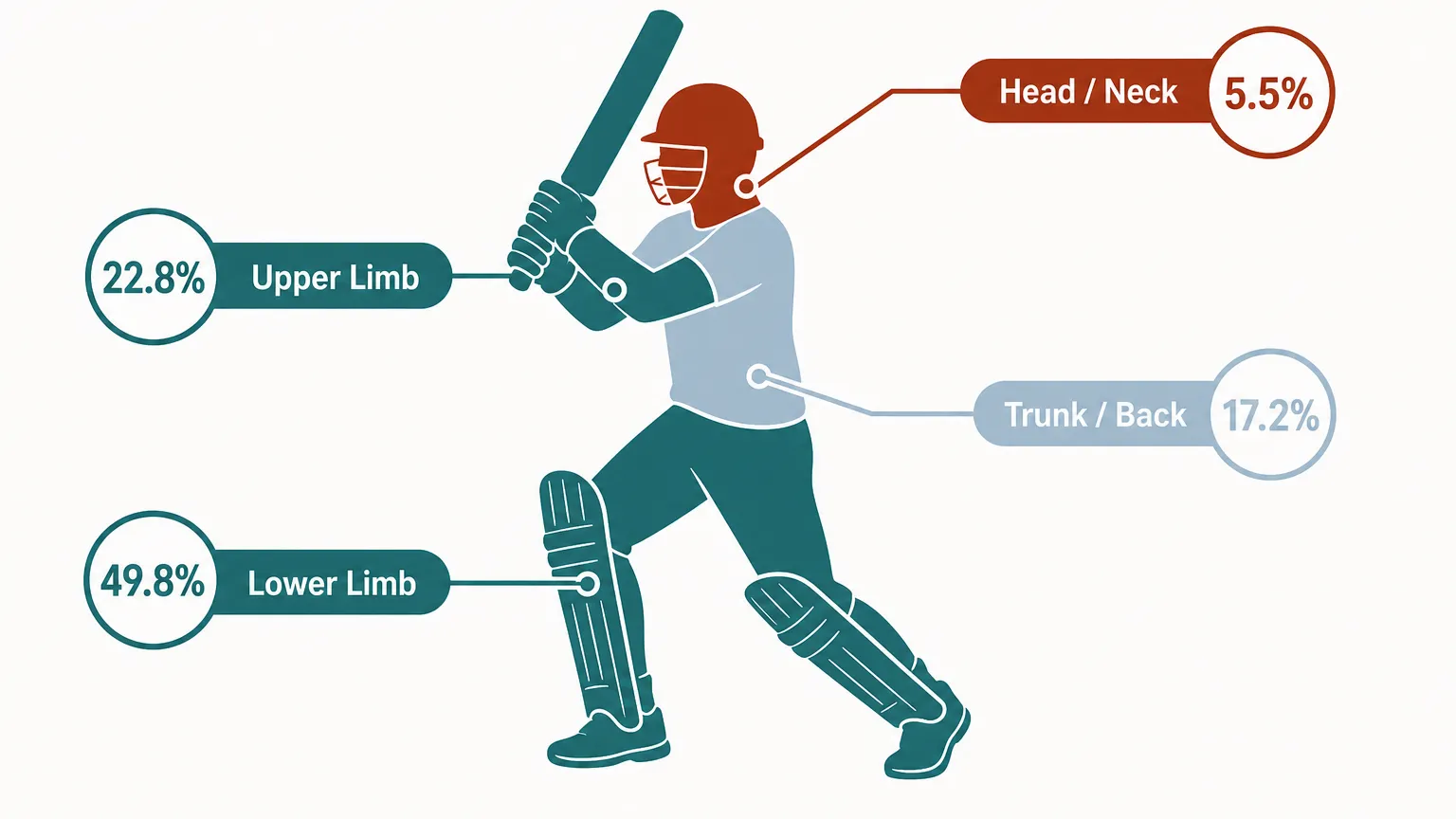
Lower limb injuries are the most common in cricket, accounting for roughly half of all reported injuries, followed by upper limb, trunk and back, and head or neck injuries. Hamstring strains, lumbar stress fractures, and shoulder injuries are the three that show up again and again in injury surveillance data.
The table below shows how injury location breaks down across the sport.
| Injury Location | Share of Cricket Injuries | Typical Mechanism |
|---|---|---|
| Lower limb | 49.8% | Sprinting between wickets, fielding, bowling run-up |
| Upper limb | 22.8% | Bowling shoulder load, batting grip, throwing |
| Trunk / back | 17.2% | Repetitive bowling rotation, lumbar loading |
| Head / neck | 5.5% | Ball contact, collisions |
Fast Bowler Injuries: Back, Shoulder, and Lower Limb
Fast bowlers absorb enormous forces every time their front foot lands. That repeated loading through the lumbar spine is why stress fractures and spondylolysis (a stress fracture in the vertebra) are so common in young, growing bowlers. Add shoulder impingement from the bowling action and hamstring strain from repeated sprinting, and it’s easy to see why fast bowlers are considered the most injury-exposed players on the field.
Batsman Injuries: Hand, Wrist, and Hamstring
Batsmen deal with a different injury pattern. Ball impacts to the hand and wrist happen often, especially against faster bowling. Hamstring strains show up too, usually from quick singles and sudden sprints between wickets after long periods of standing.
Wicketkeeper Injuries: Knee and Finger
Wicketkeepers spend hours in a crouched position, then explode into sudden lateral movements. That combination puts real strain on the knees, and repeated ball impact makes fingers one of the most commonly injured areas for keepers at any level.
How Cricket Injury Prevention Physiotherapy Works Through Gujarat’s Cricket Seasons
Cricket in and around Ahmedabad doesn’t follow one continuous season. It shifts across three distinct phases, and cricket injury prevention physiotherapy should shift with it. Pre-monsoon months bring hard, fast grounds that reward pace bowlers but punish tired legs. The monsoon stretch pushes a lot of local cricket into tape-ball and tennis-ball formats played on covered or synthetic surfaces around Bopal, which changes the loading pattern on ankles and knees. Post-monsoon, grounds soften again and domestic season intensity picks up, often overlapping with school examinations, which is when workload creeps up fastest without anyone noticing.
This is honestly one of the biggest gaps in generic cricket injury advice. Most guides are written for English county cricket or Australian grade cricket, where the season is one long block. In Bopal, a talented 16-year-old might play tape-ball on a Sunday, turn out for his academy on hard ball twice during the week, then get called up for a district trial, all in the same fortnight. Nobody is tracking his total bowling load across those formats.
Add Gujarat’s heat. Summer training sessions here regularly push past temperatures where hydration and heat management become part of injury prevention, not an afterthought. A physiotherapy program that ignores climate, format-switching, and the pull of IPL-driven ambition isn’t really built for players in this region.
“Injury prevention for cricketers here has to account for what’s actually happening on the ground: kids switching between tape-ball weekends and hard-ball academy sessions without anyone tracking the combined load on their body.”
, Dr. Sagar Vyas & Dr. Kanaiya Gadhavi, Licensed physiotherapists with expertise in musculoskeletal rehabilitation
How Can Physiotherapy Help Prevent Cricket Injuries?
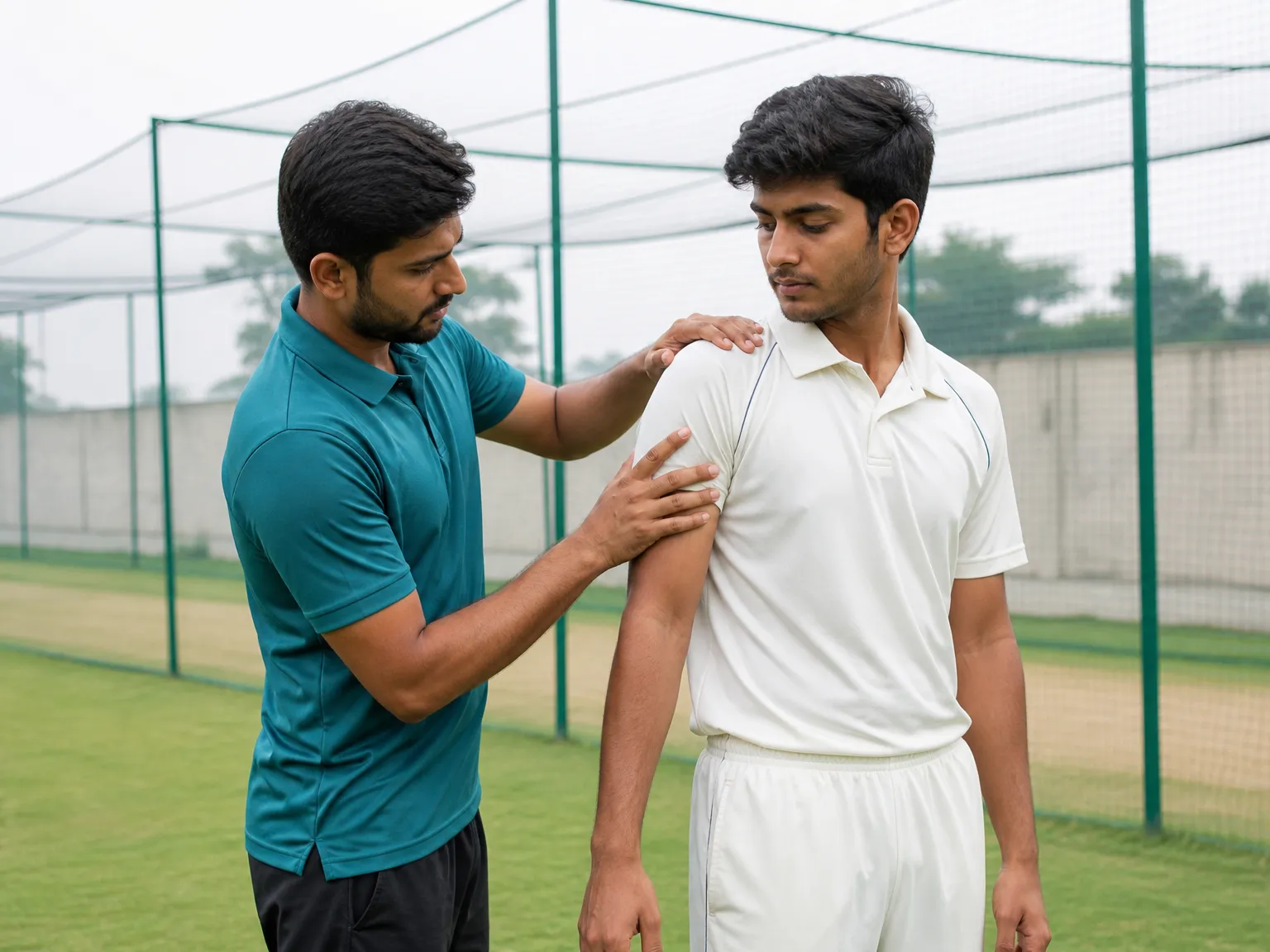
Physiotherapy helps prevent cricket injuries by combining movement screening, sport-specific strength training, and workload guidance so problems get caught before they turn into fractures or tears. A physiotherapist looks at how you actually bowl, bat, or field, not just how strong you are in a gym setting.
At our clinic, this usually starts with a movement and biomechanical assessment: checking hip mobility, shoulder mechanics, and core stability together, rather than treating each area separately. This kinetic chain approach, addressing the hip, spine, and shoulder as one connected system, is considered critical for reducing bowling-related injuries by sports physical therapy researchers such as Dr. Kevin Wilk, whose work on the kinetic chain in overhead athletes is widely referenced in sports rehabilitation.
For players already dealing with an injury, treating cricket injuries properly means addressing the root mechanical cause, not just resting until pain settles down. Rest alone often isn’t enough. A young bowler with shoulder impingement who only rests, without rebuilding scapular strength and correcting technique, tends to have the same problem return the moment he starts bowling full pace again.
What Exercises Prevent Cricket Injuries?
The exercises that prevent cricket injuries most reliably are eccentric hamstring work, rotator cuff and scapular stabilization drills, core stability training, and single-leg balance work for ankle proprioception. None of these need fancy equipment. Most can be done on a mat with a resistance band.
- Nordic hamstring curls and Romanian deadlifts build the eccentric hamstring strength that protects against strain, which is one of the more common cricket injuries and has a real chance of coming back within the first year if not rehabilitated properly.
- Scapular retraction, external rotation with a band, and prone Y-T-W raises support shoulder health for bowlers and throwers.
- Dead bugs, side planks, and anti-rotation presses build the core stability that protects the lumbar spine during repeated bowling rotation.
- Single-leg balance drills, ideally on an unstable surface, build the ankle proprioception that fielders and batsmen need for quick direction changes.
Our flexibility and strength exercises program builds these into a progressive plan rather than a random list, because sequencing matters. Building strength before adding speed and rotation work, in that order, is what actually reduces injury risk.
How Do You Prevent Fast Bowling Injuries?
Fast bowling injuries are best prevented through structured workload limits, technique correction, and consistent strength conditioning, since workload is the single most modifiable risk factor for bowling injuries. This isn’t guesswork. Cricket governing bodies, including the ICC, recommend structured spell and daily over limits for young fast bowlers to protect the growing spine.
In practice, that means tracking overs bowled across every format a player plays, not just the official academy sessions. It means building shoulder and lumbar strength ahead of a heavy bowling block, not during it. And it means correcting technique flaws, like excessive lateral trunk flexion or a mixed bowling action, before they become ingrained habits that load the spine unevenly.
Fast bowlers experience notably more injuries per hour of play compared to batsmen, largely because of the repeated high-force landing through the front leg and the rotational force through the lower back on every delivery. That gap closes considerably when workload is managed properly and conditioning keeps pace with bowling volume.
What Is the Best Warm-Up for Cricket?
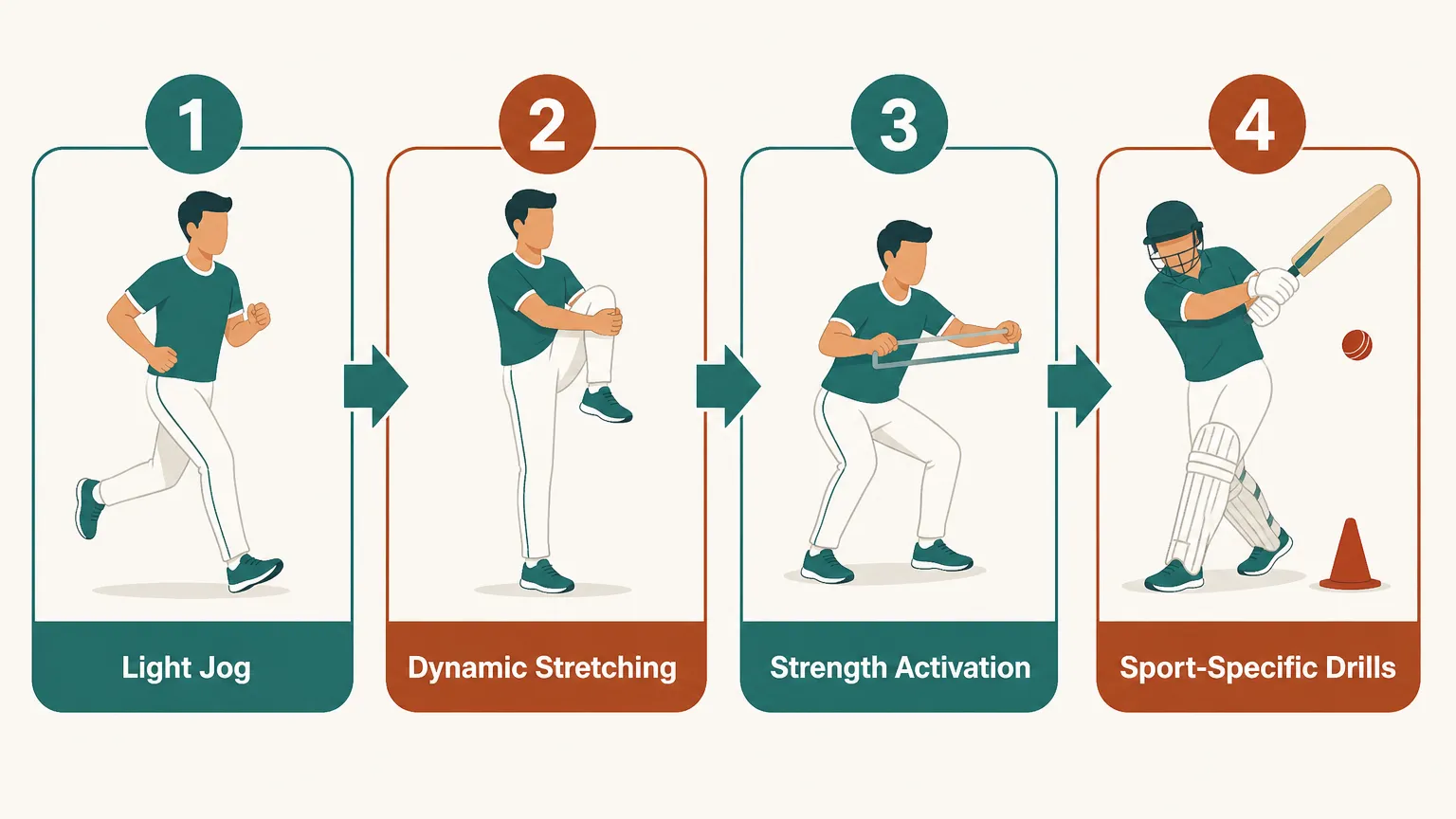
The best cricket warm-up combines a general aerobic raise, dynamic mobility drills, and sport-specific movement patterns, done in that order, over roughly 15 to 20 minutes before any bowling or batting practice. A jog followed by a few stretches isn’t enough preparation for the forces cricket puts on the body.
A solid warm-up structure looks like this: light jogging or skipping to raise heart rate, dynamic stretches for hips, hamstrings, and shoulders (leg swings, walking lunges, arm circles), then sport-specific movement, shadow bowling at increasing intensity for bowlers, throw-downs at low intensity for batsmen, and short sprint bursts for fielders. Skipping straight to full-pace bowling without this build-up is one of the most common mistakes club-level players make, especially in weekend tape-ball matches where time is short and everyone just wants to start playing.
How Often Do Cricketers Get Injured?
Cricketers, especially fast bowlers, get injured more frequently than most people assume, with bowlers experiencing considerably higher injury rates per hour of play than batsmen. Fast bowlers are considered two to three times more likely to be injured compared to other playing positions, according to injury epidemiology research published in the British Journal of Sports Medicine.
This is exactly why workload tracking matters so much for aspiring players in Bopal juggling academy sessions, school cricket, and weekend tournaments. Total exposure across all formats adds up fast, even if no single session looks excessive on its own.
What Is Cricket Pre-Season Training?
Cricket pre-season training is a structured conditioning block, usually four to eight weeks, done before competitive cricket begins, that builds strength, aerobic base, and bowling-specific load tolerance gradually. The goal is simple: arrive at the first competitive match already conditioned for the demands of the season, instead of getting match-fit during it.
Pre-season neuromuscular training programs, ones that include balance, plyometric, and strengthening components, can meaningfully reduce injury risk in sports that involve repeated pivoting and sprinting, cricket among them. A well-run sport-specific functional training block ahead of Gujarat’s post-monsoon domestic season gives young players a real head start, both physically and in confidence.
Do one thing before this season starts. Get an honest movement screen done, even if nothing hurts yet. It’s far easier to fix a mobility gap in October than to rehab a stress fracture in December.
How Do You Treat a Hamstring Injury From Cricket?
A hamstring strain from cricket is treated with an initial period of load management, followed by progressive strengthening, especially eccentric exercises, and a structured return-to-sport program before going back to full-intensity sprinting or bowling. Rushing this process is exactly why hamstring strains have such a high recurrence rate.
Early on, that means reducing painful movements, gentle mobility work, and pain-guided walking. As symptoms settle, the focus shifts to progressive loading, isometric holds first, then eccentric strengthening like Nordic curls, then sprint mechanics drills. Our post-injury rehabilitation services build in objective return-to-sport testing, checking strength symmetry and sprint mechanics, before clearing a player to bowl or bat at full intensity again. Skipping that final testing step is a major reason hamstring strains come back within the same season.
Cricket-Specific Physiotherapy Assessments in Bopal
A cricket-specific physiotherapy assessment looks at how your body moves during actual bowling, batting, or fielding actions, not just generic strength and flexibility tests. This is where comprehensive sports injury care really separates itself from a standard gym-based fitness check.
Biomechanical Screening for Bowlers
For bowlers, we look at run-up rhythm, front-foot landing mechanics, trunk rotation, and shoulder position at release. Video analysis often reveals technique quirks a player has no idea they’re doing, a slightly mixed action, excessive side flexion, that quietly loads the lumbar spine on every single delivery.
Movement Quality Assessment for Batsmen
For batsmen, the focus shifts to hip rotation, weight transfer, and grip mechanics. Hamstring flexibility and single-leg control get particular attention, since so much batting movement, quick singles especially, relies on explosive hip and hamstring function.
Frequently Asked Questions
Is physiotherapy only needed after a cricket injury happens?
No. Cricket injury prevention physiotherapy is most useful before an injury occurs, through movement screening, strength building, and workload guidance. Waiting until pain shows up usually means a longer recovery than addressing risk factors early.
At what age should young cricketers start injury prevention physiotherapy?
There’s no fixed age, but any player bowling regularly in a competitive format, including serious tape-ball leagues, benefits from a basic movement screen and age-appropriate strength program, particularly during growth spurts when stress fractures are more likely.
How long does a typical cricket injury prevention program take?
Most programs run alongside the pre-season period, often four to eight weeks of focused conditioning, followed by ongoing maintenance work through the competitive season. Results vary by player depending on baseline fitness and injury history.
Can physiotherapy improve bowling or batting performance, not just prevent injury?
Yes. Addressing hip mobility, core stability, and shoulder mechanics together often improves bowling pace and batting power as a side effect, since these are the same physical qualities that reduce injury risk.
Do tape-ball and tennis-ball cricket carry the same injury risks as hard-ball cricket?
Not identically. Tape-ball cricket tends to involve less lumbar loading for bowlers but more sudden ankle and knee movement on synthetic surfaces. Players moving between formats should have their total combined workload assessed, not just their hard-ball overs.
If you or your child are training seriously in cricket around Bopal or South Bopal, whether at a formal academy or a weekend tape-ball league, getting an individual assessment before injuries start is worth the hour it takes. Best Physio Bopal offers cricket-specific screening and rehabilitation for players of every level. Call +91 9512 114422 or visit us at 3057-3058 TRP Mall, Central, Bopal, Gujarat 380058 to schedule a consultation. Hindi and Gujarati-speaking patients are welcome, we’re happy to explain your assessment and program in whichever language is most comfortable for you.
Written and medically reviewed by Dr. Sagar Vyas & Dr. Kanaiya Gadhavi, Licensed physiotherapists with expertise in musculoskeletal rehabilitation
Last reviewed: September 2026
This article is for informational purposes only and does not constitute medical advice. Please consult a qualified healthcare provider for diagnosis and treatment.