
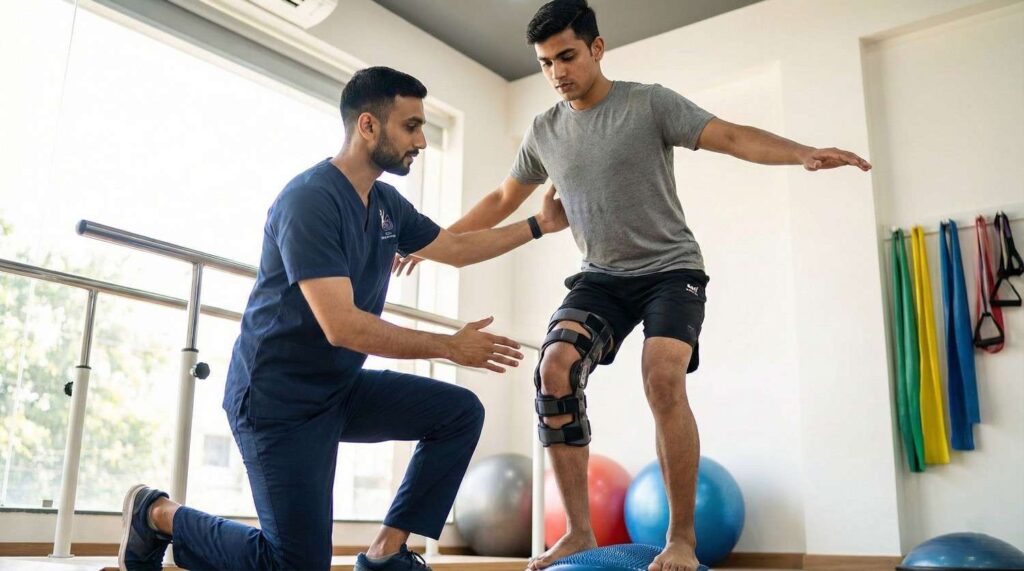
You felt the pop. Your knee swelled fast. The doctor told you it was an ACL tear. Now you are asking: How long does this take? When can I play again? What do I do each week?
This guide gives you clear, honest answers. We cover the full ACL rehabilitation timeline — from the day of surgery to the day you return to sport. We explain what to do, how to do it, and what to watch out for. Whether you play cricket in Bopal, football in Ahmedabad, or just want to run pain-free again, this guide is built for you.
The ACL Rehabilitation Timeline Explained: What You Are Really Facing
ACL stands for Anterior Cruciate Ligament. It is a strong band of tissue inside your knee. It keeps your knee stable when you cut, jump, or change direction fast.
When it tears, the knee loses that stability. You feel it — a sudden pop, then swelling, then weakness. This is one of the most common sports injuries in India. Cricket bowlers, kabaddi players, and football athletes in Bopal face this injury regularly.
The ACL injury recovery timeline depends on two things: whether you have surgery, and how well you do your rehab. For most athletes, ACL reconstruction surgery is the best choice. After surgery, a structured ACL rehabilitation timeline guides your recovery through six clear stages.
Research published in sports medicine journals shows that patients who follow a complete, phased ACL rehabilitation program return to sport at significantly higher rates than those who skip or rush stages. One major study found that athletes who cleared objective return-to-sport tests had a re-injury rate five times lower than those who returned on time alone.
The full recovery time for most people is 9 to 12 months. Basic return to sport after ACL reconstruction is possible at 6 months — but only if you pass the required tests. Some athletes, especially those returning to high-level competitive sport, need closer to 12 to 18 months.
This does not mean you will be stuck at home. Each month brings new milestones. Let us walk through them.
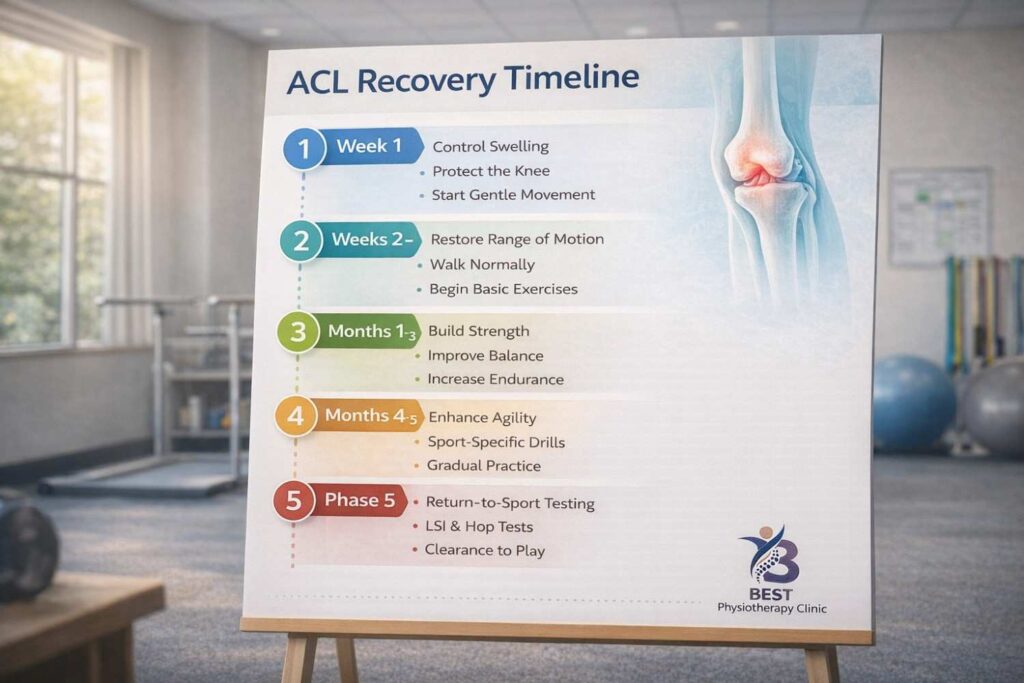
Phase 1 — Week 1 After ACL Surgery: Swelling Control and Protecting the Knee
The first week after ACL surgery is not about exercise. It is about protection and rest.
Immediately following surgery, your knee will be wrapped, swollen, and painful. This is normal. The ACL graft — the new tissue your surgeon used to replace the torn ACL — is delicate right now. It must be protected.
Your goals in Week 1:
- Control swelling with ice (20 minutes on, 20 minutes off, several times per day)
- Keep the leg raised above heart level as much as possible
- Use crutches to walk without putting full weight on the knee
- Wear your knee brace as instructed
- Begin very gentle movement to prevent stiffness
3 Exercises to Start Immediately After Surgery (Day 2–5):
- Ankle Pumps — While lying down, point your toes up toward your face, then push them down. Do 20 repetitions every hour you are awake. This keeps blood moving and reduces swelling.
- Quad Sets — Lie flat. Tighten the muscle on top of your thigh by pushing the back of your knee gently into the bed. Hold for 5 seconds. Do 3 sets of 10. This wakes up the thigh muscle without stressing the graft.
- Heel Slides — Lie on your back. Slowly slide your heel toward your bottom, bending the knee as far as it comfortably goes. Slide back. Do 2 sets of 10. Stop if you feel sharp pain.
Bracing after ACL surgery is important in these first two weeks. Your brace holds the knee at the right angle while the graft begins to attach to the bone. Do not remove it without your physiotherapist’s guidance.
A key finding from post-operative ACL rehabilitation research: starting gentle movement immediately following surgery — even within 24 hours — reduces stiffness significantly and leads to faster range-of-motion recovery. Waiting too long makes rehab harder.
Phase 2 — Weeks 2 to 6: Regaining Motion and Walking Normally Again
By the end of Week 2, most patients can begin putting more weight on the leg. The goal here is to walk normally without a limp. This sounds simple. But a limp means your body is compensating — and that creates new problems later.
Your goals in Weeks 2 to 6:
- Bend the knee to at least 90 degrees (a right angle) by Week 4
- Straighten the knee fully (this matters as much as bending)
- Walk without crutches by Week 4 to 6 (varies by surgeon instruction)
- Reduce swelling further
- Begin light strengthening
3 Key Exercises at 4 Weeks After ACL Surgery:
- Mini Squats (Partial Squats) — Stand holding a wall or chair for balance. Slowly bend both knees to about 45 degrees (half a squat). Hold 2 seconds. Straighten. Do 3 sets of 15. You should feel your thigh muscles working — not your knee hurting.
- Straight Leg Raises — Lie on your back. Tighten your thigh muscle. Lift the straight leg to the height of the other bent knee. Hold 2 seconds. Lower slowly. Do 3 sets of 15 on each leg. This builds quad strength without bending the knee under load.
- Standing Calf Raises — Stand at a counter or wall. Rise up onto your toes slowly, then lower. Do 3 sets of 20. This rebuilds lower leg strength and helps with walking.
At this stage, swelling after activity is normal. If the knee swells after exercise, use ice for 15 minutes. If it stays swollen the next morning, the exercises were too intense. Reduce the reps and tell your physiotherapist.
Cricket players in Bopal often try to return to bowling too early during this phase. Bowling requires fast knee loading and rotation. Even light throwing stresses the ACL graft. Do not rush. The graft is still weak — this is called the “ligamentization” process, and it takes months. Read more about knee ligament injury physiotherapy.
Phase 3 — Month 1 to Month 3: Building the Foundation of Strength
This is where the real work begins. Months 1 through 3 of ACL rehabilitation are about building serious muscle strength. The quad (thigh) and hamstring muscles must be strong before you can safely return to sport.
Research on outcomes after ACL reconstruction shows clearly: weak quadriceps at the time of return to sport is one of the biggest predictors of re-injury. The goal is to get your operated leg’s strength to at least 80% of the healthy leg before moving to sport-specific training.
Your goals in Months 1 to 3:
- Build quad and hamstring strength progressively
- Improve balance and single-leg stability
- Walk at full speed without a limp
- Begin light jogging (usually around Month 3, if cleared)
- Begin proprioception training (your body’s sense of where the knee is)
3 Exercises for This Phase:
- Romanian Deadlift (Light Weight) — Stand with feet hip-width apart. Hold light dumbbells. Push hips back slowly, keeping back straight, until you feel a stretch in the back of your thigh. Return. Do 3 sets of 12. This is one of the best exercises for hamstrings — often the most neglected muscle after ACL surgery.
- Single-Leg Balance — Stand on your operated leg with a slight knee bend. Hold for 30 seconds. If this is easy, close your eyes. If it is still easy, stand on a folded towel. Do 3 sets on each leg. Poor balance at this stage strongly predicts re-injury.
- Step-Ups — Use a step or box 20–30 cm high. Step up with the operated leg. Bring the other foot up. Step back down with control. Do 3 sets of 12. This builds single-leg strength in a functional way.
At our Best Physiotherapy clinic in Bopal, we use a weekly progress check during this phase. We measure leg strength, range of motion, and swelling. This helps us know when you are ready to progress — and when you need to slow down.
Phase 4 — Month 4 to Month 5: Sport-Specific Rehabilitation Protocol
By Month 4, most patients are walking normally and feeling much better. This is the most dangerous stage of the ACL rehabilitation timeline — not because the exercises are risky, but because patients feel good and want to do too much too fast.
According to the latest Research on readiness to return to sport shows that how a patient feels is a poor judge of whether they are actually ready. Many ACL re-injuries happen between Month 4 and Month 6, when patients return to sport based on feeling alone.
This phase introduces the sport-specific rehabilitation protocol. This means training movements that match your actual sport.
Examples by Sport:
- Cricket: Side-step agility drills, rotational core work, bowling run-up mechanics (not full bowling yet)
- Football: Lateral cutting drills, short-distance acceleration and deceleration runs, kicking technique (light)
- Kabaddi: Multi-directional movement drills, quick stops and starts on grass
3 Core Exercises for All Athletes in This Phase:
- Lateral Band Walks — Place a resistance band just above both ankles. Bend knees slightly. Walk sideways, 10 steps right, then 10 steps left. Do 3 sets. This builds hip abductor strength — critical for knee stability during cutting movements.
- Box Jumps (Low Box, Two-Leg Landing) — Jump up onto a low box with both feet. Step down. Then progress to jumping off and landing softly. Do 3 sets of 8. Focus on landing quietly — loud landings mean poor shock absorption.
- Jogging Progression — Start with a walk-jog interval: walk 1 minute, jog 1 minute, repeat for 15 minutes. Over 3 to 4 weeks, progress to a full 20-minute jog. Only progress if there is no swelling or pain the next day.
Recovery time at this stage is still important. Rest days matter. Overtraining can inflame the graft and delay your return to competitive sport.
Patients in Ahmedabad sometimes ask about playing social cricket at this point. Light, informal cricket with no sprinting or diving may be possible near Month 5 — but check with your physiotherapist first.
Phase 5 — 6 Months After ACL Surgery: Return to Sport Testing and Clearance
Six months after ACL surgery is a major milestone. But it is a checkpoint — not a finish line. Return to sport after ACL reconstruction is based on test results, not calendar dates.
Your physiotherapist will conduct ACL return to sport testing. This typically includes:
The Key Tests:
- Limb Symmetry Index (LSI): Measures whether your operated leg is at least 90% as strong as the healthy leg. Anything below 85% means you are not ready.
- Single-Leg Hop Test: You hop as far as you can on one leg. The operated leg should match at least 90% of the distance from the healthy leg.
- Triple Hop for Distance: Three consecutive hops. Tests both strength and coordination.
- Psychological Readiness Scale: Measures confidence and fear of re-injury. Fear is a real factor — athletes who score low on confidence re-injure more often.
Studies show that only about 55–65% of athletes pass all return-to-sport tests at the 6-month mark. This does not mean the others failed rehab. It means they need 1 to 3 more months. That is normal.
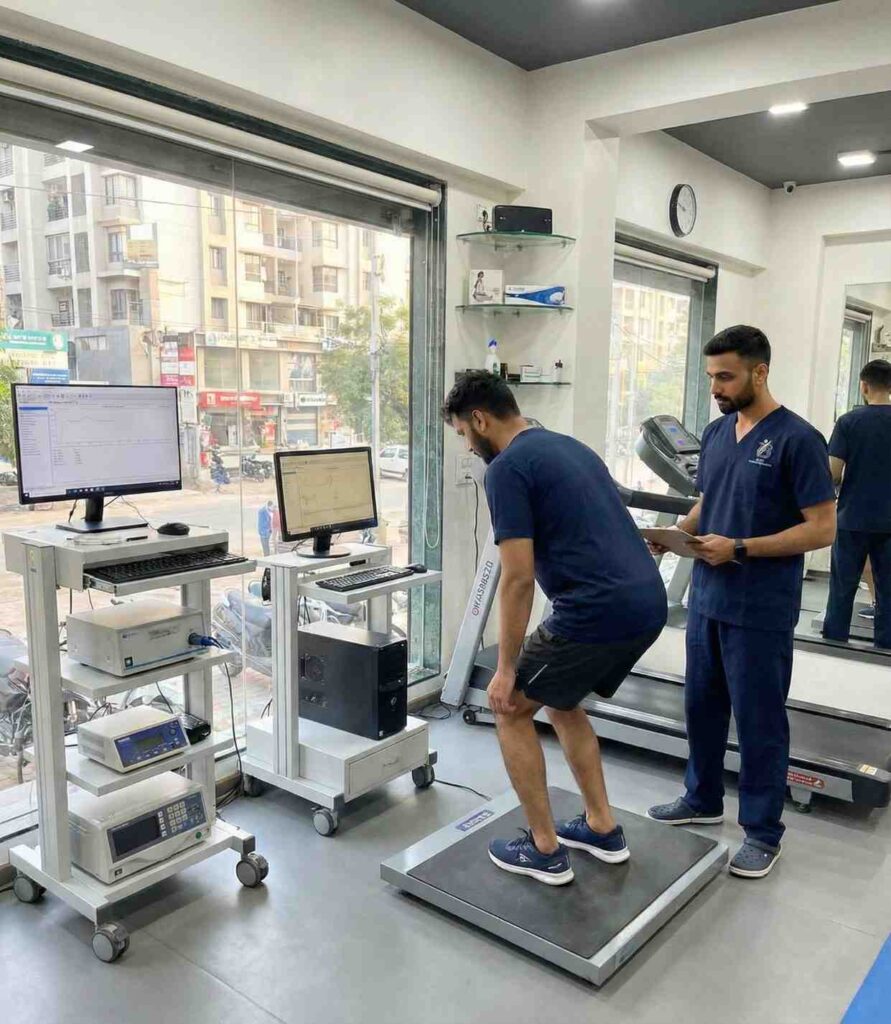
At our Best physiotherapy clinic in Bopal, we run these tests in a structured session. We give you a clear, honest result. We do not clear you based on how good you feel. We clear you based on what the numbers show.
If you pass — you begin a 2 to 4 week return-to-sport program. This means training with your team, but not full match intensity. Then full return.
If you do not pass — we continue targeted training until you do. Most patients reach clearance by Month 8 to 9.
ACL and Meniscus Surgery Recovery Timeline: When Both Are Injured
Many ACL tears also damage the meniscus — the cushioning cartilage in the knee. When both are repaired during knee surgery, the recovery timeline is longer.
A combined ACL and meniscus surgery recovery timeline typically runs 12 to 14 months before full competitive return. The meniscus repair adds 6 to 10 weeks of restricted activity early on.
Key differences if you had meniscus repair:
- No deep bending of the knee for 4 to 6 weeks
- No squatting past 90 degrees until Month 3
- Running is delayed to Month 4 or later
- Return to sport testing shifts to Month 9 or later
If your surgeon repaired a meniscus, ask specifically about these restrictions. They are different from ACL-only rehab. Failing to respect them can cause the meniscus repair to fail.
The good news: with proper rehabilitation following anterior cruciate ligament and meniscus surgery, most patients return to full activity. The outcome is very similar to ACL-only surgery — it just takes more time.
Bad Signs After ACL Surgery: What Should Concern You
Most discomfort after ACL surgery is normal. But some signs need immediate attention.
Contact your doctor or physiotherapist if you notice:
- Sudden new swelling that does not reduce with ice and rest
- Fever above 38°C (could indicate infection)
- Redness, warmth, or streaks around the incision site
- A feeling that the knee “gave way” again — especially in the first 3 months
- Sharp pain during an exercise that was previously comfortable
- Numbness or tingling in the foot
These are not signs of normal healing. They are signs that something may need medical review. Do not wait and see. Contact your care team.
Two years after surgery, the ACL graft is its strongest. But failure of an ACL reconstruction can happen — especially if return to sport happens too early, or if a new injury occurs. Protecting your recovery is the best insurance against this.
How Long Does Full ACL Recovery Take? The Honest Answer
Full recovery from an ACL injury — meaning you feel 100% and perform at your pre-injury level — takes most athletes 12 to 18 months. Some studies show that at two years after surgery, outcomes are better than at 6 months. The graft matures. Confidence returns. Muscle memory rebuilds.
Factors that affect ACL injury recovery time:
- Age: Younger athletes tend to heal faster but re-injure more often (they return to sport sooner)
- Pre-injury fitness: The fitter you were before, the faster you recover
- Meniscus involvement: Adds 2–4 months to the timeline
- Adherence to rehab: Patients who attend every session recover faster — no exception
- Sport demands: High-impact, multi-directional sports (kabaddi, football) need longer preparation than straight-line sports
If you want to return to sport at the same level — or higher — give yourself the full timeline. The athletes who rush are the ones who re-tear.
Conclusion: Your ACL Recovery Starts With the Right Team
ACL surgery is the beginning — not the end. The real recovery happens in the weeks and months of physiotherapy that follow. Follow your ACL rehabilitation timeline faithfully. Do not skip phases. Do not return to sport until you pass the tests.
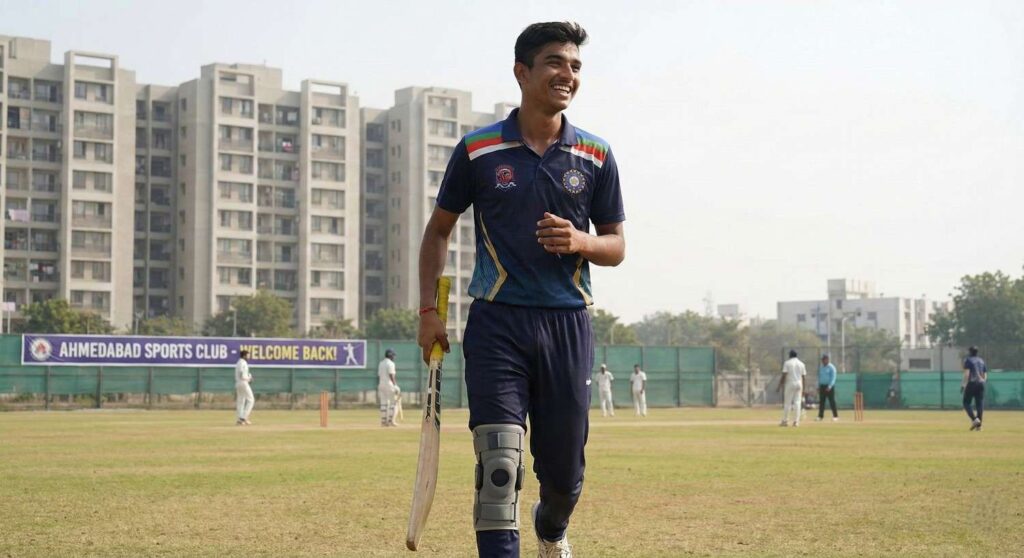
Every athlete in Bopal and across Ahmedabad who has gone through this process and done the work has come out the other side. Cricket players have returned to bowl. Footballers have returned to the pitch. Runners have returned to the track.
You can too. But it starts with the right support.
Book your ACL rehabilitation assessment at our Best Physiotherapy clinic in Bopal, Ahmedabad today. We will build a recovery plan specific to your injury, your sport, and your goals.
Frequently asked question
Most people need 9 to 12 months for full recovery after ACL surgery. Return to basic sport can happen at 6 months if you pass return-to-sport testing. Competitive athletes and those with meniscus repairs often need 12 to 18 months. Full recovery — feeling 100% — is often seen closer to 18 to 24 months.
Yes. Your physiotherapist should provide a written plan. Generic PDF protocols exist online but they do not account for your specific graft type, meniscus status, or sport demands. Ask our team in Bopal for a personalised written protocol at your first session.
At 6 months, exercises include sport-specific agility drills, plyometric jumps, single-leg strength work, and full running. But only if you have passed strength and hop tests. If not cleared yet, continue Phase 4 exercises under physiotherapist guidance.
Watch for sudden new swelling, fever, redness at the incision, a feeling the knee gave way again, or sharp pain during exercises that were previously comfortable. Report any of these to your doctor or physiotherapist immediately.
Yes — most athletes return to full sport and feel completely normal. Studies consistently show that patients who complete the full ACL rehabilitation program return to pre-injury performance levels. At two years post-surgery, outcomes are often even better than at 6 or 9 months.
Attend every physio session without skipping. Do your home exercises daily. Control swelling with ice in the early weeks. Eat enough protein to support muscle repair. Sleep 7 to 9 hours — recovery happens during sleep. Do not return to sport early; this is the single most common cause of re-injury.
Yes, but timing varies by leg and surgeon approval—typically 4-6 weeks for right knee (manual vehicles) if you pass a brake test without pain/swelling. For left knee automatics, often 2-4 weeks. Focus on full knee extension, no narcotics impairing reflexes, and safe emergency stops. In Bopal traffic, prioritize physio clearance to avoid knee strain. Pre-op fitness speeds this; consult your Ahmedabad clinic before attempting. Driving too early risks graft stress—wait for normal gait on tests.
Prehab (pre-surgical rehab) is 2-6 weeks of physio before ACL reconstruction to optimize outcomes. It reduces swelling, restores full extension, strengthens quads/glutes (preventing atrophy), and improves post-op pain/mobility. Studies show prehab patients regain strength 50% faster and return to sport sooner. In Bopal, start with quad sets, heel slides, and bike work—aim for 80-90% quad symmetry. It's like priming your knee for surgery; skip it and recovery drags. Book a session at our Best Physiotherapy clinic in Bopal for a customized plan matching your cricket/football needs.
Light jogging typically begins Month 3 (12 weeks) if cleared: no swelling, 90% quad strength, full motion, and pain-free walk. Progress to straight-line running by Month 4, then intervals. Avoid pivoting until Month 5+. In Ahmedabad heat, monitor post-run swelling—ice if needed. Poor quad activation delays this; use straight-leg raises early. Research: Early running risks graft overload, but phased progression cuts re-injury by 30%. Get hop test clearance first at Bopal physio.
Our Best physiotherapy clinic in Bopal, Ahmedabad offers a complete, science-based ACL rehabilitation program. We use objective return-to-sport testing, personalised exercise protocols, and regular progress reviews. Book your consultation today to start your recovery with a clear plan.