

Do you feel a terrifying, uncontrollable spinning sensation when you turn your head, roll over in bed, or look up to grab something from a shelf? Navigating the busy streets of Bopal, crossing the SP Ring Road, or simply managing daily life in South Bopal becomes an exhausting challenge when the world suddenly violently tilts around you. It is a profoundly disorienting condition that severely limits your independence and instills a constant fear of falling.
Most people mistakenly believe that vertigo is simply another word for generalized dizziness, lightheadedness, or physical weakness. It is emphatically not. Because of this widespread medical misconception, the vast majority of patients seek out the wrong type of treatment. They take suppressive medications and rest at home, hoping the spinning will eventually fade away on its own. Unsurprisingly, the intense spinning inevitably returns the moment they move their head. If you are actively searching for vertigo treatment physiotherapy Ahmedabad, you need to know that the real solution lies in mechanical correction, not just symptom management. This comprehensive guide will explain exactly why this spinning occurs, why pills alone fail to fix the root cause, and how targeted, hands-on physical therapy at our Bopal clinic provides a scientifically backed, structural solution to get your life back.
What actually causes vertigo — and why most people get it wrong
To properly fix a problem, you must first deeply understand exactly what is broken. When patients arrive at our clinic from neighboring areas like Ghuma, Ambli, or Shela complaining of severe dizziness, they often bring a list of suspected causes: low blood pressure, stress, cervical spondylosis, or general fatigue. While these conditions can certainly cause lightheadedness, true vertigo—the distinct, undeniable illusion that you or the room around you is physically spinning—is almost always caused by a mechanical fault inside your inner ear.
Understanding BPPV (Benign Paroxysmal Positional Vertigo)
The most common culprit behind this intense spinning sensation is a specific condition known as BPPV. BPPV stands for Benign (not life-threatening or malignant), Paroxysmal (occurring in sudden, short spells), Positional (triggered exclusively by specific head movements), and Vertigo (a false sense of rotational spinning).
To truly grasp BPPV, we must look at the remarkable, microscopic anatomy of your inner ear. Deep inside your skull lies the vestibular system, a complex network of fluid-filled tubes known as the semicircular canals. These canals act exactly like the biological gyroscope of your body. They tell your brain precisely where your head is in space—whether you are looking up at the sky, looking down at your phone, or tilting your head to the side.
In a neighboring anatomical structure of the inner ear (called the utricle), there are microscopic calcium carbonate crystals called otoconia. Think of these crystals as tiny, heavy weights that help you sense gravity and linear acceleration. Under normal, healthy circumstances, these crystals are firmly embedded in a specialized gel-like membrane. However, due to the natural aging process, a sudden head injury, a severe viral infection, or sometimes for no identifiable reason at all, these tiny crystals can break loose from their gel anchor.
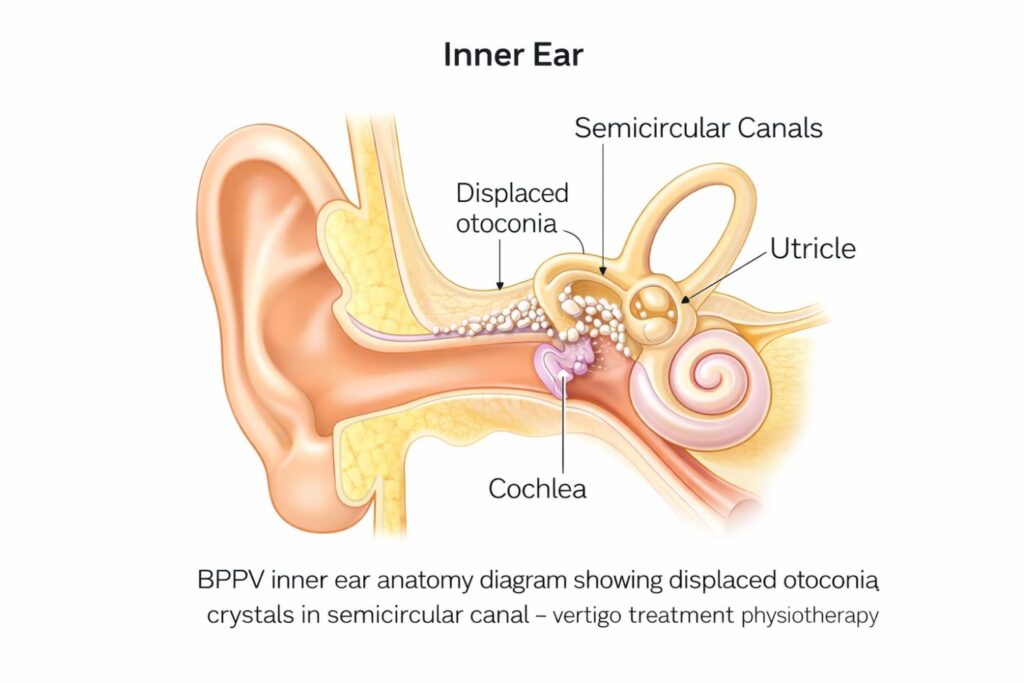
The "Snow Globe" Mechanism of Spinning
When these calcium crystals break free, they migrate into the fluid-filled semicircular canals where they absolutely do not belong. Imagine your inner ear is a small, fluid-filled snow globe. When your head is perfectly still, the displaced crystals settle at the bottom of the canal, and you feel entirely fine. But the precise moment you roll over in bed, sit up quickly, or tilt your head back to wash your hair, you violently shake that snow globe.
The loose crystals violently tumble through the heavy fluid of the canal. This creates an abnormal, artificial fluid wave that bends the highly sensitive nerve endings (hair cells) inside your ear. Your ear immediately fires a massive panic signal to your brain, screaming, “We are spinning at high speed!” Meanwhile, your eyes are looking at a stationary bedroom wall, sending the exact opposite, conflicting signal: “We are perfectly still.”
Your brain simply cannot reconcile these two drastically conflicting sensory signals. The neurological result? Severe, nausea-inducing vertigo. This is a purely mechanical, anatomical plumbing problem. It is not in your imagination, it is not caused by stress, and it unequivocally requires a physical, biomechanical intervention to correct the root cause.
Why ENT medication and rest alone don't fix BPPV
When the terrifying spinning starts, the first instinct for most people across Ahmedabad is to visit a general physician, an Ear, Nose, and Throat (ENT) specialist, or a neurologist. Typically, the patient is evaluated, prescribed vestibular suppressants—medications such as Meclizine, Betahistine, Cinnarizine, or various anti-nausea tablets—and advised to go home and rest strictly.
While this standard medical approach comes from a genuine place of wanting to reduce acute patient suffering, it fundamentally misunderstands the physical, mechanical nature of BPPV. Relying solely on medication for BPPV is one of the most significant roadblocks to actual, lasting recovery.
The Illusion of Medication in Mechanical Disorders
It is vital to understand that vestibular suppressants do not interact with your inner ear crystals in any way. They do not dissolve the calcium deposits, nor do they magically float the displaced crystals back to their proper home. Instead, these medications work entirely by heavily sedating your central nervous system. They dull your brain\’s ability to process the chaotic, conflicting signals coming from your affected inner ear.
Think of it like discovering a massive water leak in your kitchen. Taking medication for BPPV is the direct equivalent of simply turning off the kitchen lights and putting on a blindfold so you do not have to look at the flooding water. You might feel slightly less anxious because you can no longer see the mess, but the pipe is still violently broken, and the room is still actively flooding. The crystals are still trapped in the wrong canal. The very moment you stop taking the sedating medication, the brain “wakes up,” senses the displaced crystals once again, and the aggressive spinning returns instantly. Masking symptoms is not healthcare; it is temporary avoidance.

The Severe Dangers of Prolonged Bed Rest
Furthermore, the common advice to “just stay in bed and avoid moving your head” is highly detrimental to your long-term vestibular health. The human balance system relies on constant, varied movement to stay sharp and calibrated. When a patient avoids head movements out of an intense fear of triggering vertigo, they undergo rapid vestibular deconditioning. Their brain literally forgets how to process normal spatial movements accurately.
Over weeks and months, this fear-avoidance behavior transforms a relatively simple mechanical ear problem into chronic, daily unsteadiness and a highly elevated risk of dangerous falls. This is especially critical for our senior patients in Bopal, where a fall can lead to severe fractures. If you are concerned about fall risks in older family members, please review our comprehensive guide on Specialized Rehabilitation for vertigo and elderly care.
Vertigo Treatment Physiotherapy Ahmedabad: How hands-on physiotherapy (Epley Manoeuvre) resets your inner ear
If chemical medication cannot fix a mechanical crystal displacement, what actually works? The definitive answer is targeted, biomechanical repositioning. Because BPPV is a purely physical problem governed by the laws of gravity, it requires a purely physical solution governed by gravity. This is where highly trained, hands-on vertigo treatment physiotherapy Ahmedabad fundamentally changes the trajectory of a patient’s recovery, offering a true path to healing rather than lifelong management.
The Biomechanics of the Epley Manoeuvre
The most highly validated, universally recognized evidence-based treatment for the most common form of BPPV (posterior canalithiasis) is the Epley Manoeuvre. This is not a massage or a generic stretch; it is a highly specific, hands-on clinical procedure performed exclusively by a specially trained vestibular physiotherapist. At Best Physiotherapy Clinic bopal, this procedure is performed by Dr. Sagar and Dr. Kaniya, who are among Ahmedabad’s few physiotherapists with advanced vestibular rehabilitation certification.
The fundamental goal of the Epley Manoeuvre is elegantly simple yet clinically profound: we precisely utilize the natural force of gravity to gently flush the loose calcium crystals out of the sensitive semicircular canal and drop them safely back into the utricle. Once in the utricle, they are reabsorbed and can no longer cause the violent dizziness.
The Step-by-Step Repositioning Process
During a dedicated session at our clinic, our vestibular specialist will carefully guide your head and body through a highly precise series of four primary positions. Each specific position is held for 30 to 60 seconds—this pause is absolutely crucial as it allows enough time for the heavy crystals to settle at the lowest point of the ear canal before moving to the next strategic step.
- The Initial Provocation Drop: You sit upright on the clinical treatment bed. The physiotherapist gently turns your head 45 degrees toward the affected ear, and you are rapidly—but entirely safely—laid back so your head hangs slightly over the edge of the bed. This initial drop often provokes a brief, intense burst of vertigo as the crystals begin to move along the canal.
- The First Rotation: After the acute spinning stops entirely, the therapist carefully rotates your head 90 degrees to the opposite side, stopping at a precise 45-degree angle. This crucial step navigates the crystals further around the circular curve of the inner ear canal.
- The Body Roll: You are then instructed to roll your entire body onto your side, matching the exact direction of your head. Your face ends up pointing downward toward the clinic floor. This step essentially uses gravity to push the crystals toward the final exit point of the canal.
- The Safe Return: Finally, you are assisted into a seated position with your chin tucked slightly down. Gravity drops the crystals through the final anatomical opening and safely back into the utricle, where they are rendered harmless.
The entire clinical procedure takes less than 15 minutes to execute. It requires no needles, no risky surgery, and no invasive scanning machinery. When performed correctly by a trained professional, it effectively resolves the mechanical root cause of BPPV in up to 80-90% of all clinical cases within just one to three focused treatment sessions. This is the absolute definition of true, effective, evidence-based care.
What a vertigo physiotherapy session looks like at our Bopal clinic
We intimately understand that coming in for a physical therapy session when you feel as though the world is violently spinning around you requires immense courage. You may be anxious about the car ride to our clinic or fearful of falling in the waiting room. We have meticulously designed our clinical environment at the Best Physiotherapy Clinic Bopal to be as calm, reassuring, and structurally safe as possible for dizzy patients.
The Comprehensive Clinical Interview
Our vestibular specialists, Dr. Sagar and Dr. Kaniya, operate on a simple principle: we never guess; we comprehensively assess. Both hold advanced post-graduate certification in Vestibular Rehabilitation Therapy. Your very first session begins with a deep-dive conversation regarding your symptoms. We need to know the exact biomechanical movements that trigger your vertigo. Does it happen exclusively when you roll over to your right side in bed? Does it hit you when you bend down to pick up groceries or tie your shoes? We also conduct a thorough, rigorous review of your past medical history to rule out any “red flag” neurological conditions (like strokes or tumors) that can mimic vertigo, ensuring that you are completely, undeniably safe to proceed with hands-on physical treatment.
Oculomotor Testing and The Dix-Hallpike Assessment
Before we manipulate the inner ear, we carefully examine how your brain and eyes track movement. Because the inner ear is directly, neurologically wired to your eye muscles via the Vestibulo-Ocular Reflex (VOR), the specific way your eyes twitch and jump during an episode of vertigo gives our experts an exact, real-time roadmap of what is happening deep inside your skull.
To definitively confirm BPPV, we perform a gold-standard diagnostic test called the Dix-Hallpike maneuver. We safely and carefully lower you backward on our padded treatment table and observe your eyes for a specific, involuntary, rhythmic jumping movement known as nystagmus. The exact direction your eyes jump (whether they beat upward, downward, or in a twisting rotational pattern) tells our vestibular physiotherapists exactly which of the six semicircular canals the loose crystals are trapped inside. Once we pinpoint the precise location of the crystal debris, we instantly transition into the correct hands-on repositioning maneuver to fix the root cause.
We must stress this strongly: we urgently advise against attempting these maneuvers at home by following random YouTube videos without a proper clinical diagnosis. Performing the wrong repositioning maneuver for the wrong ear canal can easily force the crystals deeper into the ear structure, making the vertigo significantly more violent, prolonged, and difficult to treat later. Always trust your specialized care to professionals who are dedicated to providing evidence-based physiotherapy in Bopal.
Our 4-week vestibular rehabilitation plan for Ahmedabad patients
While expert repositioning maneuvers like the Epley successfully and quickly remove the offending crystals, the brain almost always needs dedicated time to recalibrate after a severe, traumatic bout of vertigo. Your inner ear has been bombarding your brain with chaotic, terrifying signals for days or even weeks. This sensory trauma leaves many patients feeling subtly “off-balance,” foggy-headed, or unsteadily “walking on a boat” even after the violent rotational spinning has been fully stopped.
To guarantee a full functional recovery, completely eliminate this residual fogginess, and drastically prevent future relapses, we implement a highly comprehensive, structured vestibular rehabilitation therapy (VRT) program. Here is the rigorous, highly effective recovery timeline our local patients follow to regain their total independence:
| Phase of Recovery Plan | Clinical Focus & Physiotherapy Interventions | Expected Patient Outcome & Relief |
|---|---|---|
| Week 1: Mechanical Repositioning & Acute Control | Precise application of specific Canalith Repositioning Maneuvers (such as the Epley, Semont, or Lempert roll) tailored exclusively to the affected canal. Instruction on strict, safe sleeping postures to prevent immediate crystal dislodgment in the first 48 hours. | Total eradication of the acute, violent “room-spinning” sensation. A profound, immediate reduction in severe nausea and vomiting. |
| Week 2: Gaze Stabilization & Neural Retraining | Introduction of targeted Vestibulo-Ocular Reflex (VOR) exercises. Patients practice keeping their eyes sharply fixed on a stationary target (like a letter on the wall) while gently and continuously moving their head side-to-side and up-and-down. | Complete elimination of visual blurring, dizziness, or fogginess when turning the head quickly while walking down the street or driving a car. |
| Week 3: Habituation & Desensitization Training | Controlled, systematic, and repeated exposure to the specific daily movements that previously caused mild residual dizziness. This clinical technique forces the central nervous system to adapt and permanently ignore residual abnormal sensory signals. | Restored confidence in seamlessly performing daily household tasks like bending over to load the washing machine, reaching for high pantry shelves, and comfortably rolling over in bed without fear. |
| Week 4: Functional Balance, Gait & Relapse Prevention | Advanced proprioceptive and dynamic training. Walking on uneven surfaces (like thick foam pads), safely navigating physical obstacles, and performing complex dual-task exercises (e.g., walking while simultaneously turning the head and talking). | Full, robust restoration of dynamic physical balance, a profound and lasting reduction in fall risk, and a confident, secure return to normal, active, independent living. |
This structured, scientifically rigorous recovery timeline ensures that we do not just temporarily stop the spinning; we completely, permanently rebuild the structural integrity and resilience of your entire balance system.
Book a free vertigo assessment at Best Physiotherapy Clinic Bopal
Living day after day with unresolved BPPV is physically exhausting, emotionally stressful, and entirely medically unnecessary. You do not have to accept severe dizziness as your “new normal,” you do not have to sacrifice your independence, and you certainly do not have to spend weeks heavily sedated on medications that only mask a structural, mechanical problem.
Who Should Book an Assessment Immediately?
You should contact our highly specialized Bopal clinic for a comprehensive vestibular evaluation right now if you are actively experiencing any of the following symptoms:
- A powerful, short-lasting (typically less than one minute) spinning sensation when you roll over in bed, sit up quickly, or get out of bed in the morning.
- Sharp dizziness specifically triggered by tilting your head backward in the shower or when leaning back at the salon sink.
- A persistent, lingering sense of unsteadiness, floating, or feeling like you are “walking on a boat” in the hours or days following a severe bout of vertigo.
- You have previously visited a doctor and been prescribed vestibular suppressants, but the frustrating dizziness returns with full force the moment you stop taking the pills.
Important Clinical Safety Note: While BPPV is incredibly common and highly treatable with hands-on physiotherapy, dizziness can occasionally be a warning sign of a more serious, acute neurological condition. If your vertigo is suddenly accompanied by total or partial hearing loss, severe “thunderclap” headaches, difficulty speaking or slurring words, numbness or weakness in your face or limbs, or double vision, please bypass the clinic and seek immediate emergency medical care at the nearest hospital.
If your symptoms point squarely to an inner ear mechanical imbalance, Dr. Sagar and Dr. Kaniya, our dedicated vestibular specialists, are ready to step in and help . Our clinical specialists utilize strictly evidence-based protocols to diagnose the root cause with pinpoint accuracy and deliver precise, hands-on treatment that actually works. Stop waiting anxiously in bed for the spinning to magically disappear on its own. Take decisive control of your balance, your mobility, and your life.
We are conveniently, centrally located for residents across Bopal, South Bopal, Ghuma, Ambli, Shela, and the wider Ahmedabad area, offering the region’s premier, science-backed vestibular rehabilitation program meticulously tailored to your specific, individual recovery needs.
Frequently asked question
General physiotherapy most often focuses on rehabilitating muscles, joints, ligaments, and recovering from orthopaedic sports injuries. Vestibular rehabilitation, however, is a highly specialized, niche sub-field of physical therapy. It focuses entirely on treating the complex neurological and biomechanical relationship between your inner ear structures, your eyes, and your brain's balance centers. It requires highly specific advanced training to accurately perform complex diagnostic tests like the Dix-Hallpike and safely execute precise canalith repositioning maneuvers without causing further harm.
The physical maneuver itself does not cause any structural pain in your neck, spine, or ear. However, it is explicitly designed to shift the problematic crystals, which will inevitably and temporarily trigger the exact same severe vertigo sensation you have been experiencing at home. This intense spinning usually lasts for about 10 to 30 seconds during the clinical procedure. While it is momentarily uncomfortable and scary, this brief burst of intense vertigo is actually a highly positive clinical sign—it confirms to our therapists that we are successfully and accurately moving the problematic crystals completely out of the canal.
Because BPPV is fundamentally a mechanical issue involving loose calcium crystals, it is unfortunately possible to experience a recurrence later in life—especially as we age and the delicate gel holding the crystals naturally degrades and weakens over time. However, patients who diligently complete a full, rigorous 4-week vestibular rehabilitation program have a significantly, measurably lower recurrence rate because their brain and balance systems are highly conditioned and resilient. Furthermore, once you truly understand what BPPV is, you can return to our Bopal clinic immediately at the first sign of trouble for a fast, 15-minute repositioning fix, rather than suffering silently in bed for weeks.
You should absolutely never abruptly stop taking prescribed medication without directly consulting your primary doctor or ENT specialist first. However, it is important to know that vestibular suppressants heavily sedate the inner ear and can chemically mask the specific eye movements (nystagmus) that our physiotherapists rely on to diagnose exactly which ear canal is currently affected. When you book your appointment at our clinic, our clinical team will provide you with specific, safe guidelines regarding your medication timing to ensure your hands-on assessment is as accurate, effective, and revealing as possible.
Yes, vertigo treatment physiotherapy Ahmedabad can permanently resolve BPPV in the majority of patients. Unlike medication that only masks symptoms temporarily, hands-on canalith repositioning maneuvers like the Epley physically correct the mechanical root cause — displaced calcium crystals in your inner ear. Once these crystals are guided back into the utricle, they are reabsorbed by the body and can no longer trigger spinning. Studies consistently show 80–90% of BPPV cases resolve within 1–3 physiotherapy sessions. While recurrence is possible with age, completing a full vestibular rehabilitation program significantly reduces that risk long-term.
At a specialized physiotherapy clinic in Bopal, BPPV is diagnosed using the gold-standard Dix-Hallpike test — no MRI or blood tests required. Your physiotherapist carefully lowers you backward on a treatment table while turning your head at a precise angle toward the suspected ear. They then observe your eyes for nystagmus, an involuntary rhythmic jumping movement. The exact direction of the nystagmus tells the vestibular specialist precisely which semicircular canal contains the loose crystals. This clinical diagnosis takes under 5 minutes and immediately guides which repositioning maneuver — Epley, Semont, or Lempert — is most appropriate for your specific case.
Vestibular rehabilitation physiotherapy is not only safe for elderly patients in Ahmedabad — it is one of the most critically important treatments for seniors. Falls are among the leading causes of serious injury in older adults, and untreated BPPV dramatically increases that risk. At a specialized Bopal clinic, therapists modify repositioning maneuvers to accommodate neck stiffness, limited mobility, or osteoporosis. The entire program is supervised one-on-one, ensuring no patient moves unsupported. In fact, completing vestibular rehabilitation significantly reduces fall risk in seniors by retraining the brain's balance responses — making it both the safest and most effective intervention available for elderly vertigo patients.
The number of sessions needed for vertigo treatment physiotherapy in Bopal depends entirely on your diagnosis. For straightforward BPPV — the most common cause of vertigo — most patients experience complete resolution of spinning within 1 to 3 sessions of canalith repositioning. However, if you also experience residual fogginess, unsteadiness, or have had chronic vertigo for weeks, a structured 4-week vestibular rehabilitation program is recommended. This rebuilds your brain's balance processing, eliminates lingering dizziness, and prevents future relapses. Complex conditions like vestibular neuritis or post-concussion dizziness may require 6–8 weeks of progressive gaze stability and habituation exercises.
This is one of the most common diagnostic confusions seen at physiotherapy clinics in Ahmedabad. True vertigo — caused by BPPV — produces an intense, brief spinning sensation triggered exclusively by specific head positions, such as rolling over in bed or looking upward. It originates entirely from a mechanical fault inside the inner ear. Cervical spondylosis dizziness, on the other hand, produces a more constant, dull lightheadedness or neck-related unsteadiness triggered by sustained poor posture or prolonged sitting. It originates from faulty proprioceptive signals in tight cervical muscles. A trained vestibular physiotherapist will perform specific clinical tests to accurately differentiate between the two and prescribe the correct treatment.
Stress and anxiety can cause dizziness, lightheadedness, and a floating sensation — but they do not produce the same intense, rotational spinning that characterizes true BPPV vertigo. BPPV spinning is always brief (under 60 seconds), always triggered by specific head movements, and always linked to a mechanical inner ear fault. Stress-related dizziness tends to be constant, non-positional, and accompanied by other anxiety symptoms like a racing heart or breathlessness. However, unresolved BPPV frequently causes secondary anxiety because the unpredictable spinning creates a constant fear of falling. Vertigo treatment physiotherapy Ahmedabad addresses both — resolving the mechanical root cause naturally reduces the associated anxiety significantly.