
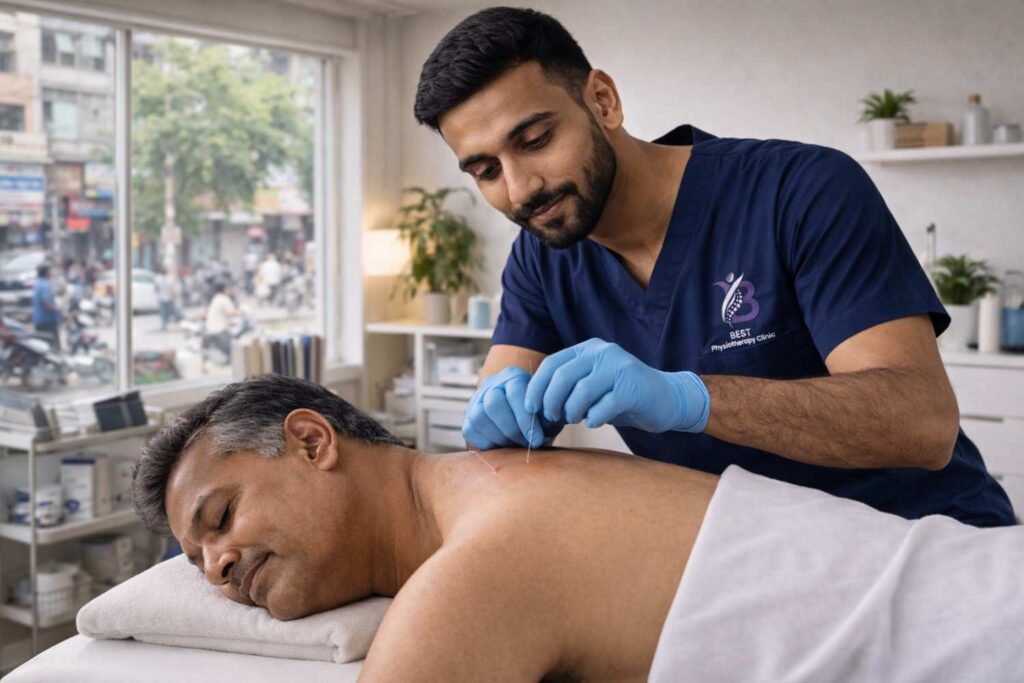
You pull your neck every morning. Your lower back aches after sitting at a desk all day. You have tried painkillers, hot bags, and rest. Nothing lasts.
Many people across Bopal and Ahmedabad are now turning to dry needling therapy — a precise, drug-free treatment that targets the exact source of muscle pain. But most people do not know what it actually is, whether it hurts, or if it is safe.
This guide to dry needling answers all of that. We will explain the science, the process, the risks, and what you can realistically expect. No jargon. No fluff.
Why Bopal Residents Are Choosing This Therapy
We see a specific pattern in our clinic near South Bopal and Sun City. Many of our patients are IT professionals commuting to SG Highway or business owners driving along the SP Ring Road. That specific driving posture creates chronic “upper trap” tightness — shoulder knots that build up over months of Ahmedabad traffic.
Dry needling is uniquely effective for this “commuter’s neck.” Unlike massage, which works the surface, the needle releases the deep tension that hours behind a steering wheel create.
Dry Needling Explained: What the Needle Is, What "Dry" Means, and Why It Is Called That
Let us start with the name itself, because it confuses almost everyone.
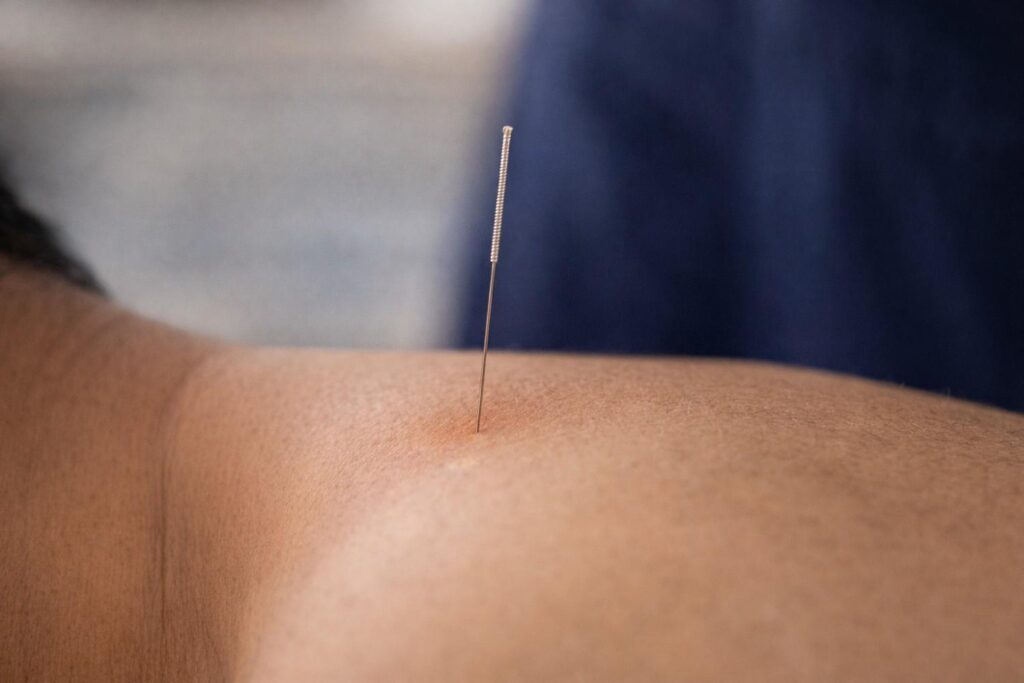
A needle used in dry needling is called a filament needle. It is extremely thin — about the width of a human hair. It has no hole at the tip, which means it cannot inject or draw out any fluid. That is the entire reason it is called dry needling. The needle is dry. It carries nothing in or out.
Compare this to a standard injection, which is called wet needling because it delivers a liquid — medicine, saline, or local anaesthetic — into the tissue. Dry needling delivers nothing chemical. The needle itself is the tool.
This distinction matters because many people assume the treatment involves a drug. It does not. The healing comes entirely from your body’s own response to the needle’s presence. Think of it like pressing a reset button on an overworked muscle — the needle creates a precise, controlled stimulus, and your nervous system does the rest.
The filament needle is sterile, individually packaged, and used only once. It is then disposed of safely. This is standard practice in every certified clinic.
One more common question: is dry needling the same as acupuncture? They use the same type of needle, which is why people confuse them. But the philosophy, targets, and training are completely different. We will cover that comparison in its own section below.
How Dry Needling Works: Trigger Points, the Local Twitch Response, and the Biology of Pain Relief
Understanding how dry needling works requires understanding what a trigger point is.
A trigger point is a tight, hypersensitive knot inside a muscle. You have likely felt one — a small, tender lump in your neck or shoulder that hurts when you press it. Sometimes it sends pain to another part of the body entirely. A trigger point in your neck, for example, can cause headaches. A trigger point in your lower back can send pain down your leg.
Trigger points form when a muscle is overloaded, injured, or held in one position for too long. Sitting at a computer, repetitive movement in a sport, or carrying heavy loads all create them. The muscle fibers in that area become stuck in a shortened state. Blood flow to the area drops. Waste products build up. The knot gets tighter. The pain gets worse.
This is where the needle comes in.
When the needle is inserted directly into a myofascial trigger point, the muscle responds with an involuntary contraction called a local twitch response. You will feel a brief, sudden cramp or zing. This is actually a good sign. Research consistently shows that eliciting a local twitch response is linked to better pain outcomes.
After the twitch, the muscle fiber relaxes. Blood flow returns to the area. Waste products clear out. The nerve signals that were stuck on “high alert” begin to normalize. This is the core of how dry needling works — it breaks the cycle of tension, poor circulation, and pain.
A systematic review and meta-analysis of dry needling for musculoskeletal conditions concluded that this mechanism produces measurable, clinically significant reductions in pain and improvements in function. It is not placebo. The biology is real.
The Technique: Superficial vs. Deep, Types of Needling, and What Your Therapist Actually Does
Not all dry needling is the same. The term covers several needling techniques, and the right one depends on your specific condition, pain level, and the depth of the trigger point.
Superficial dry needling involves inserting the needle just below the skin — only a few millimetres deep. It does not reach the muscle belly directly. Instead, it works through the nerve endings in the connective tissue. This approach is gentler. It suits patients who are sensitive, new to the treatment, or who have conditions where deeper penetration is not appropriate.
Deep dry needling targets the trigger point inside the muscle itself. The needle is inserted further to directly stimulate the tight fibers and elicit the local twitch response described above. This is the more common technique for musculoskeletal pain and is what most people receive in a standard session.
Research comparing superficial versus deep dry needling shows both are effective, but deep dry needling tends to produce faster results for chronic muscle pain.
Within these two categories, your therapist may use different needling techniques depending on what they find:
- Pistoning — moving the needle in and out quickly within the trigger point to cover a wider area of the knot.
- Static retention — inserting the needle and leaving it in place, allowing the tissue to respond slowly.
- Fan technique — redirecting the needle at different angles without fully removing it, covering a broader zone.
The needle used in dry needling is thin enough that these movements cause minimal discomfort. A skilled dry needling practitioner chooses the technique based on the muscle, its depth, and how reactive your trigger points are. What they do in your shoulder will differ from what they do in your calf.
The Benefits of Dry Needling: What Conditions It Can Treat and What the Research Shows
Dry needling is a therapeutic technique with a wide range of applications. The core benefit is pain relief — but the mechanism creates several downstream effects that matter for recovery.
What dry needling can treat:
- Chronic and acute back pain, including sciatica and herniated disc pain
- Neck pain and tension headaches from tight suboccipital muscles
- Frozen shoulder and rotator cuff injuries
- Tennis elbow and golfer’s elbow
- Knee pain, including pain from osteoarthritis and ligament strain
- Plantar fasciitis (heel pain)
- Sports injuries including muscle strains, Achilles tendinitis, and overuse syndromes
- Post-surgical stiffness and rehabilitation
The effects of dry needling extend beyond simple pain relief:
- Range of motion improves because tight muscles that restrict joint movement are released.
- Blood flow increases to the treated area, accelerating tissue repair.
- Central sensitization is reduced — the nervous system’s over-sensitivity to pain is dampened by the needle’s effect on pain-processing pathways in the spinal cord and brain.
- Muscle function normalizes — the muscle can contract and relax properly again.
One area where dry needling offers particularly strong results is chronic pain that has not responded to other treatments. Dry needling is a treatment, not just a symptom manager. It targets the cause — the trigger point — rather than masking the signal.
Dry needling as an adjunct to exercise therapy and manual physiotherapy consistently outperforms either treatment alone. The combination is now considered best practice for musculoskeletal conditions in evidence-based physiotherapy.
Dry Needling vs. Acupuncture: The Honest Comparison
This is one of the most searched questions about this treatment — and it deserves a direct, clear answer.
Both use the same type of thin filament needle. That is where the similarity ends.
Acupuncture comes from traditional Chinese medicine, a system over 2,000 years old. It is based on the concept of energy (“Qi”) flowing through invisible channels called meridians. The acupuncturist places needles at specific points along these meridians to restore energy balance. Acupuncture and dry needling share tools, not philosophy.
Dry needling is grounded in Western anatomy and pain science. There are no meridians. There is no energy theory. The needle goes into a muscle knot — a real, palpable, anatomically-defined structure — because research shows that is where the pain originates.
Does acupuncture work? For some conditions, yes — the research is genuinely mixed. But dry needling’s mechanism is more directly testable because its target (the trigger point) is a measurable physical object.
What about sham needling? In clinical trials, sham needling uses a retractable needle that appears to insert but does not penetrate the skin. Studies comparing dry needling vs. sham needling consistently show real dry needling produces significantly greater pain reduction. This confirms the effect is not purely placebo.
In practice: Some physiotherapists are also trained in acupuncture and may combine both. But if your problem is a tight, painful muscle knot, dry needling is the more targeted intervention. If you are looking for broader relaxation or energy-based wellness, acupuncture may suit you better.
Neither is a replacement for diagnosis and physiotherapy. They are tools in a larger treatment plan.
Does Dry Needling Hurt? The Honest Pain Scale
The Dry Needling Pain Scale (What It Really Feels Like)
Most patients at our Bopal clinic are surprised by how little it hurts. Here is the honest breakdown:
- Insertion (0–1/10): Like a mosquito bite. You might not even feel it.
- The “Twitch” (3/10): A sudden, quick cramp or “zing” that lasts less than a second. This is the good pain — it means the knot is releasing.
- During Treatment (0/10): Once the needle is placed, you usually feel nothing.
- Post-Session (2/10): Similar to “gym soreness” after a leg day. It fades within 24 hours.
The twitch is the part that surprises new patients most. It is involuntary — the muscle is reacting, not being damaged. Most people say it was far less painful than they expected after dreading it for weeks.
What to do after your session: Drink plenty of water. Do gentle stretching or a short walk. Avoid heavy exercise for 24 hours. The soreness means your body is in active repair mode — that is a good thing.
A dry needling session typically runs 20–30 minutes. The first session includes a full assessment. Subsequent sessions are faster. For most acute problems, 3–4 sessions are enough. For chronic conditions, 6–8 sessions is more realistic.
Is Dry Needling Safe? Real Risks, Rare Complications, and What "Safe" Actually Means
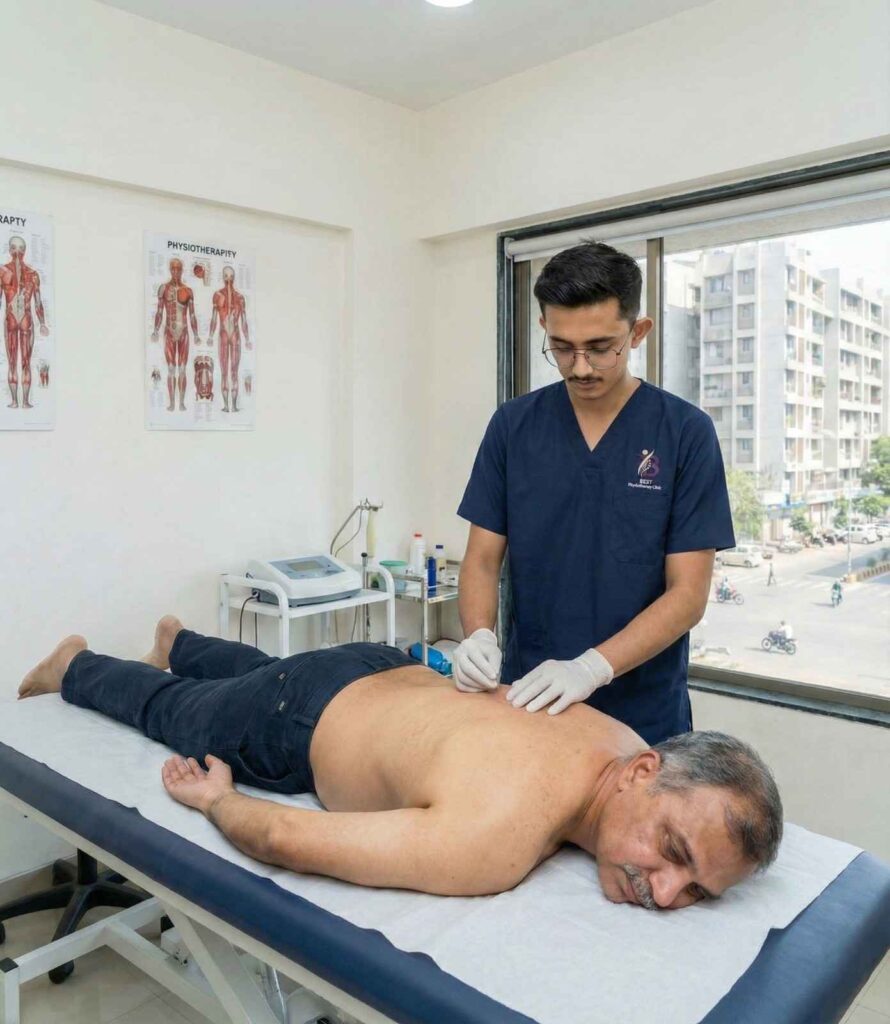
Dry needling is a safe treatment for most adults when performed by a trained, certified practitioner. That qualifier matters. The safety record of dry needling in clinical settings is excellent. But context is everything.
Common, minor side effects (expected and temporary):
- Muscle soreness for 24–48 hours
- Small bruise at the needle site
- Slight bleeding (a drop or two)
- Mild fatigue after a session
These are not signs something went wrong. They are normal tissue responses.
Rare but serious risks:
- Pneumothorax (dry needling collapsed lung): This occurs when a needle is inserted near the chest or upper back at the wrong angle, puncturing the lung lining. It is extremely rare and almost exclusively associated with improperly trained practitioners. Certified physiotherapists are trained specifically to avoid this.
- Nerve injury: If the needle touches a nerve rather than a muscle, you may feel sharp shooting pain, numbness, or tingling. This is rare. Tell your therapist immediately if it happens. It usually resolves quickly.
- Infection: Risk is near zero when sterile, single-use needles are used correctly.
Who should not get dry needling:
- Pregnant women (especially first trimester)
- Patients on blood-thinning medications (Warfarin, aspirin in high doses, etc.)
- People with severe needle phobia or anxiety
- Anyone with an active skin infection at the treatment site
- Patients with certain bleeding disorders
Following dry needling, if you experience prolonged sharp pain, significant swelling, fever, or chest discomfort, contact your therapist or a doctor immediately.
The key takeaway: dry needling is a safe, evidence-based treatment when you go to a qualified clinic. The risks people fear are mostly the result of unqualified practitioners, not the technique itself.
Who Can Practice Dry Needling? Qualifications, Legal Status in India, and How to Choose a Practitioner
Patient Safety Checklist: How to Verify Your Physiotherapist in Ahmedabad
Since dry needling requires specialized training, do not be afraid to ask your therapist these 3 questions before your session:
- “Are you a GSCPT-registered Physiotherapist?” (Gujarat State Council for Physiotherapy). This is the baseline qualification. No registration means no treatment.
- “Can I see your Dry Needling Certification?” It should be a post-graduate certificate from a recognized institution — not just a weekend workshop attendance slip.
- “Do you use single-use, sterile filament needles?” They should open the sealed packet in front of you. If they cannot show you this, leave.
At Best Physiotherapy Clinic Bopal, we are happy to show you our certifications and safety protocols before we even start. Your safety is non-negotiable.
Why this matters — and why the “illegal” question comes up
Dry needling is not outright illegal in India. But it exists in a regulatory grey area because there is no single national licensing body for the technique. The legal concern arises from unregistered practitioners performing the procedure without the required training — which is genuinely dangerous.
A qualified physiotherapist with recognized post-graduate certification in dry needling is legally permitted to practice it as part of physiotherapy treatment. That is the distinction. The checklist above helps you tell the difference quickly.
Physical therapists who practice dry needling within a broader physiotherapy plan — combining it with corrective exercise, manual therapy, and posture work — consistently get better results than those who offer it as a standalone “quick fix.” It is a tool in a plan, not a miracle in a needle. Meet our physiotherapy team in Bopal.
Is Dry Needling Right for You? Practical Guidance for Patients in Ahmedabad
Before booking a session, it helps to think through whether dry needling suits your specific situation.
Strong candidates for dry needling:
- You have had muscle pain for more than 4 weeks that has not fully resolved with rest or medication
- You can feel a specific “knot” or tender spot in the muscle
- Massage provides temporary relief but the tightness keeps returning
- You have been told by a doctor or physiotherapist that you have trigger points or myofascial pain
- You have a sports injury that is not healing at the expected rate
Less suitable candidates:
- Your pain is primarily joint-based (arthritis, for example) with no significant muscle component
- You have not yet had a proper diagnosis — dry needling should never replace a proper assessment
- You have a condition that contrainddicates needling (see the safety section above)
Is dry needling covered by health insurance in India?
Currently, most Indian health insurance policies do not cover physiotherapy procedures including dry needling unless the plan specifically includes outpatient physiotherapy benefits. Group policies through employers sometimes include partial physiotherapy coverage. It is worth checking your policy documents under “outpatient physiotherapy” or “allied health services.” If you are unsure, call your insurer directly and ask about coverage for physiotherapy treatment including dry needling.
What does dry needling cost compared to other treatments in Ahmedabad?
A single dry needling session at a certified clinic in Ahmedabad typically ranges from ₹800 to ₹1,500 depending on the clinic, the practitioner’s experience, and whether it is combined with other treatments. Compare this to repeated massage sessions, which may provide similar short-term relief without addressing the root trigger point. For chronic conditions, dry needling often resolves the issue in fewer total sessions than massage alone — making it cost-effective over time.
Comparison: Dry Needling vs. Massage vs. Injection in Ahmedabad
| Feature | Dry Needling | Deep Tissue Massage | Cortisone Injection |
|---|---|---|---|
| Best For | Specific muscle knots & trigger points | General muscle relaxation | Severe inflammation (joint pain) |
| Pain Level | Low (brief twitch) | Medium (sustained pressure) | High (needle sting) |
| Medicine Used? | No (Drug-Free) | No (Oil/Cream) | Yes (Steroids) |
| Time to Relief | Immediate to 24 hours | 1–2 days | 2–5 days |
Determine if dry needling is right for you by booking an initial assessment. A good physiotherapist will tell you if the technique suits your condition — and if it does not, they will recommend what does.
Conclusion
Dry needling therapy works by targeting the root of muscle pain — the trigger point — in a way that massage and medication often cannot reach. It is safe, drug-free, and backed by solid clinical research. The short discomfort of a session is small compared to weeks or months of chronic pain.
If you have been dealing with muscle pain that keeps coming back, it is worth finding out whether dry needling is the right step for you.
Book a physiotherapy assessment at our Best Physiotherapy clinic Bopal today. Our certified team will assess your condition, explain your options, and build a treatment plan that actually works — not just for now, but for the long term.
Frequently asked question
Dry needling therapy is highly effective for treating musculoskeletal pain caused by myofascial trigger points—tight, hypersensitive knots in your muscles. It is particularly good for resolving chronic "stuck" pain that massage cannot reach. Common conditions treated include chronic back pain, neck stiffness (often called "text neck" or "commuter's neck"), tension headaches, frozen shoulder, tennis elbow, and plantar fasciitis. It is also excellent for athletes dealing with muscle strains or overuse injuries. By releasing the deep muscle tension, it restores range of motion and reduces pain signals, allowing you to return to normal movement faster than with rest alone.
Most patients are surprised by how manageable the sensation is. The insertion of the thin filament needle typically feels like a tiny pinprick or mosquito bite—many patients don't feel it at all. The "pain" usually comes when the needle hits the trigger point, causing a "local twitch response." This feels like a sudden, deep cramp or a quick "zing" that lasts for less than a second. While it can be momentarily uncomfortable, it is a "good pain" that signals the knot is releasing. Post-treatment, you may feel a dull muscle soreness, similar to how you feel after a heavy gym workout, which fades within 24 hours.
When performed by a trained professional, side effects are minor and temporary. The most common effect is post-treatment soreness, which occurs in about 50% of patients and resolves within a day. You might also see small bruising at the needle site or feel mild fatigue immediately after the session. Serious risks like a pneumothorax (collapsed lung) or nerve injury are extremely rare and are almost exclusively associated with untrained or uncertified practitioners. At certified clinics like our Best Physiotherapy Clinic Bopal, we use strict safety protocols and anatomical mapping to ensure the needle never enters high-risk zones, making the procedure very safe.
While both techniques use the same thin, sterile filament needles, their philosophy and goals are completely different. Acupuncture is based on Traditional Chinese Medicine and focuses on balancing the body’s energy ("Qi") by placing needles along meridian lines. It is often used for systemic issues like stress or internal health. Dry needling is based on modern Western anatomy and neurophysiology. It purely targets "trigger points"—physical muscle knots that can be felt under the skin. A dry needling practitioner does not follow energy lines; they follow your anatomy to release specific tight muscles and improve blood flow to injured tissue.
Many patients feel a difference immediately after their first session—often describing a "release" in tension or an immediate improvement in range of motion. However, lasting pain relief usually builds up over time. For acute injuries (like a recent muscle strain), you may see significant results in just 2–3 sessions. For chronic conditions that have built up over years (like long-term back pain from sitting in Ahmedabad traffic), it typically takes 6–8 sessions to fully resolve the issue. Consistency is key; combining needling with the corrective exercises we prescribe ensures the pain doesn't just come back next month.
Dry needling exists in a regulatory grey area in India because there is no single national council specifically for "dry needling" alone. However, it is a recognized and legal part of advanced physiotherapy practice when performed by a qualified Physiotherapist. The key is certification. A registered Physiotherapist (with a GSCPT number in Gujarat) who has completed additional post-graduate certification in dry needling is legally permitted to perform the technique. It becomes "illegal" or dangerous only when performed by unregistered, untrained individuals (like gym trainers or uncertified healers) who do not have the medical knowledge to practice safely.
Nerve damage is a very rare complication, but it is a valid concern if you visit an unskilled practitioner. A trained physiotherapist knows the exact anatomy of nerves and arteries to avoid them. If a needle accidentally touches a nerve, you will feel a sharp, electric "shooting" sensation. In a professional setting, the therapist will immediately retract or reposition the needle, and any sensation usually disappears instantly. Permanent nerve damage is incredibly unlikely with standard safety protocols. This is why we emphasize checking your therapist’s credentials and ensuring they are a registered medical professional before starting treatment.
After a dry needling session, your muscles are in a state of recovery and repair. You should avoid heavy, high-intensity exercise (like heavy weightlifting or sprinting) for at least 24 hours. Do not apply ice immediately unless directed, as we want to encourage blood flow to the area, not restrict it. Avoid keeping the muscle in a static, shortened position for too long (like sitting hunched over a laptop for 4 hours without moving). Instead, keep moving gently—walking and light stretching are excellent. Hydration is also critical; drink plenty of water to help your body flush out metabolic waste released from the muscle knots.
The number of sessions depends entirely on how long you have had the pain and how your body responds. For a standard case of mechanical low back pain or "stiff neck," we typically recommend a course of 3 to 6 sessions, scheduled once or twice a week. You should start seeing tangible improvements (less pain, better movement) within the first 3 sessions. If there is no change by then, we reassess the diagnosis. Dry needling is rarely a "forever" treatment; our goal in Bopal is to fix the issue and transition you to strengthening exercises so you don't need needles indefinitely.
Dry needling is incredibly effective at "deactivating" active trigger points and releasing muscle knots. However, whether that release is permanent depends on what caused the knot in the first place. If the knot was caused by a specific injury, the relief is often permanent once the tissue heals. But if the knot is caused by a daily habit—like poor posture while driving on SP Ring Road or a non-ergonomic desk setup—the knot will likely return if you don't change those habits. That is why we combine dry needling with posture correction and strengthening exercises. The needle resets the muscle; the exercises keep it that way.