
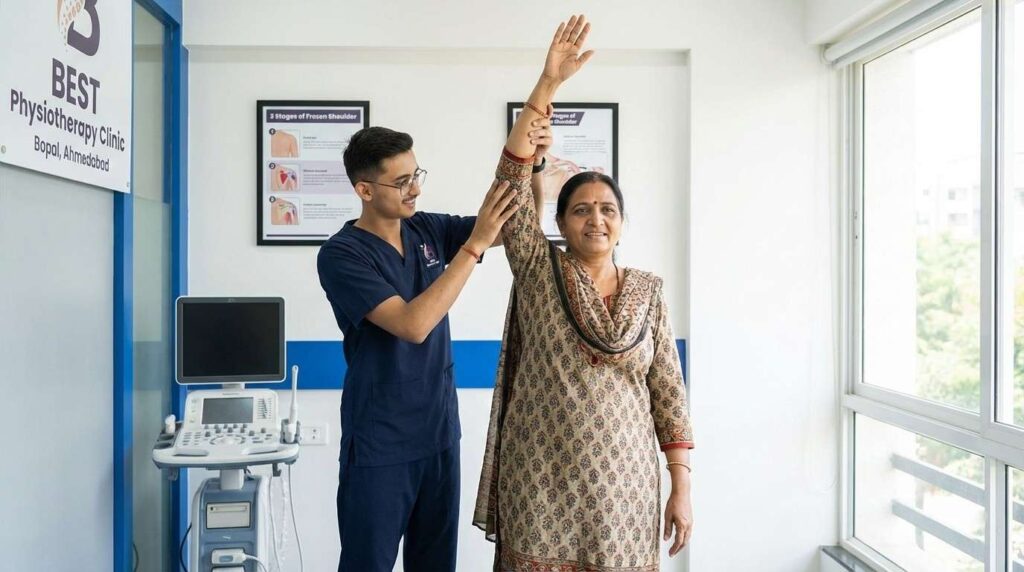
Have you ever tried to reach for your phone — and your shoulder just stopped? Not because you didn’t want to move it. Because it simply would not go. This is what frozen shoulder feels like. And right now, thousands of people across Bopal, Ahmedabad are waking up every night with this exact pain — not knowing what stage they are in or how long the pain will last.
This guide will change that. You will learn exactly what frozen shoulder is, what causes it, and the 3 stages of frozen shoulder Recovery your body goes through. You will understand your recovery timeline, what treatments work, and what you can do today to start healing faster. If you live in Bopal or anywhere in Ahmedabad, this guide is written for you.
What Is Adhesive Capsulitis? Here Is What You Need to Know
Frozen shoulder is the common name. The medical term is adhesive capsulitis. Both names point to the same problem — your shoulder joint gets wrapped in tight, scarred tissue and stops moving freely.
Think of your shoulder like a zip-lock bag. Normally, the bag is soft and open. Your arm moves in and out easily. But with adhesive capsulitis, it is like someone slowly heats that bag. The plastic starts to shrink and stick to itself. The opening gets smaller. Soon, you can barely get your arm in at all.
That “plastic” in your shoulder is called the shoulder capsule — a thin layer of tissue that wraps around the shoulder joint. When this capsule gets inflamed, it thickens. Bands of scar tissue called adhesions start to form inside. These adhesions act like glue. They stick the folds of the capsule together. This is why the condition where the shoulder joint becomes stiff is called adhesive capsulitis. The word “adhesive” literally means “sticky glue.”
The shoulder capsule normally holds about 3 tablespoons of fluid. In a frozen shoulder, that space shrinks to just 1 tablespoon or less. That is how tight it gets.
This condition is more common than most people think. About 2–5% of the general population will develop it at some point. In Bopal and greater Ahmedabad, we see many cases each year — especially in people between the ages of 40 and 60. Women are slightly more affected than men. People with diabetes are 2–4 times more likely to develop it. If your blood sugar is not well controlled, your risk goes up significantly.
The good news? With the right care, frozen shoulder recovery is possible. Most people do get their shoulder back. It takes time — but it does happen.
The 3 Stages of Frozen Shoulder: Your Recovery Roadmap
Before your shoulder recovery can begin, you need to understand the roadmap. Frozen shoulder develops in three stages. Each stage feels different. Each stage needs a different approach. Skipping steps or rushing through treatment makes things worse, not better.
Here is the big picture:
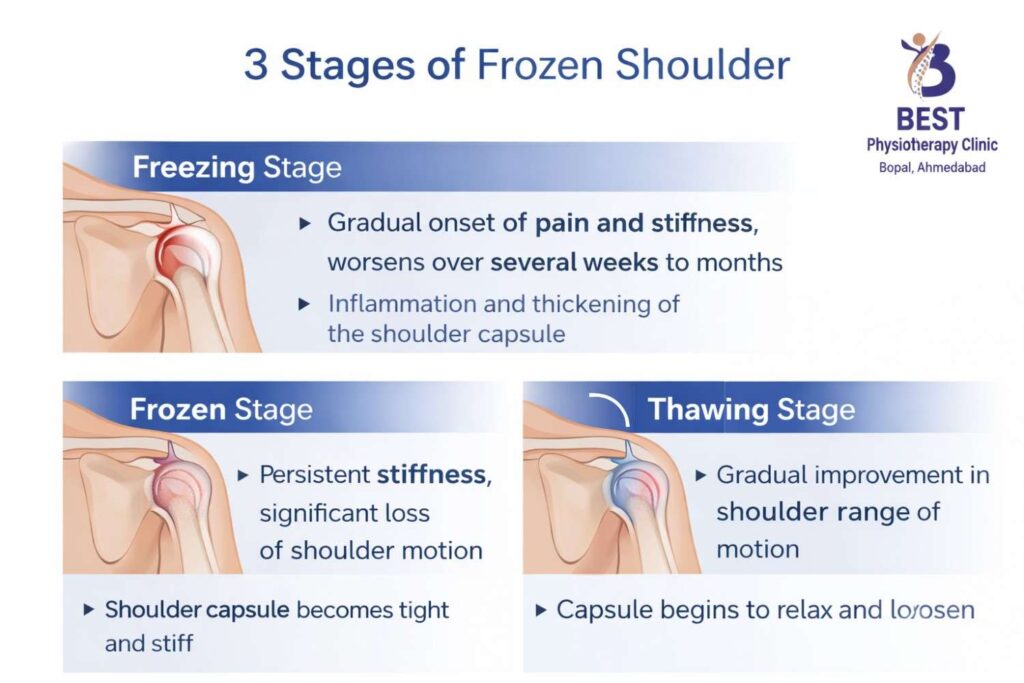
- Stage 1 – Freezing: Pain increases. Stiffness begins. Lasts 2–9 months.
- Stage 2 – Frozen: Pain eases slightly. Stiffness is at its worst. Lasts 4–6 months.
- Stage 3 – Thawing: Stiffness slowly releases. Movement comes back. Lasts 6 months to 2 years.
The total journey — from first pain to full recovery — can take 1 to 3 years. That sounds scary. But here is the truth: patients who start physical therapy early and follow a proper 3-phase rehab plan recover significantly faster. Research published in peer-reviewed journals shows that early, guided treatment can cut recovery time by months.
Each stage also responds to different treatments. A steroid injection works best in Stage 1. Exercise therapy matters most in Stage 3. Knowing where you are helps your physiotherapist design the right plan for you.
Many patients who walk into our Best Physiotherapy clinic in Bopal have already been suffering for months — sometimes in Stage 2 or Stage 3 — without knowing it. Naming your stage is the first step to fixing it.
Stage 1: The Freezing Stage — When Pain Takes Over
This is where frozen shoulder begins. The freezing stage is named well — because your shoulder starts to “freeze up,” slowly, from the inside. This stage lasts anywhere from 2 to 9 months.
In the beginning, you might just feel a dull ache. Maybe you slept on your side and woke up sore. You stretch it out and think nothing of it. But over the next few weeks, the pain becomes more specific. Reaching behind your back hurts. Lifting your arm above your head brings a sharp pinch. In Bopal, we often hear patients say: “I thought I just strained it when I was carrying grocery bags from Reliance Fresh.”
Here is what is actually happening inside. The tissue around your shoulder joint capsule is getting inflamed. The capsule starts to tighten like a fist slowly closing. Your range of motion begins to drop — even if you don’t notice it yet. A normal shoulder can rotate nearly 180 degrees. In the freezing stage, that number starts falling.
The pain in this stage is worse at night. This is one of the key signs of frozen shoulder. Lying on the affected side becomes impossible. Even lying on your back, the weight of your arm pulls at the inflamed capsule. Many patients in Ahmedabad tell us they start sleeping sitting up, or propped against pillows, just to get a few hours of rest.
This is also the stage where a steroid injection directly into your shoulder joint can help most. Steroids reduce the inflammation inside the capsule before too much scar tissue forms. Acting early — in the freezing stage — is your best chance at a shorter total recovery.
Do not ignore this stage. Do not “wait and see.” Get assessed by a shoulder specialist now.
Stage 2: The Frozen Stage — Stiffness Remains at Its Worst
In Stage 2, something strange happens. The intense pain of Stage 1 often eases a little. You might think: “I’m getting better!” But this is misleading. The stiffness remains — and it is now at its absolute worst.
Think of it like this. In Stage 1, your shoulder was a fire — hot, painful, burning. In Stage 2, the fire has burned down. But what is left? A hard, cold lump of charcoal. The inflammation is lower. But the scar tissue has already formed. The shoulder joint is now genuinely locked.
This stage lasts around 4 to 6 months. During this time, your shoulder movement is at its most limited. You may only be able to raise your arm to waist height. Simple daily activities like putting on a shirt, reaching into a back pocket, or fastening a bra strap become real challenges. Some patients in our Bopal clinic describe needing help to dress in the morning.
This is when many patients give up. Because the pain is less, they think the shoulder has “sorted itself out.” They stop doing their exercises. They stop coming to physio. This is a critical mistake. Stiffness that is not actively treated during Stage 2 can become permanent.
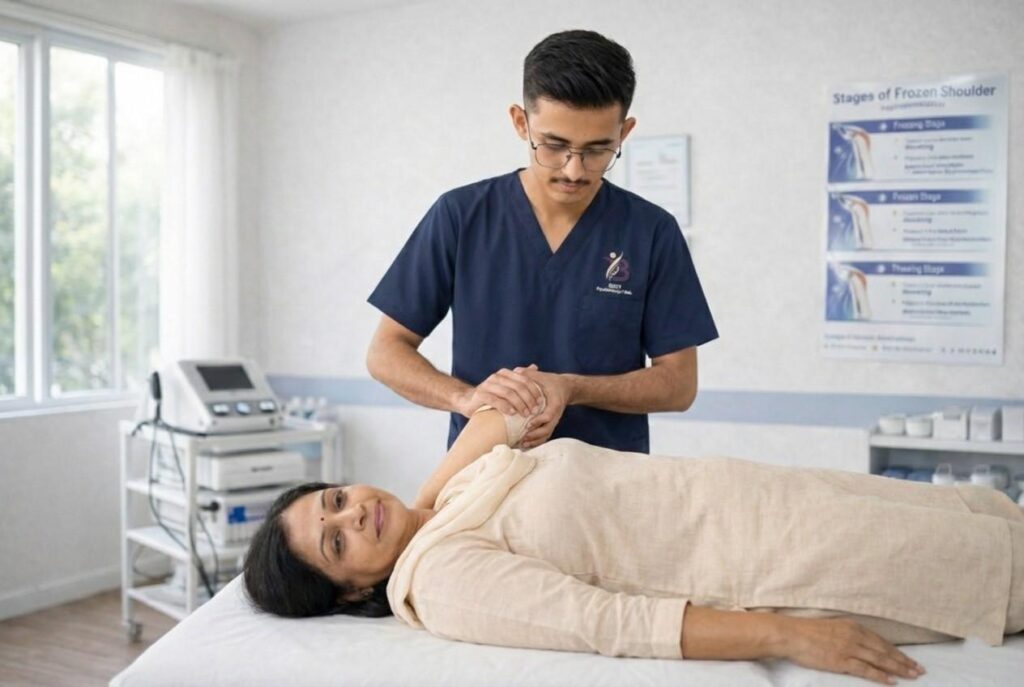
The right action in Stage 2 is consistent physical therapy. Your physiotherapist will use joint mobilization Treatment, manual stretching, and range of motion exercises to gently loosen the adhesions inside your shoulder capsule. This should never be forced or painful — it should be controlled and progressive.
Ultrasound therapy and interferential therapy can also help reduce the residual inflammation at this stage. These are both available at our Best Physiotherapy clinic in Bopal, Ahmedabad.
Stage 3: The Thawing Stage — Range of Motion Returns
This is the stage people wait for. In Stage 3, your shoulder slowly improves. The scar tissue inside the capsule begins to break down naturally. Your shoulder mobility starts to return. The “zip-lock bag” begins to open again.
This stage can last from 6 months to 2 years. It is the longest stage. But it is also the most rewarding — because you can see and feel yourself getting better, week by week. Your range of motion comes back in a predictable order: first forward movement, then side movement, then rotation (the last to return).
The key thing to understand about the thawing stage is that it requires active effort. Your shoulder will not fully heal on its own just because time passes. You need to stretch every day. You need to do your shoulder exercises every day — even on the days it feels almost normal. Because stopping early is why many people end up with 80% recovery instead of 100%.
Studies show that approximately 90% of people with frozen shoulder recover full or near-full function with proper, guided rehabilitation. But that word “guided” is important. Random YouTube exercises are not the same as a structured 3-phase rehab program designed for your specific stage.
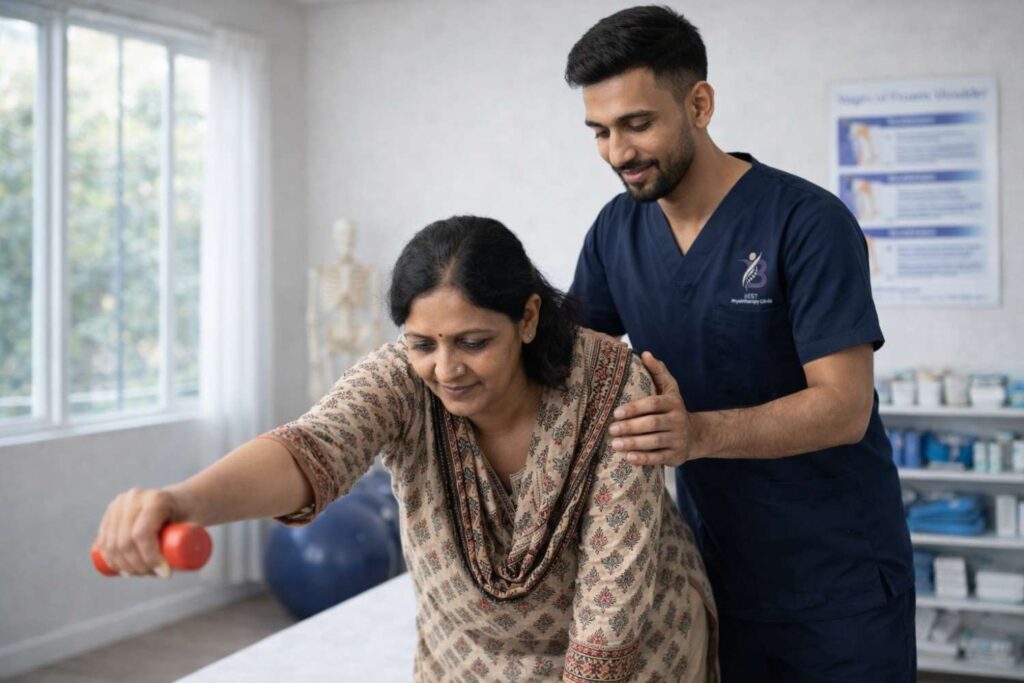
The thawing stage is also when your shoulder function needs to be rebuilt — not just unlocked. Range of motion comes back first. Strength comes back second. This is why rehabilitation does not end when your shoulder “feels better.” You still need to rebuild the muscles that weakened during Stages 1 and 2.
Causes of Frozen Shoulder: Why Does This Happen to You?
This is one of the most common questions we hear in our clinic in Bopal, Ahmedabad: “Why did this happen to me?” The causes of frozen shoulder are not always clear. But we do know the risk factors very well.
The most well-known cause is immobility — not moving your shoulder for a long time. This often happens after a different injury. You break your wrist. You wear a sling. You stop using your shoulder for 4 weeks. During that time, the shoulder capsule begins to tighten. Adhesions form. Before you know it, a wrist injury has led to a frozen shoulder.
Diabetes is the single biggest risk factor besides immobility. Research consistently shows that diabetic patients have a 2 to 4 times higher risk of developing frozen shoulder. In Gujarat, where rates of Type 2 diabetes are among the highest in India, this is especially relevant. Our diet — rich in refined carbohydrates and sugar — contributes to this. If you are diabetic and you feel early stiffness in your shoulder, take it seriously and come in early.
Thyroid disease — both overactive and underactive thyroid — also raises risk. So does Parkinson’s disease, heart disease, and prolonged bed rest after any illness.
Sometimes, there is no clear cause at all. Your shoulder just begins to freeze. This is called idiopathic frozen shoulder — meaning it appeared on its own. This is frustrating, but it is also common. The good news is that treatment works regardless of the cause.
How Long Does Frozen Shoulder Recovery Take? The Real Timeline
Let’s be honest with you about frozen shoulder recovery time. There is no magic number. But here is what the evidence says.
Without any treatment: Some shoulders do eventually thaw on their own. But this can take up to 3–4 years and may leave permanent stiffness in up to 40% of patients. That is a long time to live with pain and limitation.
With early physical therapy: Recovery is significantly faster. Most patients who begin physio in Stage 1 or early Stage 2 recover in 12–18 months. Some recover faster.
With a steroid injection + physio: Studies show that a steroid injection at the right stage, combined with structured physiotherapy, can cut the active painful phase by 2–3 months.
With shoulder arthroscopy (surgery): If non-surgical options fail after 6–12 months, shoulder arthroscopy becomes an option. In this procedure, a surgeon uses a tiny camera to remove scar tissue from inside the joint. Recovery after shoulder surgery usually takes 3–6 months of rehabilitation. Most patients do very well.
The honest recovery guide is this: expect at least 1 year if you start treatment promptly. Expect 2+ years if you delay. Every month of delay adds months to your full recovery. The patients who come to us in Best Physiotherapy Clinic in Bopal, Ahmedabad early get back to normal life faster — there is no question about that.
Frozen Shoulder Treatment: What Actually Works
There is a lot of noise about frozen shoulder treatment. Let’s cut through it.
What works:
- Physical Therapy — This is the backbone of all frozen shoulder treatment. A trained physiotherapist uses hands-on techniques and guided exercises to progressively restore your range of motion. This is not optional. It is essential.
- Steroid Injection — A steroid injection directly into the shoulder joint reduces inflammation. It works best in Stage 1 and early Stage 2. It does not cure the problem on its own — but it buys your physio time to work by reducing pain.
- Hydrodilation — A doctor injects fluid into the shoulder joint capsule to stretch it from the inside. This can help in Stage 2 when the capsule is very tight.
- Shock Wave Therapy — A newer option available at our clinic in Bopal. High-energy sound waves are directed at the shoulder to break down adhesions and stimulate tissue healing.
- Shoulder Arthroscopy — The surgical last resort. The surgeon removes scar tissue under general anaesthesia. Recovery takes months, but outcomes are excellent.
What does NOT work alone:
- Rest
- Heat packs alone
- Painkillers alone
- “Waiting it out”
These can ease symptoms temporarily. But they do not treat the actual cause — the shrinking, scarred shoulder capsule. Without active treatment, the capsule will not open on its own quickly enough.
For frozen shoulder treatment in Ahmedabad, look for a clinic that offers a combination of hands-on physiotherapy, electrotherapy, and advanced Physiotherapy Treatments like dry needling and shock wave therapy.
Can You Speed Up Frozen Shoulder Recovery? Yes — Here Is How
Faster recovery is possible. But it requires consistent action. Here is what genuinely works to speed up frozen shoulder recovery:
Do your exercises every single day. Not “most days.” Every day. Even on the days your shoulder feels almost fine. Especially those days. The shoulder capsule responds to consistent, gentle stretching. Miss a week and you can lose progress that took a month to build.
Apply heat before stretching. A warm shower or heat pack for 10–15 minutes before your exercises loosens the tissue. Cold is better for pain relief after. Warm is better for movement before.
Get proper sleep positioning. Sleep on your back with a pillow under the affected arm. This takes pressure off the capsule at night. Better sleep = less pain = more energy to do rehab.
Control your blood sugar. If you are diabetic, this is not optional. High blood sugar slows healing in the shoulder capsule directly. Many patients in Bopal & Ahmedabad see a real improvement in their shoulder recovery speed when they improve their diet and sugar control together.
Do not force the movement. Aggressive stretching into pain causes micro-tears in the capsule. This triggers more inflammation. More inflammation = more scar tissue. Go to the edge of your comfortable range, hold gently, and stop.
Stick to your 3-phase rehab plan. The best results come from a structured programme with a real physiotherapist — not random exercises from social media.
Shoulder Surgery Recovery: What to Expect After Arthroscopy
Shoulder arthroscopy is not the first option — but for some patients, it is the right option. If you have been in Stage 2 or 3 for over 6–12 months with no meaningful improvement despite physio and injections, surgery may be recommended.
In shoulder arthroscopy, a surgeon makes tiny cuts around the shoulder. They insert a small camera and a tool to cut through the tight, scarred capsule. The scar bands are released from the inside. This is not open surgery — the cuts are tiny, about the size of a pen tip.
After shoulder surgery, you will be sore. Your arm will be in a sling for a short time. But here is the critical part — you must start physio almost immediately. Within days of surgery. This is not optional. If you do not move the shoulder right after surgery, new scar tissue will form again. The whole point of the surgery is to create a window of opportunity for physio to work.
Recovery takes time even after surgery. Most patients need 3–6 months of dedicated rehabilitation before feeling normal again. The exercises are more intense post-surgery. But the results are worth it. The vast majority of patients who have shoulder arthroscopy followed by proper physiotherapy regain full range of motion.
If you are considering surgery and are based near Bopal, Ahmedabad, speak to a shoulder specialist first. Many patients who thought they needed surgery actually didn’t — because they had never tried a properly supervised physio programme.
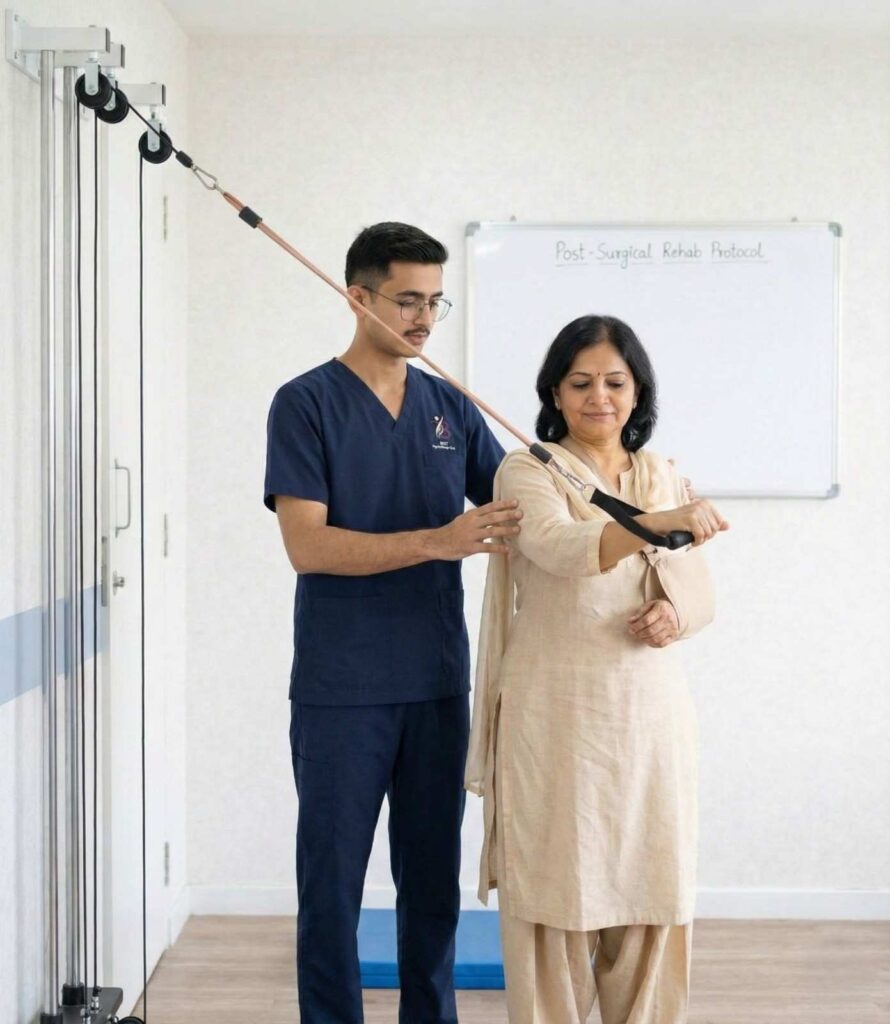
How to Prevent Frozen Shoulder: Simple Steps That Work
You cannot always prevent frozen shoulder — sometimes it just happens. But you can reduce your risk significantly.
Keep moving after any injury. If you break a bone, sprain a wrist, or have chest surgery — keep your shoulder moving, even gently. Prolonged immobility is the biggest avoidable trigger.
Manage your blood sugar. In Gujarat, this is especially important. Diabetes drives frozen shoulder risk. A healthy diet — less maida, less mithai, more vegetables — protects your shoulder joints.
Correct your posture. Rounded shoulders and forward head posture strain the shoulder capsule over time. If you sit at a desk for long hours — at a tech office in GIFT City, or working from home in South Bopal — take breaks every hour. Roll your shoulders back. Open your chest.
Strengthen your rotator cuff. The four small muscles of the rotator cuff stabilize the shoulder joint. Weak rotator cuff muscles increase the stress on the shoulder capsule. A good physio can teach you the right exercises.
Act early on pain. The single best way to prevent full frozen shoulder is to catch Stage 1 before it advances. Any shoulder pain lasting more than 2–3 weeks deserves a professional assessment. Don’t wait until you can’t lift your arm.
Find a Shoulder Specialist Closest to You in Bopal for Faster Recovery
The right specialist makes a real difference. A trained shoulder specialist will assess which stage you are in, design a treatment plan for that specific stage, and adjust it as you progress. Generic “do these 5 exercises” advice does not work for frozen shoulder.
At our Best Physiotherapy clinic in Bopal, Ahmedabad, we have helped hundreds of patients across Gujarat move through their frozen shoulder recovery with expert, personalised care. Our team offers:
- Hands-on joint mobilization and manual stretching
- Shock wave therapy for stubborn adhesions
- Dry needling to release muscle trigger points
- TENS therapy and ultrasound therapy for pain relief
- Customised 3-phase rehab plans for each patient’s stage
- Posture correction and ergonomics advice to prevent recurrence
Many patients tell us they searched for “frozen shoulder treatment near me in Bopal” and couldn’t find a clinic that offered this level of specialist care close by. We are the closest specialist physiotherapy clinic to Bopal — and Ahmedabad locals trust us because our results speak for themselves.
Conclusion:
Frozen shoulder is painful. It is slow. It disrupts your sleep, your work, and your daily life. But it is beatable — and it does get better with the right care. Now you know the 3 stages of frozen shoulder, what causes them, how long recovery takes, and exactly what treatment options are available. The most important thing you can do right now is take action — not wait.
If you are in Bopal or Ahmedabad and you have been living with shoulder pain and stiffness, don’t wait any longer. Come in for an assessment. Let us find your stage, build your plan, and get your shoulder moving again. Ahmedabad locals have trusted our physiotherapy clinic in Bopal for years — and your faster recovery starts with one appointment.
Frequently asked question
Frozen shoulder progresses in three phases: Freezing (2-9 months) with increasing pain and early stiffness; Frozen (4-6 months) where pain eases but motion is severely limited; Thawing (6 months-2 years) with gradual mobility return. Early physiotherapy in Bopal targets each stage—steroids for freezing, mobilization for frozen—to shorten the 1-3 year total timeline.
Full recovery averages 1-3 years without treatment, but early guided physio cuts it to 12-18 months. Factors like diabetes extend time; prompt Bopal clinic intervention with exercises and shockwave therapy prevents permanent stiffness in 40% of untreated cases.
Primary causes include shoulder immobility post-injury, diabetes (2-4x risk), thyroid issues, and idiopathic onset. In Gujarat's high-diabetes areas like Bopal, poor blood sugar control worsens capsule inflammation and adhesions.
No, 90% recover full/near-full function with proper rehab, though 10% retain mild stiffness. Consistent 3-phase physio in Bopal avoids this; delaying past 6 months risks chronic issues.
Physical therapy is cornerstone—joint mobilization, stretches, ultrasound. Stage-specific: steroids in freezing, hydrodilation/shockwave in frozen. Bopal clinics combine these for optimal results over rest alone.
Guided exercises restore motion but need physio oversight; random ones risk injury. Daily gentle stretches (pendulum, towel) in thawing phase, plus rotator cuff strengthening, yield 90% success in structured Bopal programs.
After 6-12 months of failed conservative care (PT, injections). Arthroscopy releases scar tissue; post-op rehab (3-6 months) restores function. Most Bopal patients avoid it with early intervention.
Yes, but slower (2-4x higher risk/complication). Tight blood sugar control plus physio accelerates healing; Bopal specialists tailor plans for Gujarat's diabetic population.
Sleep on back with pillow under affected arm; avoid side-lying. Night pain peaks in freezing stage—use heat/NSAIDs pre-bed. Bopal physio teaches positioning for better rest.
Post-recovery: maintain shoulder mobility/strength (rotator cuff exercises), manage diabetes/posture, avoid prolonged immobility. Best Physiotherapy Clinic in Bopal, Ahmedabad follow-ups with ergonomics advice reduce risk after Ahmedabad's desk jobs/injuries.