

Do you wake up with shooting pain down your leg in Bopal? Meet Priya, a 34-year-old runner from South Bopal. Eight weeks ago, she could barely walk to her car. Today, she runs 5 kilometers along Sardar Patel Ring Road every morning. This is her complete sciatica recovery story. You will learn exactly how she achieved sciatica pain relief and whether you can run again too.
Understanding Sciatica and the Sciatic Nerve
Sciatica is not a disease—it is a symptom. The pain comes from your sciatic nerve, the longest nerve in your body. It starts in your lower back, runs through your buttocks, and travels down each leg. When something presses on this nerve, you feel sharp, shooting pain.
What causes this pressure? Often, a herniated disc pushes on the nerve root. Sometimes bone spurs narrow the space. Tight piriformis muscles can also trap the nerve. Many patients in Bopal experience this after sitting long hours at IT parks near Iscon Platinum or from lifting heavy shopping bags at Bopal Vegetable Market.
Common symptoms:
- Sharp, shooting pain down your leg (left or right)
- Burning or tingling sensations
- Numbness in your foot or toes
- Weakness in your leg muscles
- Lower back pain that radiates downward
The pain intensity varies throughout the day. For Priya, evenings were worst. After working all day at her desk, the shooting pain became unbearable. She describes it as “lightning bolts running from my spine to my toes.”
Complete Sciatica Treatment Guide: Physiotherapy, Relief Methods, and Daily Habits in Bopal
Finding relief from sciatica requires a multi-layered approach. Here is what actually works:
Professional Treatment Options
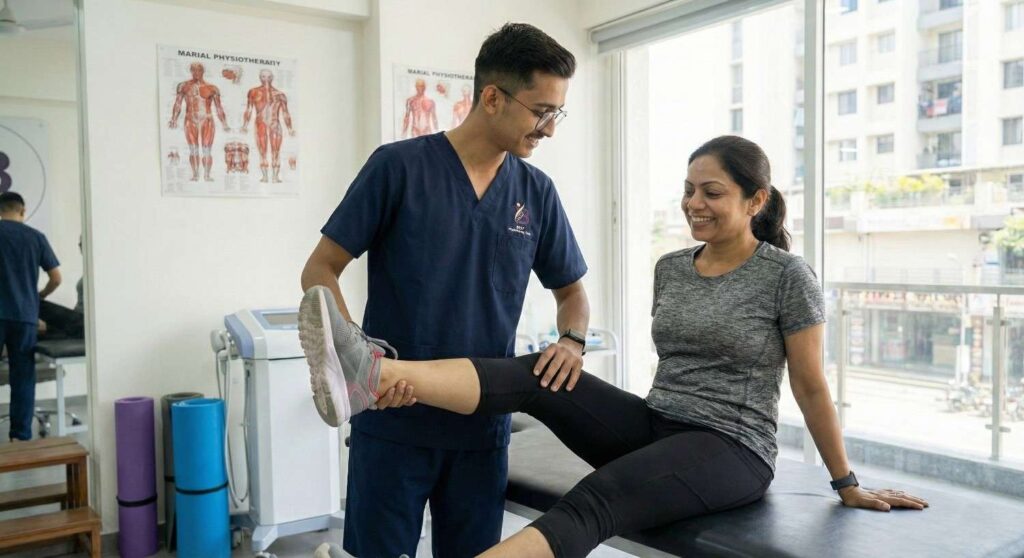
Manual Therapy: A trained physiotherapist uses hands-on techniques to mobilize your spine. This reduces pressure on the sciatic nerve. Soft tissue work releases tight muscles that might be pinching the nerve.
Electrotherapy: TENS therapy uses electrical pulses to block pain signals. Ultrasound therapy reduces deep tissue inflammation. Some clinics in Bopal offer advanced options like shock wave therapy or laser treatment for sciatica.
Exercise Therapy: Specific stretches release pressure on your sciatic nerve. Core strengthening prevents future problems. Nerve glide exercises help the nerve move freely without irritation.
Priya’s treatment plan included manual therapy twice weekly, daily stretching, and core strengthening. Within two weeks, her pain medication use dropped by half.
Daily Habits That Relieve the Pain
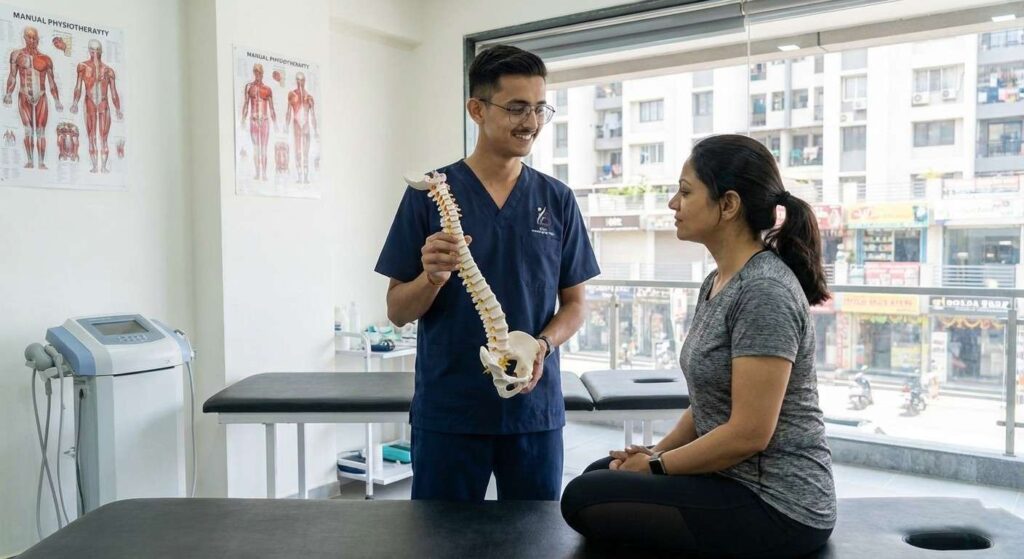
You cannot heal sciatica with treatment alone. Your daily habits matter just as much:
Sitting: Sitting puts 40% more pressure on your discs than standing. Stand up every 30 minutes. Walk around for two minutes. This simple habit reduces pain significantly.
Sleeping: Sleep on your side with a pillow between your knees. This keeps your spine aligned and alleviates pressure on the sciatic nerve. Avoid sleeping on your stomach—it twists your lower back.
Movement: Gentle activity brings blood flow to damaged tissues. Blood carries oxygen and nutrients that speed healing. Walking is usually safe once acute pain subsides.
Posture: Imagine a string pulling the top of your head toward the ceiling. Good posture takes pressure off compressed nerves.
Priya changed her mattress to medium-firm and started taking breaks during her workday at Iscon Platinum. These small changes made a big difference—her pain levels dropped even on days when she skipped formal exercises.
Vitamin Support for Nerve Health
What vitamin deficiency causes sciatica to worsen? Low vitamin B12 damages the protective coating around nerves. This makes you more sensitive to neuropathic pain. Vitamin D deficiency increases inflammation. Many people in urban Ahmedabad have low vitamin D despite the sunny climate because they work indoors all day.
Priya’s blood tests showed low vitamin B12 and D. Her doctor prescribed supplements. She noticed less nerve sensitivity within 3 weeks.
The 8-Week Sciatica Recovery Timeline: Priya's Success Story
Recovery from sciatica varies by person. Mild cases improve in 4-6 weeks. Moderate cases need 8-12 weeks. Here is Priya’s week-by-week journey:
Week 1-2: Focus on pain management. Priya did gentle stretches and learned proper sitting posture. Heat therapy helped relax tight muscles. Pain dropped from 9/10 to 6/10.
Week 3-4: Added core strengthening exercises. Could sit for 1 hour without pain. Returned to work with ergonomic setup. Pain now 4-5/10, with less severe episodes.
Week 5-6: Walked 20 minutes daily. Started stationary bike for 10 minutes. Pain reduced to 3/10—only occasional twinges.
Week 7-8: Began walk-jog intervals. Jogged 2 minutes, walked 3 minutes. By week 8, she ran continuously for 15 minutes. Pain dropped to 1-2/10, only with prolonged sitting.
The key to Priya’s fast recovery? She started treatment early, did every prescribed exercise, and stayed consistent.
Can You Run with Sciatica? Understanding When It's Safe
This is the question Priya asked most: “When can I run again?” The answer depends on your pain level.
When NOT to Run
If you have unbearable sciatica pain, do not run. Running with severe sciatica is dangerous. It can worsen nerve compression and delay healing. You risk permanent nerve damage.
Warning signs to stop immediately:
- Shooting pain down leg when running
- Increased numbness or tingling
- Weakness in leg muscles
- Pain that worsens with each run
When Running Actually Helps Sciatica
Surprisingly, running helps sciatica recovery in the later stages. How? Movement prevents muscle atrophy. When you stop moving due to pain, your core muscles weaken. Weak cores mean less support for your spine.
Running (when done correctly) strengthens your glutes, hamstrings, and core. These muscles support your lower back. Running also releases endorphins—your body’s natural painkillers.
But timing is everything. Start running too early, and you worsen the problem. Start at the right time, and you accelerate healing.
Light Jogging with Sciatica: The Safe Approach
If your doctor approves light jogging, follow these guidelines:
- Warm up thoroughly: 10 minutes walking + dynamic stretches
- Start with short intervals: Run 2-3 minutes, walk 3-4 minutes, repeat 3-4 times
- Focus on form: Land softly on midfoot, not heel. Keep steps short and quick
- Choose soft surfaces: Grass or tracks, not concrete
- Cool down properly: Walk 5-10 minutes, stretch, ice if needed
Priya followed this exact protocol. She gradually increased running intervals by 1 minute each week. By week 10, she ran continuously for 30 minutes with zero pain.
Nerve Pain After Running: What It Means and What to Do
How long after sciatica can I run? Most people can return to running 6-10 weeks after symptoms begin. Wait until pain is minimal or gone.
If you feel shooting pain during running, it indicates active nerve irritation. Your sciatic nerve is still compressed or inflamed. The impact from running jostles inflamed tissues. The nerve protests by sending pain signals.
What to do:
- Stop running immediately
- Ice the affected area for 15-20 minutes
- Rest for a few days
- Return to gentler exercises like swimming or cycling
- Talk to your physiotherapist in Bopal about modifying your plan
Remember: pushing through nerve pain does not build character—it builds chronic injuries.
Will Running Aggravate Sciatica? The Truth About Marathons
Will running aggravate sciatica? It depends on timing and technique.
Running can aggravate sciatica if done too early or with poor form. The impact forces compress your spine slightly with each step. If your disc is already bulging, this worsens the pressure on your sciatic nerve. Heel striking sends harder shock waves up your skeleton.
However, running done correctly at the right time strengthens the support system around your spine. The key factors are:
- Timing: Wait until pain is minimal
- Form: Midfoot strike, soft landing
- Surface: Grass or tracks preferred
- Duration: Start very short
- Frequency: Allow rest days between runs
Can You Run a Marathon with Sciatica?
Short answer: No, not during active sciatica. Running a marathon requires high weekly mileage. If you have current sciatic nerve pain, this stress will worsen your condition. You risk converting acute sciatica into chronic debilitating sciatica.
But after full recovery? Yes. Once your sciatica is fully healed, marathon running is possible. Rebuild gradually—start with 5K races, progress to 10K, then half marathons. Many former sciatica patients complete marathons successfully.
Priya’s goal is to run the Adani Ahmedabad Marathon next year. Her physiotherapist says she is on track if she continues her strength training.
Sciatica Symptoms and Chronic Pain Management
How long does it take to recover from severe sciatica? Studies show 50% of patients recover within 6 weeks. By 12 weeks, 75% are pain-free. But 10-25% develop chronic pain lasting over 12 weeks.
What determines which group you fall into?
- Severity of nerve compression
- How quickly you start treatment
- Compliance with exercises
- Overall health and body weight
- Job demands (prolonged sitting worsens outcomes)
When to See a Doctor in Bopal
Not all sciatica requires immediate medical attention. But certain red flags demand urgent evaluation:
See a doctor immediately if you experience:
- Loss of bladder or bowel control
- Progressive weakness in your leg
- Numbness in groin or inner thighs
- Pain after trauma like a car accident
See a doctor within 2 weeks if:
- Pain does not improve after self-care
- Pain worsens despite treatment
- You develop fever or unexplained weight loss
In Bopal, look for physiotherapy clinics with certified physiotherapists who specialize in spine conditions. Early professional treatment significantly improves your chances of fast, complete recovery.
Find Relief: Long-Term Prevention Strategies
Successfully treating your current sciatica is only half the battle. Prevention ensures it does not return. The recurrence rate for sciatica is unfortunately high—up to 40% within 2 years.
How to avoid recurrence:
- Maintain a strong core: Do core exercises 3-4 times weekly even after pain resolves
- Watch your weight: Every extra kilogram adds stress to your lower back
- Practice good lifting mechanics: Bend knees, not back. Keep objects close. Never twist while lifting
- Stay active: Take movement breaks every 30 minutes if you sit all day
- Manage stress: Chronic stress causes muscle tension, which increases spine pressure
Priya follows all these principles. Eighteen months later, she remains pain-free and runs regularly along Sardar Patel Ring Road.
Conclusion
Sciatica pain relief is achievable for most patients in Bopal, Ahmedabad. Priya’s 8-week recovery story proves it. She went from unbearable pain to running 5K pain-free. The key factors were early professional treatment, daily exercise compliance, lifestyle modifications, and patience.
You can achieve similar results. Do not suffer in silence. Find relief by contacting a qualified physiotherapy clinic near you in Bopal today. With proper sciatica treatment and dedication, you can relieve the pain and reclaim your active life. Like Priya jogging along Sardar Patel Ring Road, you too can run pain-free again.